
A political meeting in medieval Germany was supposed to settle a bitter land dispute. Instead, a crowded room gave way beneath the officials, sending dozens of people plunging into a massive pit filled with human waste.
The bizarre disaster took place in Erfurt, where a dispute had developed between Landgrave Louis III of Thuringia and Archbishop Conrad of Mainz. The young King Henry VI was brought into the negotiations to help settle the disagreement.
Henry was only 18 years old, but he had already been placed in an important political position. He decided that the meeting would take place on the upper level of a two story building located near Erfurt Cathedral.

The choice of location turned out to be disastrous.
Beneath the building was a large cesspit used for collecting human waste. Unlike modern sewage systems, medieval cities relied on pits and underground chambers to store enormous amounts of waste.
Inside the building, the meeting initially appeared completely normal. Henry’s representatives arrived alongside nobles, bishops, and other influential figures who had gathered to watch the negotiations.
But there was a serious problem nobody seemed to notice. The wooden supports holding up the upper floor were badly deteriorated.
As more people entered the room, the structure was placed under increasing pressure. Eventually, the weakened floor could no longer support the enormous crowd.
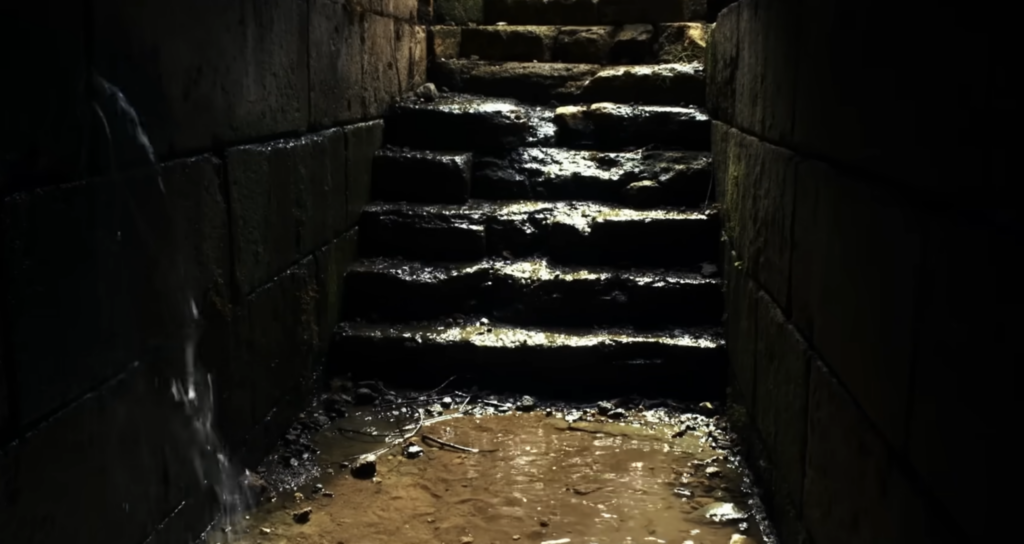
Without warning, the wooden platform collapsed. The falling people crashed through the lower level as well, opening a path directly into the cesspit underneath the building.
Historical accounts differ over the exact number of victims, but estimates suggest that somewhere between 60 and 100 people fell into the pit. Many died from the initial collapse. Others were crushed beneath falling debris or trapped inside the wreckage.
For those who survived the fall, the situation was even more horrifying. They were surrounded by human waste with little possibility of climbing out. Some reportedly suffocated in the filthy pit before rescuers could reach them.
The disaster became known as the Erfurt latrine disaster, one of the strangest and most gruesome accidents recorded in medieval European history. Yet several important figures somehow escaped the catastrophe.

King Henry VI and Archbishop Conrad were reportedly sitting near a stone section of the building beside a window. When the wooden floor collapsed, the stone structure remained intact beneath them, preventing them from falling into the pit.
Landgrave Louis III was not so fortunate. He fell during the collapse but survived and was eventually rescued from the wreckage.
The political meeting that had been intended to resolve a land dispute therefore became a mass casualty event instead.
The incident also demonstrates how dangerous medieval buildings could be. Structures were often constructed from timber and stone without the engineering standards used today, while maintenance and structural inspections were far less sophisticated.
The enormous crowd gathered for such an important political meeting placed a tremendous load on a structure that was already weakened. Nobody attending the negotiations expected the floor itself to become the greatest threat in the room.

One moment, nobles and religious leaders were discussing politics. The next, the building was collapsing beneath them and dozens of people were falling into a medieval sewage pit. For the survivors, especially those who escaped the cesspit, the meeting must have been impossible to forget.
Henry VI, meanwhile, managed to survive one of the most bizarre political disasters of the Middle Ages. The negotiations may have been intended to settle a dispute between powerful men, but instead, the collapsing floor settled nothing.
It simply turned an ordinary political gathering into a horrifying struggle for survival.