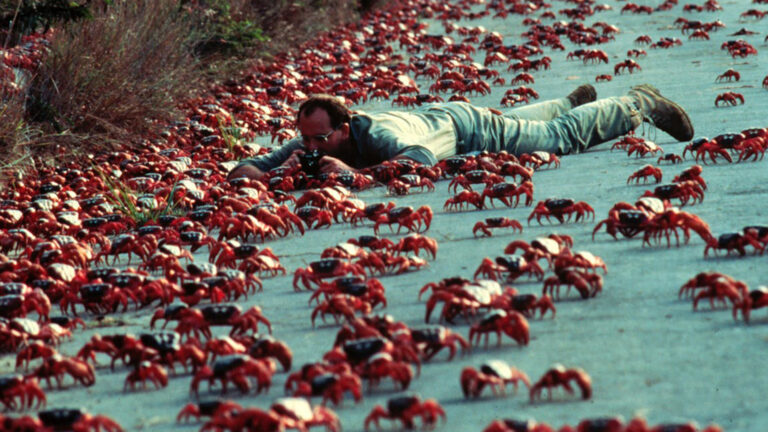
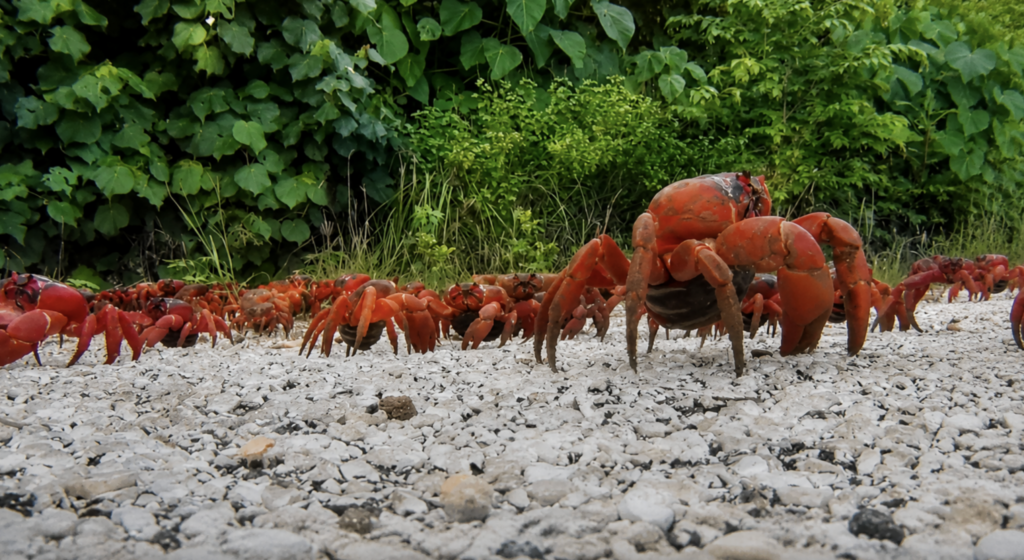
Every year on Christmas Island, something almost unbelievable happens as millions of tiny red crabs begin to move across the landscape in one massive, coordinated wave. Forest floors turn red, roads disappear beneath moving shells, and entire sections of the island seem to come alive as if the ground itself is shifting.
This is not a rare accident or a one time spectacle. It is a natural cycle that repeats every wet season, transforming the island into one of the most visually striking biological events on Earth.
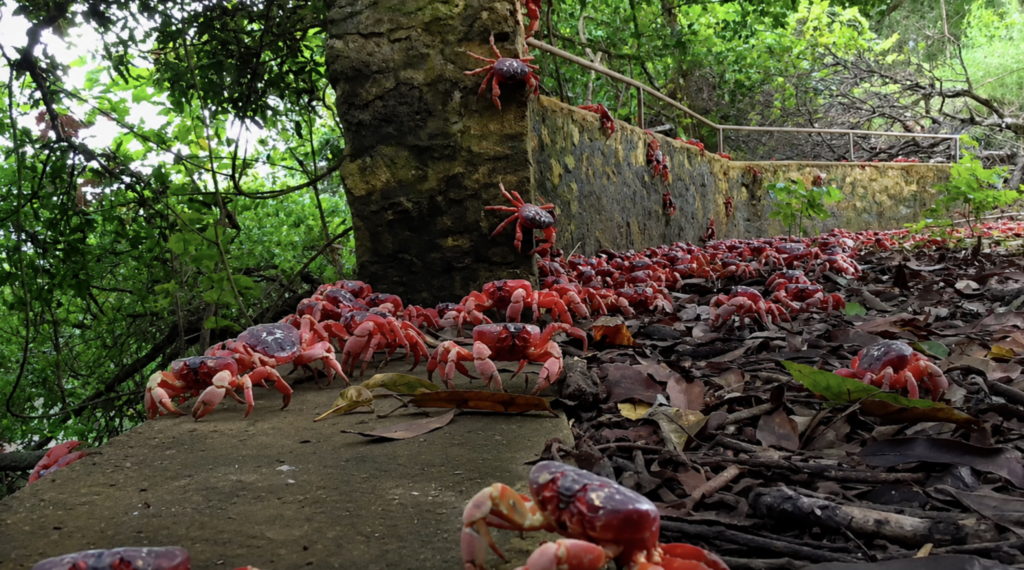
Christmas Island is home to an estimated 40 to 50 million red crabs, a population so large that in many areas they completely dominate the ecosystem. For most of the year, they live quietly hidden in the island’s rainforest, digging burrows and feeding among the leaf litter. But everything changes when the wet season arrives.
Triggered by rainfall and environmental cues, the crabs begin emerging from the forest in enormous numbers, moving steadily toward the coastline in what looks like flowing rivers of red stretching across roads, cliffs, and jungle paths.
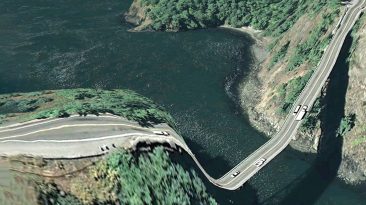
To manage this extraordinary migration, humans have had to adapt the island itself. Over time, infrastructure has been built specifically for the crabs, including around 21 kilometers of fencing, 31 dedicated underpasses, and even a purpose built bridge designed to help them safely cross busy roads.
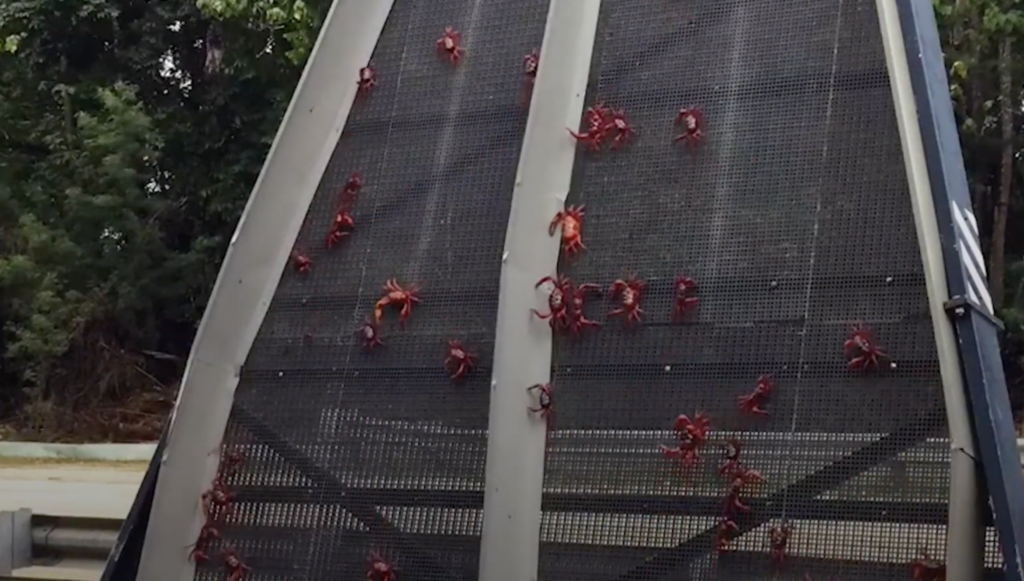
Without these protections, millions of crabs would be killed by traffic during their journey, but with them, the migration continues with far fewer interruptions, allowing nature to proceed almost exactly as it has for thousands of years.
What makes this migration even more remarkable is how precisely it is timed. The crabs do not move randomly or continuously, but instead synchronize their journey with the lunar cycle. If environmental conditions are not ideal, they will simply wait for the next suitable moon phase before beginning.
This level of timing ensures that when they finally reach the shore, conditions are perfect for reproduction, maximizing the survival chances of the next generation.
Once the crabs reach the ocean, the most critical phase of their life cycle begins. Male crabs dig burrows where mating takes place, and after fertilization, females carry their eggs safely inside these burrows for about 12 days.
Each female can produce up to 100,000 eggs, meaning that the coastline becomes a massive spawning ground where life is released into the ocean in unimaginable quantities. Just before dawn, under the cover of darkness and falling tides, the females make their way to the water’s edge, where they release their eggs into the sea in a perfectly timed biological event.
The moment these eggs hit the water, they hatch instantly into microscopic larvae, beginning a dangerous journey in the open ocean. While the sea provides the environment needed for development, it is also filled with predators, and a large percentage of larvae are quickly eaten by creatures such as manta rays and whale sharks.
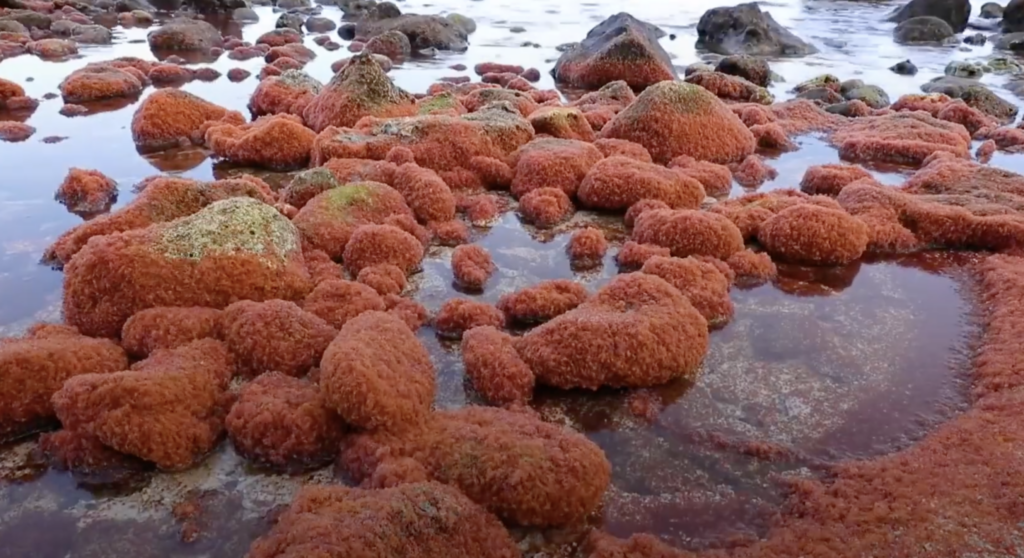
Only a small number survive this stage, drifting and growing in the ocean for about a month before returning toward the island as tiny juvenile crabs.
When they finally return, they are only about 5 millimeters wide, barely visible to the human eye, yet they immediately begin the same journey inland that their parents completed before them. They move into the rainforest, dig burrows, and begin the cycle again, continuing one of the most extraordinary natural migrations on the planet.
Every year, this process repeats with astonishing precision, turning Christmas Island into a living system in motion, where survival, timing, and nature’s rhythm all come together in a single breathtaking event.