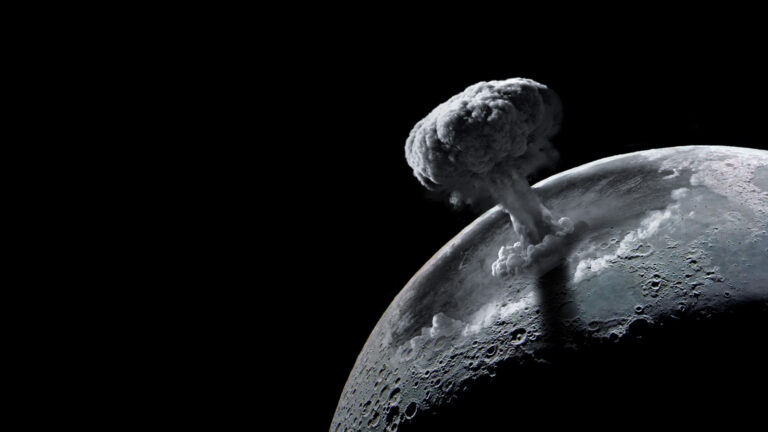
The Moon has inspired myths, guided sailors, and lit up our nights for thousands of years. But during one of the most intense periods of the Cold War, people considered something far more dramatic. What if we detonated a nuclear bomb on the Moon?
It sounds like an idea pulled from science fiction. Yet it was once a real proposal. During the late 1950s, the United States was looking for ways to demonstrate its technological strength after the Soviet Union gained an early lead in the Space Race. One idea was surprisingly simple. Detonate a nuclear device on the lunar surface and make the explosion visible from Earth.
Today, the proposal raises a fascinating question. If a nuclear weapon exploded on the Moon, what would actually happen?
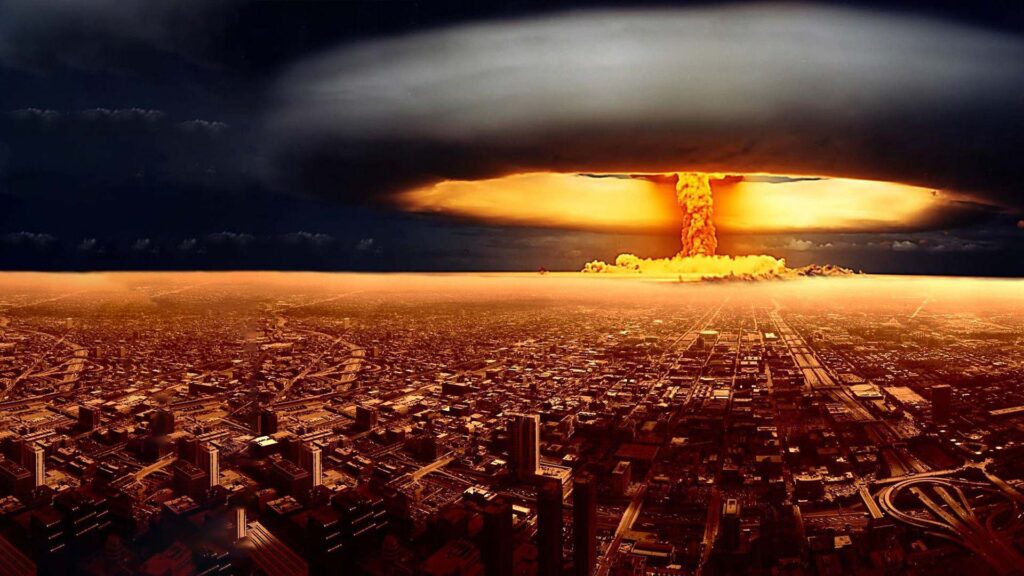
The first thing many people imagine is the Moon exploding into countless pieces. Movies have taught us that giant explosions can destroy planets and moons with ease. Reality is much less dramatic.
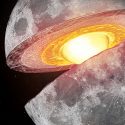
The Moon is an incredibly massive object. It contains about one eightieth of Earth’s mass and stretches nearly 3,500 kilometers across. Even the largest nuclear weapon ever built would be insignificant compared with the amount of energy needed to seriously damage it.
The most powerful nuclear device ever detonated on Earth released energy equivalent to about 50 megatons of TNT. That sounds enormous, and it certainly is by human standards. But compared with the Moon itself, it would barely make a mark.
In practical terms, a nuclear explosion would not split the Moon apart. It would not send it crashing toward Earth. It would not noticeably change its orbit around our planet. The Moon would continue circling Earth just as it has for billions of years.
To significantly alter the Moon’s orbit would require an amount of energy so immense that our entire nuclear arsenal would not even come close.
So if the Moon survives, what exactly would we see?
The explosion would look very different from a nuclear blast on Earth. Here, explosions produce giant fireballs and mushroom clouds because they interact with the atmosphere. The Moon has almost no atmosphere at all.
Without air, there would be no rolling cloud of smoke and no expanding wall of fire. Instead, observers might see a bright flash followed by a spray of dust and rock blasted away from the lunar surface.
The explosion would likely create another crater. That might not sound particularly impressive, but the Moon is already covered with craters created by countless asteroid impacts over billions of years. One more crater would hardly stand out.
Some debris might even be launched above the lunar surface before eventually falling back down. Depending on the size of the explosion, scientists could potentially study the material that was thrown into space and learn more about what lies beneath the Moon’s surface.
Another common concern is radioactive contamination. Nuclear explosions on Earth can leave behind dangerous fallout because radioactive particles become trapped in the atmosphere and spread through weather systems.
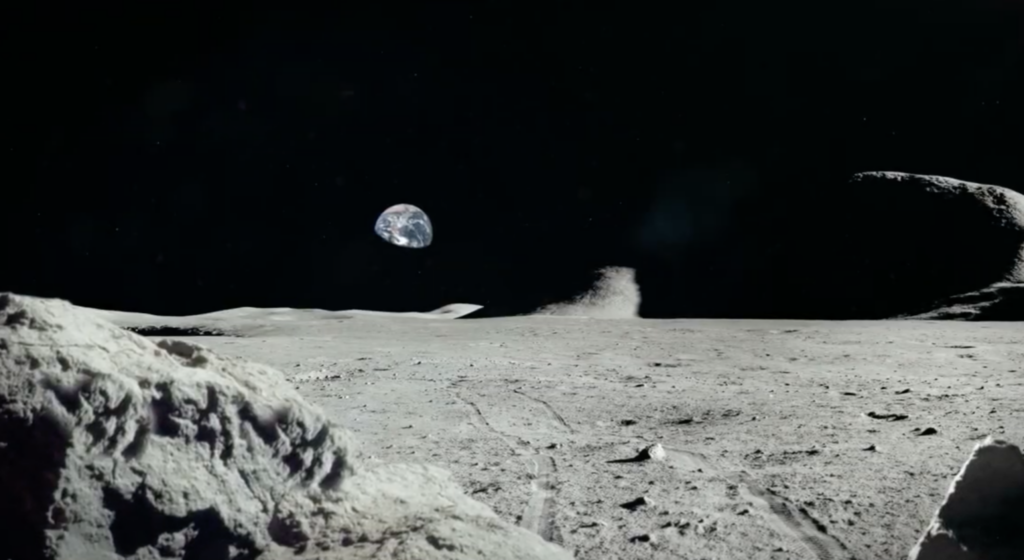
The Moon is a completely different environment.
It has no weather and no substantial atmosphere. In fact, the lunar surface is constantly bombarded by cosmic radiation and energetic particles coming from the Sun. Radiation levels there are already much higher than what humans experience on Earth.
Ironically, the radioactive material from a single nuclear detonation would probably have little impact on the overall radiation environment of the Moon.
That does not mean radiation on the Moon is unimportant.
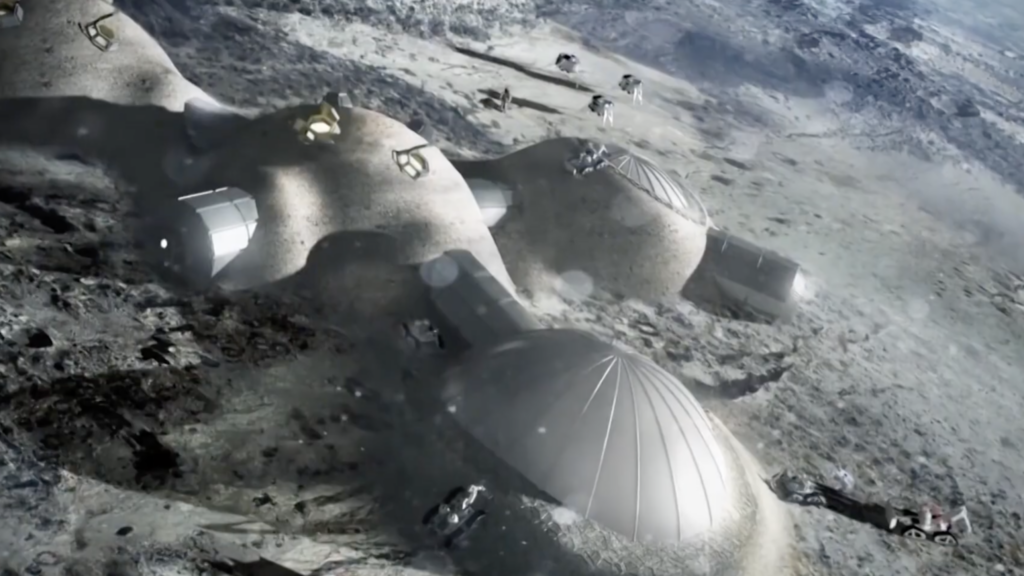
One of the biggest challenges facing future lunar missions is protecting astronauts from long term radiation exposure. Space agencies hope to establish permanent bases on the Moon in the coming decades, but surviving in such a harsh environment will require advanced shielding and careful planning.
The Moon may appear peaceful from Earth, but it is actually an extremely hostile place.
Perhaps the most surprising part of this entire scenario is how much humanity depends on the Moon. It helps stabilize Earth’s tilt as our planet spins through space. This contributes to relatively stable seasons over very long periods of time.
The Moon also drives ocean tides, which influence marine ecosystems around the globe. Throughout Earth’s history, our natural satellite has helped shape conditions that made life here possible.
It has also absorbed countless impacts from asteroids and meteoroids over billions of years. Every crater on its surface tells the story of a violent event somewhere in the Solar System.
For something that seems so familiar in our night sky, the Moon is remarkably resilient. A nuclear explosion might create a flash and leave behind another crater, but our cosmic companion would remain almost entirely unchanged.
The real lesson is not that humanity could destroy the Moon. It is quite the opposite. The Moon is vastly bigger, tougher, and more important than we often realize. If we ever did detonate a nuclear weapon there, the Moon would endure. It would simply add one more scar to a surface that has been surviving cosmic violence for billions of years.