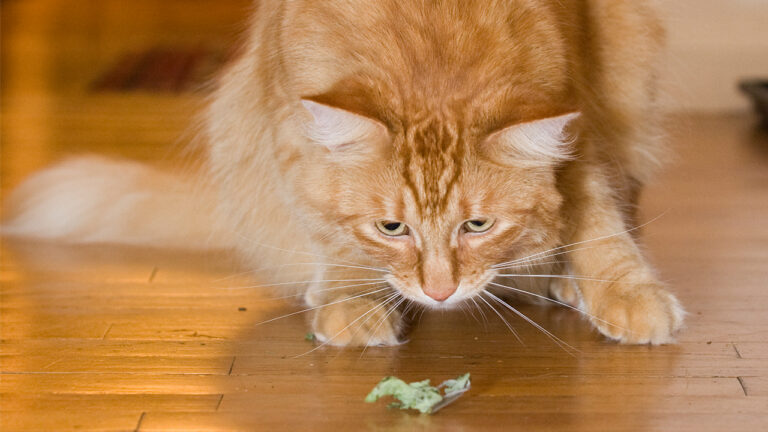
If you’ve ever given your cat a toy filled with catnip, you’ve probably seen the transformation happen within seconds. One moment they’re calm and relaxed. The next they’re rolling across the floor, rubbing their face on everything, purring loudly, or sprinting around the house with endless energy.
It almost looks as though they’ve gotten high.
But is that really what’s happening inside a cat’s brain?
Catnip, scientifically known as Nepeta cataria, is a flowering herb in the mint family. It’s closely related to familiar herbs like basil, rosemary, and oregano, and people have even used it for herbal teas. To humans, catnip has a mild, minty aroma. To many cats, however, it’s almost irresistible.

The secret lies in a natural chemical called nepetalactone.
Tiny glands found in the leaves and flowers of the plant produce this compound. When a cat sniffs catnip, nepetalactone enters its nose and binds to specialized scent receptors. Those receptors send signals to areas of the brain involved in emotion and behavior, triggering the dramatic reactions many owners know so well.
Depending on the cat, those reactions can vary. Some become playful and energetic, racing around the room or chasing invisible prey. Others flop onto their backs, roll from side to side, rub their faces against the catnip, or simply appear blissfully relaxed. Many cats will repeatedly return for another sniff as long as the scent remains strong.
Scientists have discovered another intriguing clue about how catnip works. The effects can be blocked by naloxone, a medication commonly used to reverse opioid overdoses in humans. This suggests that catnip may activate some of the same biological pathways associated with pleasure and reward.

Even so, researchers still do not believe that cats experience catnip in exactly the same way humans experience recreational drugs. Although their behavior may look similar to intoxication, scientists have not confirmed that cats actually become “high” in the human sense.
Not every cat responds to catnip, either.
Sensitivity is inherited through genetics, and only about 70 to 80 percent of domestic cats carry the genes needed to react. Kittens younger than a few months old usually show little or no interest, even if they possess the necessary genes. As they mature, their sensitivity often develops naturally.
The effects are also surprisingly brief. A typical reaction lasts only five to fifteen minutes before the cat returns to normal. Afterward, most cats become temporarily immune to catnip for around an hour, meaning additional exposure has little or no effect until that sensitivity resets.
Perhaps the best news for cat owners is that catnip is considered safe. When used in moderation, it has no known long term harmful effects on healthy cats. While eating very large amounts may occasionally cause mild stomach upset, simply sniffing or playing with catnip is generally harmless.
So the next time your cat suddenly starts rolling, purring, and acting as though it has discovered pure happiness, you’re watching one of nature’s strangest chemical reactions. A simple plant releases a compound that temporarily changes the way many cats process smells and emotions, creating a burst of excitement that lasts only a few minutes before disappearing as quickly as it arrived.