What could possibly scare a big, powerful predator with sharp teeth and massive jaws?
The answer, surprisingly, is its own reflection.
Across the animal kingdom, mirrors often trigger confusion, aggression, or curiosity. But in some rare cases, they may reveal something far more fascinating: the ability to recognize oneself. Scientists have been studying this question for decades, because self recognition is considered one of the clearest signs of advanced intelligence.
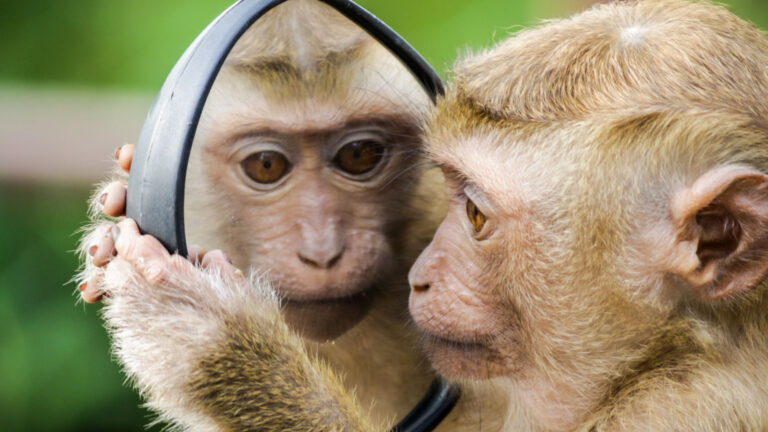
One of the most well known methods used to test this is called the mirror mark test. It works by placing a small, non smelly mark on an animal’s body in a spot it cannot normally see, then giving it access to a mirror.
If the animal touches or investigates the mark on itself instead of reacting as if it belongs to another animal, it may suggest self awareness.
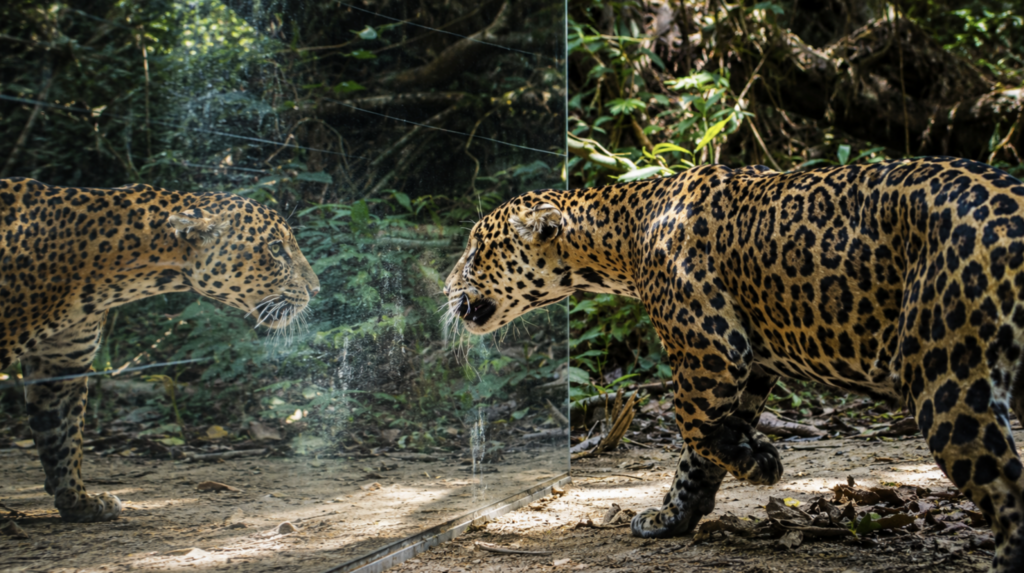
Researchers have used variations of this test on many species around the world, including big cats in the Amazon rainforest. In one study led by wildlife photographer Mark Fernley in Brazil, mirrors were placed in natural environments to observe how wild animals reacted to their own reflections. The goal was not only curiosity, but also to better understand how animals perceive themselves and others.
At first glance, the results can look chaotic. Some animals appear startled. Others become aggressive. Many simply ignore the mirror entirely. Even humans do not always look particularly intelligent when confronted with their own reflection, especially in unfamiliar or confusing situations.
So which animals actually pass the test?
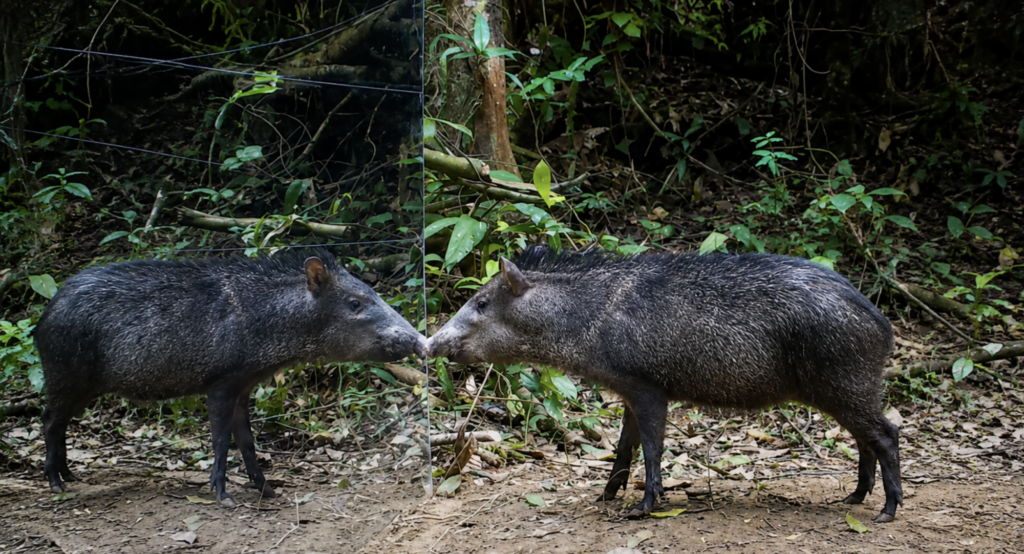
So far, only a small number of species have shown clear signs of self recognition. These include chimpanzees, orangutans, elephants, and magpies. In these cases, individuals have been observed inspecting marks on their own bodies after seeing them in a mirror, suggesting they understand the reflection is themselves rather than another creature.
However, not all results are straightforward. Gorillas, for example, often fail the mirror test, but scientists believe this does not necessarily mean they lack intelligence. Instead, gorillas tend to avoid direct eye contact, which they interpret as a threat. Because of this, they may treat their reflection as another aggressive individual rather than themselves.
Interestingly, even famous cases like the gorilla Koko showed behavior that researchers interpreted as passing the test under certain conditions, adding complexity to the debate.
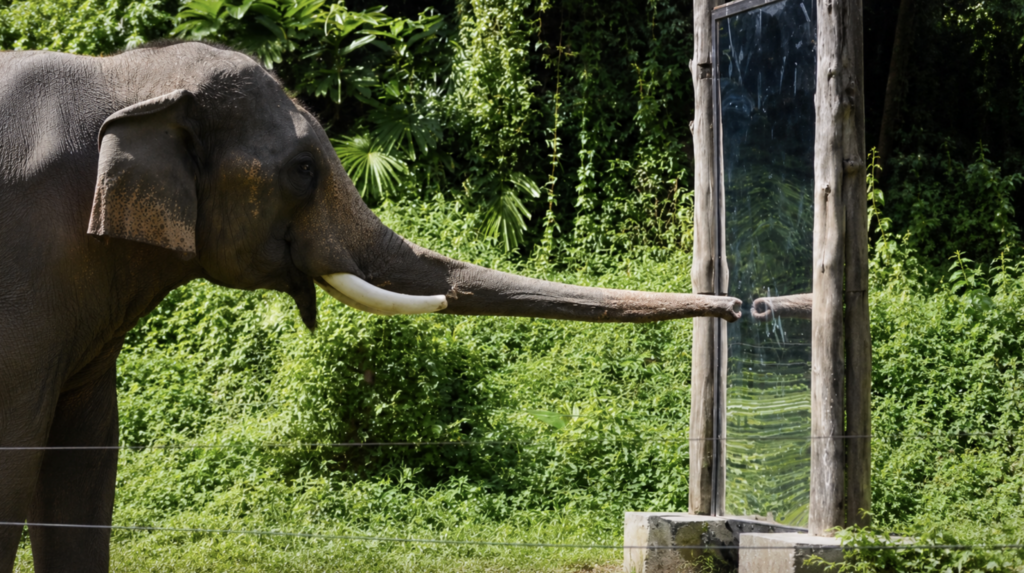
Other animals react in very different ways. Birds may attack mirrors, treating the reflection as a rival. Dogs often show mixed responses, ranging from confusion and fear to playful interaction or curiosity. Their reactions suggest recognition of movement, but not necessarily recognition of self.
Scientists have also developed alternative versions of the test using scent based markers instead of visual ones. In these experiments, an odorless dye is placed on an animal, and researchers observe whether it attempts to investigate or remove it after seeing its reflection. This helps reduce the chance that the reaction is simply curiosity about a visual object.
Human children also go through a similar developmental stage. Babies under about 18 months old typically do not recognize themselves in mirrors. They may react with curiosity or even confusion, but they do not yet understand that the image is their own. Only as cognitive development progresses do children begin to consistently pass the mirror test.
In many studies involving wild animals, big cats such as jaguars or leopards often respond to mirrors with territorial behavior. They may growl, paw at the surface, or even leave scratch marks nearby. In some cases, they urinate around the mirror, treating it as if it is another animal entering their territory.
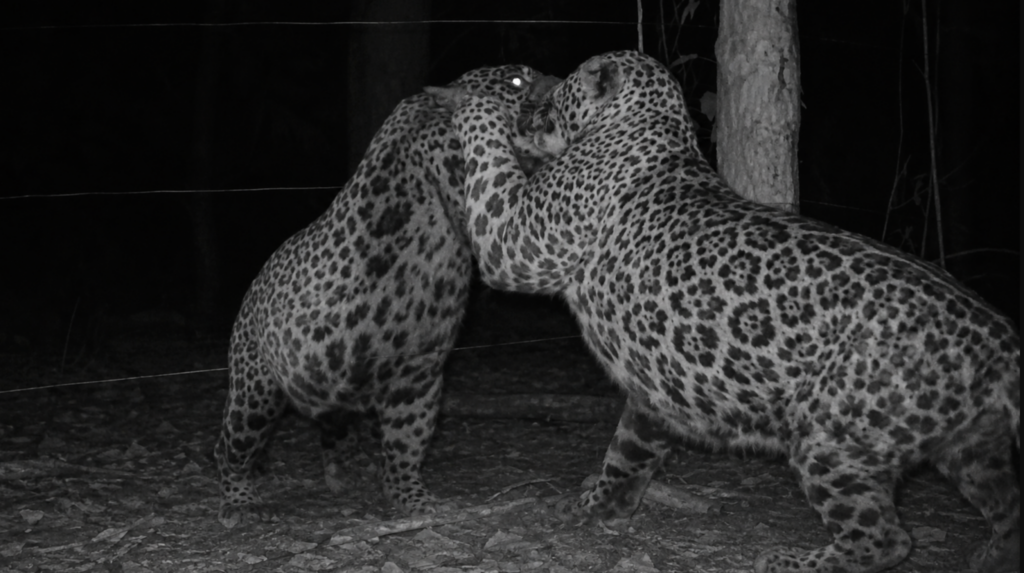
Some researchers interpret this as an attempt to assert dominance or even a form of social signaling rather than self recognition.
After several minutes, most animals lose interest in the mirror altogether, typically within five to ten minutes. Their behavior suggests they may interpret the reflection as another member of their species rather than a self image.
Overall, scientific conclusions so far suggest that most animals do not consistently demonstrate self recognition in mirrors. Instead, their reactions tend to reflect social instincts like dominance, curiosity, fear, or play.
This does not mean they lack intelligence. It simply means their awareness of self may be very different from ours.
And perhaps that is the most interesting part of all. Because understanding whether animals recognize themselves is not just about mirrors. It is about understanding how they experience the world at all.