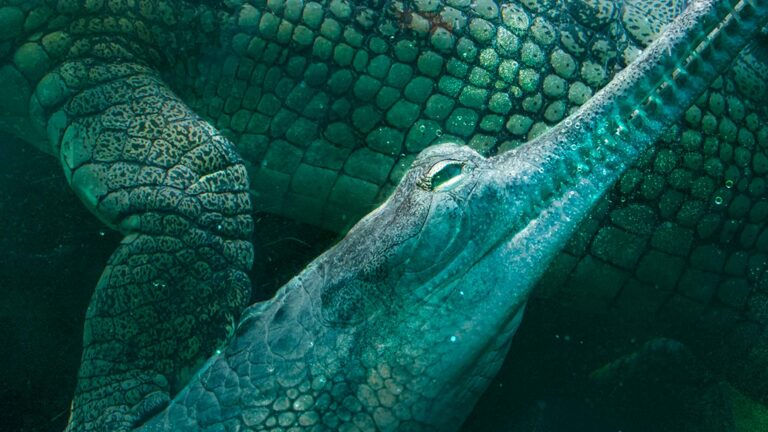
Deep in the winding rivers of northern India and Nepal, researchers searching for one of the world’s most elusive reptiles made an incredible discovery. Gliding silently through the water was a crocodile unlike any other on Earth. Its long, razor thin snout looked almost too strange to be real, giving it the appearance of a prehistoric monster that had somehow survived into the modern world.
The animal they found was a gharial, one of the rarest crocodilians alive today. Adult males can reach nearly 6 m (20 ft) in length, making them among the largest crocodiles on the planet. Yet despite their impressive size, fewer than a thousand adults remain in the wild, and they now survive only in a handful of rivers across India and Nepal.
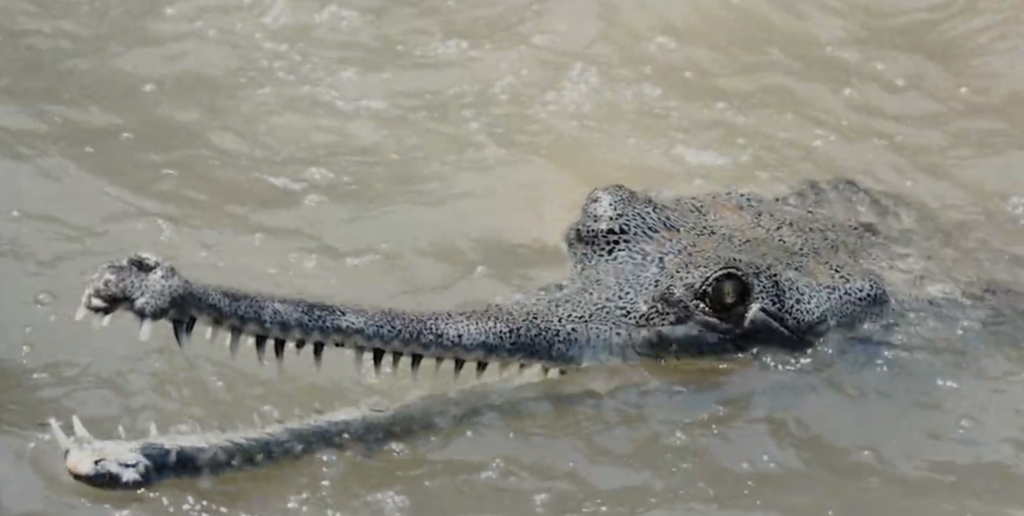
At first glance, the gharial’s bizarre snout seems like a design flaw. In reality, it is the perfect hunting tool.
Unlike other crocodiles that attack mammals, birds, or reptiles, the gharial specializes almost entirely in catching fish. Tiny sensory organs covering its head allow it to detect even the smallest vibrations in the water. The moment a fish swims nearby, the gharial whips its head sideways with incredible speed, trapping its prey between more than 100 razor sharp interlocking teeth.
Its long, narrow snout creates very little resistance in the water, allowing it to strike with remarkable precision. Once a fish is caught, it is swallowed whole without chewing.
Fish remain on the menu throughout the gharial’s entire life. Hatchlings weigh only about 100 g (3.5 oz), but as adults they can exceed 1,000 kg (2,200 lb), all while feeding almost exclusively on aquatic prey.
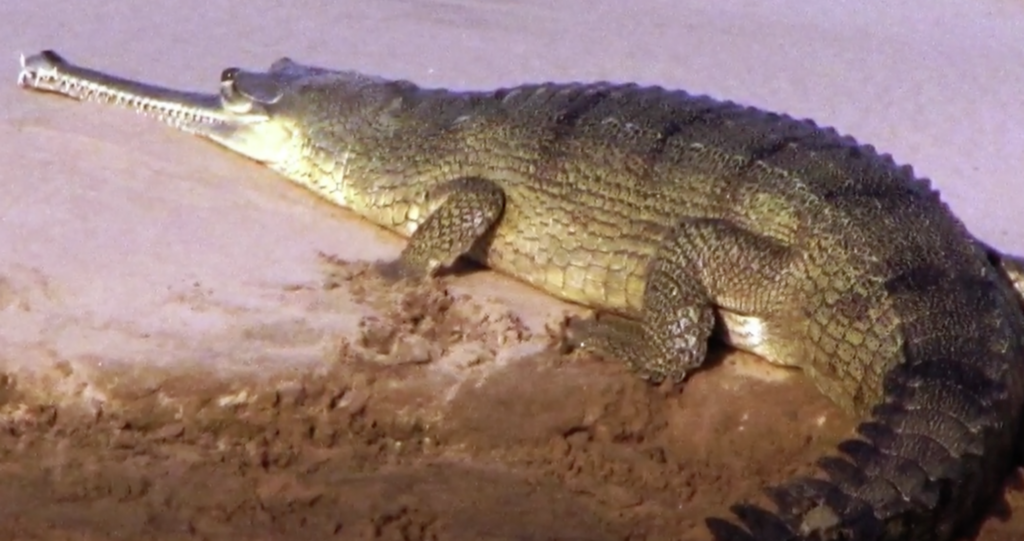
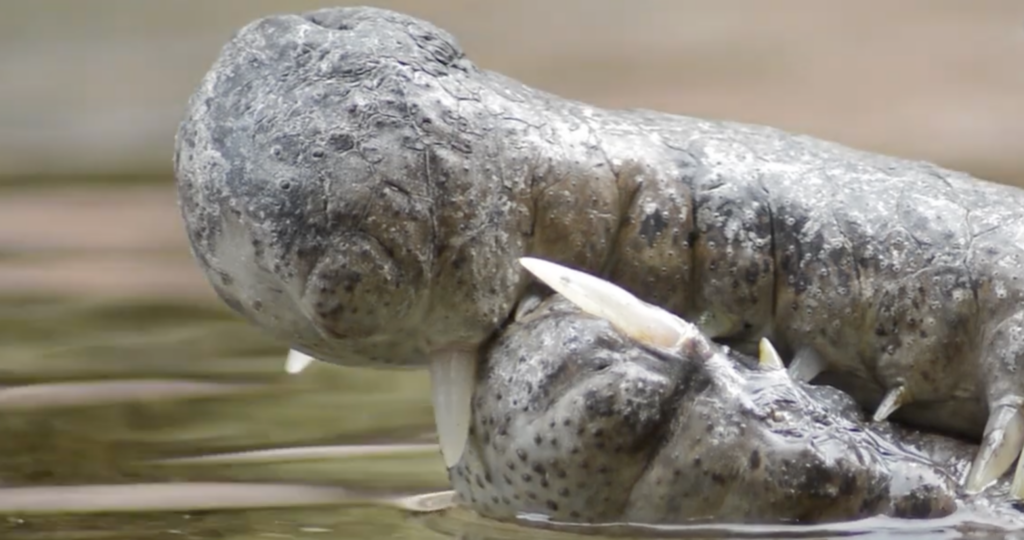
One of the most fascinating features appears only in mature males. At the end of the snout grows a large rounded bump known as the ghara, named after the Hindi word for an earthen pot. This unusual structure contains openings connected to the nostrils and acts like a natural amplifier.
During the breeding season, males produce loud buzzing calls and explosive popping sounds that travel across the river. These calls help attract females while also warning rival males that the territory is already occupied. Scientists are still studying exactly how these sounds are used to communicate.
The gharial’s family life is just as remarkable.
A dominant male often mates with several females, and many of those females gather together to build their nests along the same stretch of sandy riverbank. Each nest may contain between 30 and 50 eggs.
Like many reptiles, the temperature inside the nest determines whether the hatchlings become male or female. Warmer nests usually produce males, while cooler nests produce females.
After roughly two and a half months, hundreds of tiny gharials emerge at nearly the same time. They crawl toward the river and gather in large nurseries called creches, where hundreds, sometimes even more than a thousand young crocodiles stay together before the arrival of the monsoon season.
Unlike other crocodiles, female gharials cannot carry their babies gently in their mouths because their long, narrow jaws are packed with sharp teeth. Instead, both parents protect the hatchlings as they make the dangerous journey to the water.
The father is especially devoted. He guards the young from predators and even allows them to climb onto his head, back, and tail to rest safely above the water. The hatchlings communicate with soft grunting calls while adults remain alert for hungry storks, jackals, and other animals looking for an easy meal.
Despite being excellent swimmers, gharials are surprisingly awkward on land.
Their short, weak legs cannot lift their bodies high off the ground like other crocodiles. Instead, they slide across the sand on their bellies, leaving deep trails behind them. They usually come ashore only to bask in the sun, rest at night, or lay their eggs.
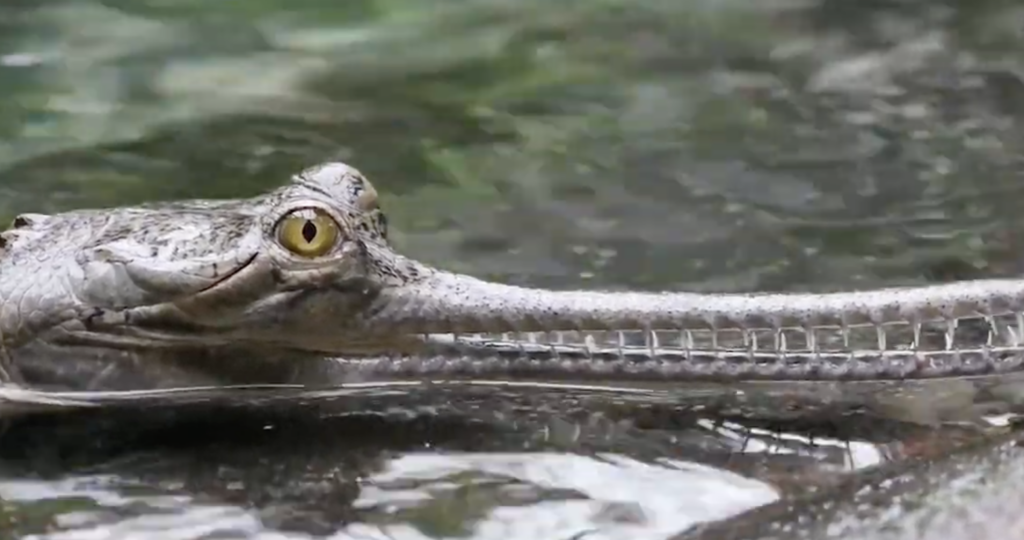
Fortunately, humans have very little to fear from these unusual reptiles. Their slender jaws are designed for catching fish, not large mammals, and attacks on people are extremely rare. In fact, gharials are known for being shy and avoiding human contact whenever possible.
Sadly, it is humans who have become the greatest threat to the species.
Dams, irrigation projects, and river development have destroyed much of the gharial’s natural habitat. Sand mining removes the beaches where females lay their eggs, while fishing nets can accidentally trap and drown these rare reptiles.
Today, the Chambal River supports more than 80 percent of the remaining wild population, making it the best place on Earth to spot a gharial in its natural habitat. Conservation programs, breeding centers, and zoos around the world are working together to protect the species and slowly rebuild its numbers.
The discovery of this strange crocodile is a reminder that some of the world’s most extraordinary animals are also among its most endangered. With its unbelievably long snout, unique family behavior, and ancient lineage, the gharial truly deserves its reputation as the strangest and rarest crocodile on Earth.