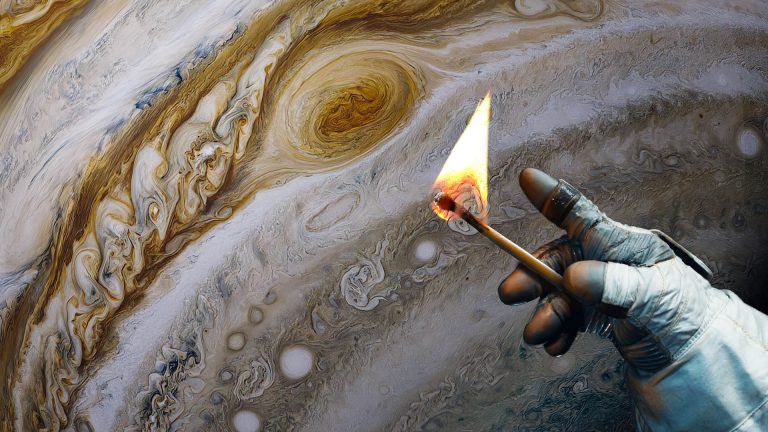
Jupiter is the largest planet in the Solar System. It’s 300 times more massive than Earth. But it’s less dense than our home. With no solid surface, this planet is almost entirely gaseous. It has an atmosphere composed of 90% hydrogen, about 10% helium and trace amounts of methane and ammonia. With so much hydrogen present, pretty much all of Jupiter must be flammable, right?
So if you lit a match, how much of that wooden stick would burn off before it all goes KABOOM?
Usually, when you drag a matchstick along the red strip on your matchbox, you start a series of small chemical reactions that end in a flame. When you apply friction to the box, red phosphorus converts to white phosphorus. This mixes with the oxygen in the air and ignites. Without oxygen, this ignition wouldn’t happen. But since you’re so determined to set Jupiter on fire, you’d have to find a way around this obstacle.
For starters, you would need to reinvent the matchbox. You would need one that could ignite the match without the need for external oxygen in the atmosphere. So you could lose the white phosphorus in your match.
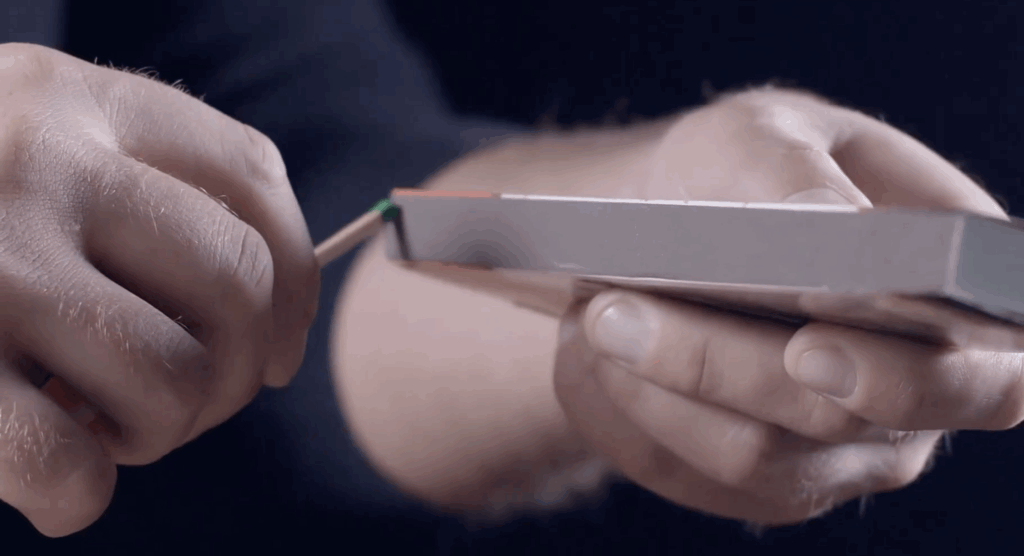
Instead, you would need a match that could generate enough heat from friction to break down potassium chloride on the matchstick into oxygen. The flame would keep burning as long as the matchstick coating lasted. But one matchstick wouldn’t provide you with the oxygen you’d need to ignite Jupiter. You’d need a lot more.
Considering that Jupiter is the most massive planet in our Solar System, you’d be burning off an astounding amount of hydrogen. To be more precise, about 1.4e27 kg (3e27 lb) of the stuff. For hydrogen to combust, you’d need about half as much oxygen present in the atmosphere as there is hydrogen.
As you might’ve guessed, you would need to gather a lot of oxygen. And because molecules of oxygen are way heavier than molecules of hydrogen, the total mass of oxygen we would need would be about six times the mass of Jupiter. There isn’t enough oxygen in the entire Solar System for this to happen.
Sorry to disappoint you. But Jupiter won’t erupt in flames anytime soon. And before you try to get creative with your methods, let me tell you that even the most energetic impact that ever occurred on the gas giant didn’t cause a single spark.
In 1994, the comet Shoemaker-Levy 9 crashed into Jupiter. As it entered the atmosphere, it broke into multiple pieces. Some were as large as 1 km (0.62 mi) in diameter. The total impact of all these pieces was massive. So massive that the total kinetic energy was many times more powerful than the Hiroshima nuclear bomb. But still, no flames.