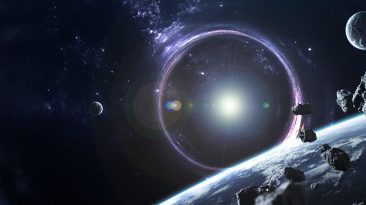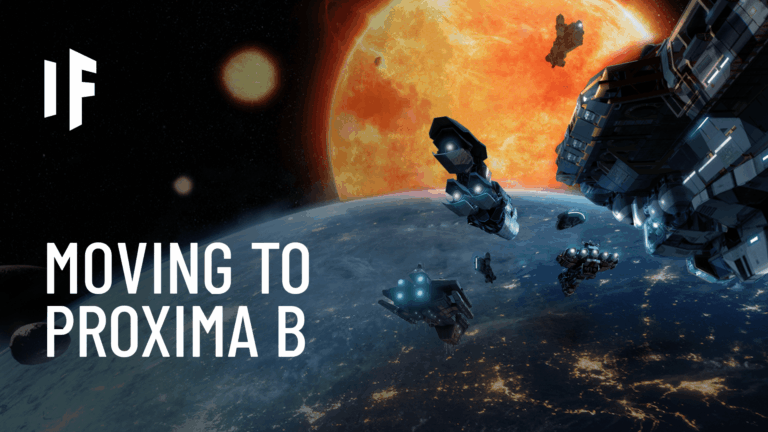
Proxima b is very promising. It orbits a red dwarf star called Proxima Centauri in a system with three stars in it. Proxima Centauri is small. It only has between 7.5% and 50% of our Sun’s mass.
That’s a good thing. Because the red dwarf Proxima Centauri is so much smaller than our yellow dwarf Sun, it burns at a lower temperature. It takes stars like Proxima Centauri much longer to burn through all of their hydrogen supply. Because of that, Proxima Centauri has a lifetime of trillions of years, while our Sun has a 10-billion-year expiration term.
That alone makes Proxima b a good candidate for relocation. That and the fact that its orbit lies in Proxima Centauri’s habitable zone.
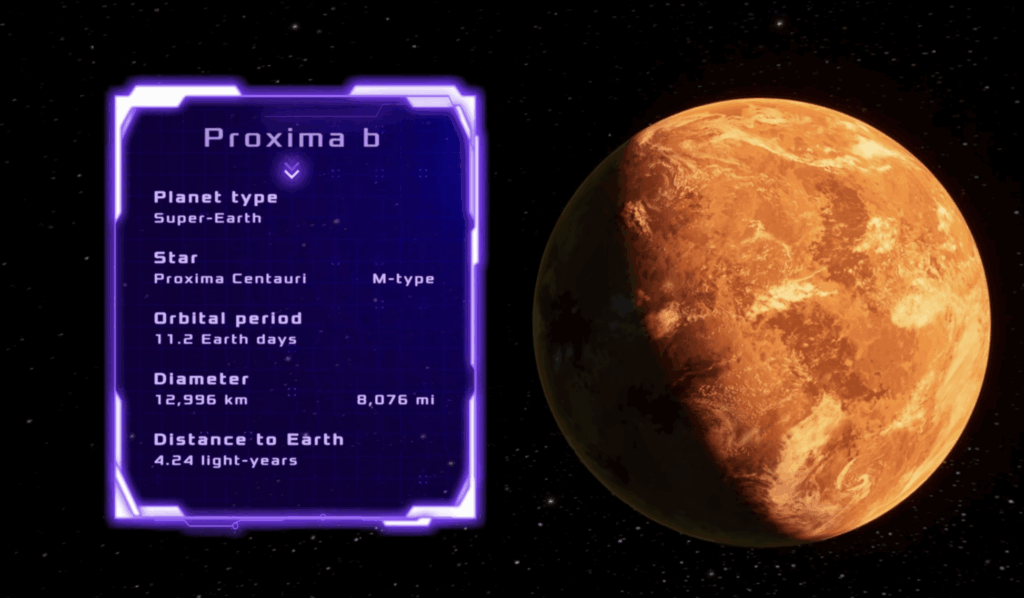
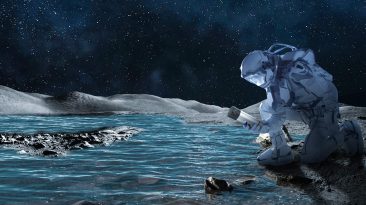
That means there’s the potential for liquid water and comfortable surface temperatures. If we’re lucky, Proxima b would have an atmosphere that we could breathe. If it does, the surface temperatures would be in the range of 30°C (86°F).
I don’t know about you, but I’d move there right now. I just need to warn you that there are a few problems.
A trip to Proxima b would be long and very dangerous. Proxima b might be the closest habitable exoplanet we’ve got, but that doesn’t mean it’s close. The red dwarf star, Proxima Centauri, is about 4.3 light-years away. That means that if you could travel at the speed of light, it would take you 4.3 years to get there. But nothing we’ve built so far can reach such speed.
Realistically, a trip to Proxima Centauri in a space shuttle would take 165,000 years, give or take. That’s right, some of the colonists would be born in transit. Some of them would never see the Earth. Some of them would never see Proxima b. They’d just live their lives aboard the spaceship and die in space.
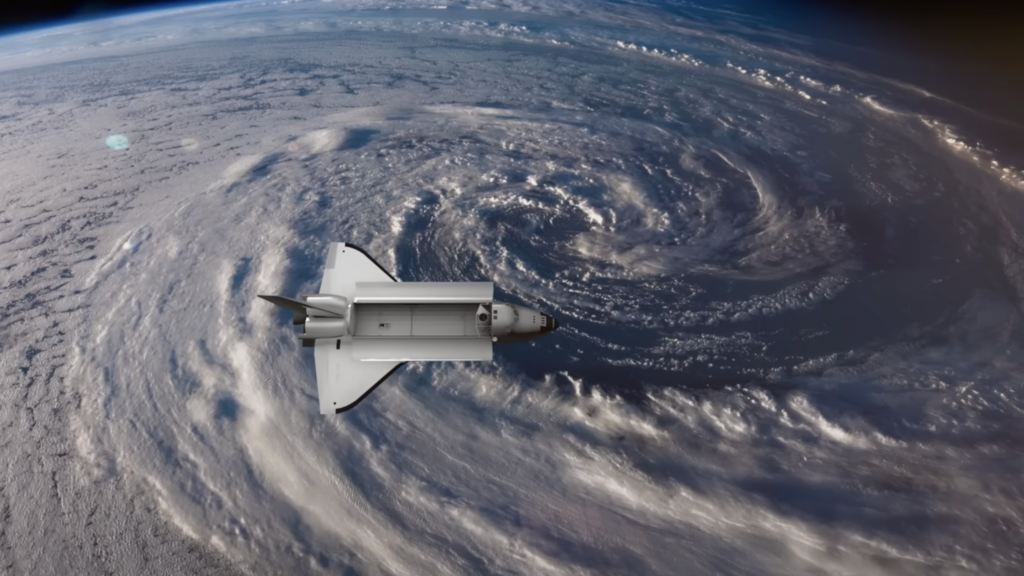
How many humans would we need to send on a mission, exactly?
According to some calculations, 98 people would be just enough. Their descendants would arrive at Proxima b with enough genetic diversity to populate the entire planet. That’s accounting for possible cases of infertility, inbreeding and sudden deaths.
In those calculations, the crew would be traveling on something faster than a space shuttle.
Their mission to Proxima b would take only 6,300 years.But don’t be surprised. Technology is constantly improving. Right now, a scientific and technological program called Breakthrough Initiatives is looking at how we can get in the neighborhood of Proxima Centauri within one generation.
Their Project Starshot is working on an ultra-light unmanned probe that would reach the star system in just 20 years. Now I definitely need to sign up! But, again, Proxima b is really far away. It’s so far that we can’t even see if it has an atmosphere. It might just happen that we would arrive at a frozen planet with surface temperatures of -40°C (-40°F).
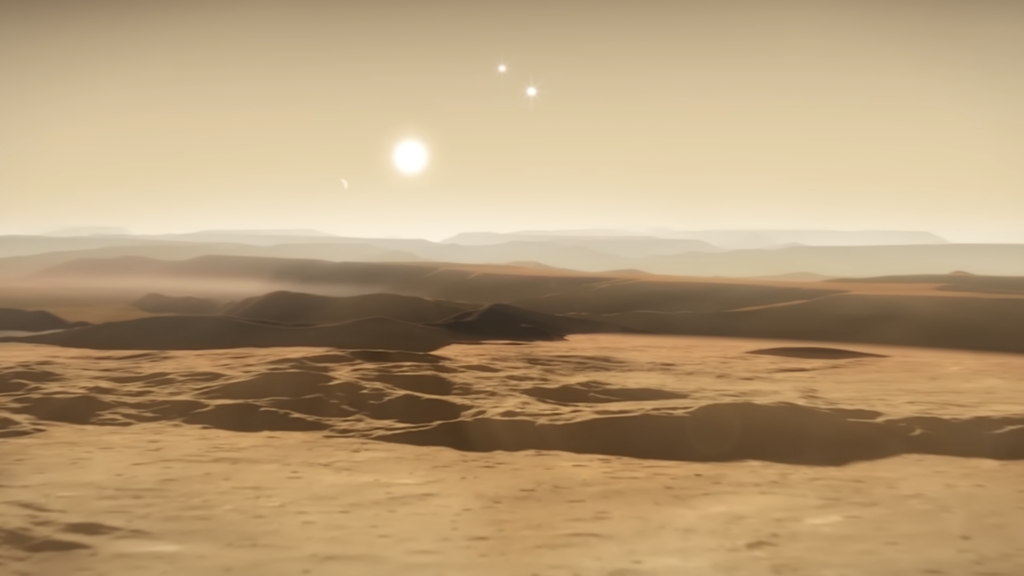
And even if it has an atmosphere, it might not be the right one. We might still enjoy warm temperatures, but we’d be doing that in space suits and with oxygen tanks.
Or, Proxima b could be tidally locked to Proxima Centauri, meaning one of the planet’s sides would always face its star, and the other side would be plunged into darkness. Space flight itself could bring some unpleasant surprises. Spending an entire lifetime in a zero-gravity environment would lead the crew members to lose muscle and bone density. They’d be constantly exposed to space radiation. Their microbiomes, immune systems and physiology would be different from ours.
They wouldn’t be the same kind of humans as we are. They would change their values and culture. They might forget all the farming techniques we’d teach them to sustain themselves in space and on their new planet. They might change their mind about the mission altogether and just turn their spaceship in a different direction.
Who knows, they might even come back to Earth and take revenge for all those years they were forced to spend in space. If that happens, I’ll be asking for a refund.
Sending anyone on such a mission is a huge risk. We’d need to design and build a vehicle, choose the space travelers very carefully, supply them with all the food and water, and make sure they could become self-sustaining. We’d have to design new propulsion, navigation, hibernation and life support systems.
And we have no way of knowing if Proxima b is actually habitable.