







Swipe Down for Full Video Story
Deep above the South Atlantic Ocean, there is a region of space that has puzzled scientists and space agencies for decades. In this zone, spacecraft can experience sudden technical glitches, sensitive electronics may behave unpredictably, and satellites are exposed to unusually intense levels of radiation. Because of its strange effects, it is often referred to as the “Bermuda Triangle of Space.”
Despite its dramatic nickname, researchers now understand that this region is not a mystery in the supernatural sense. It is a real and measurable feature of Earth’s environment known as the South Atlantic Anomaly.
What is the South Atlantic Anomaly?
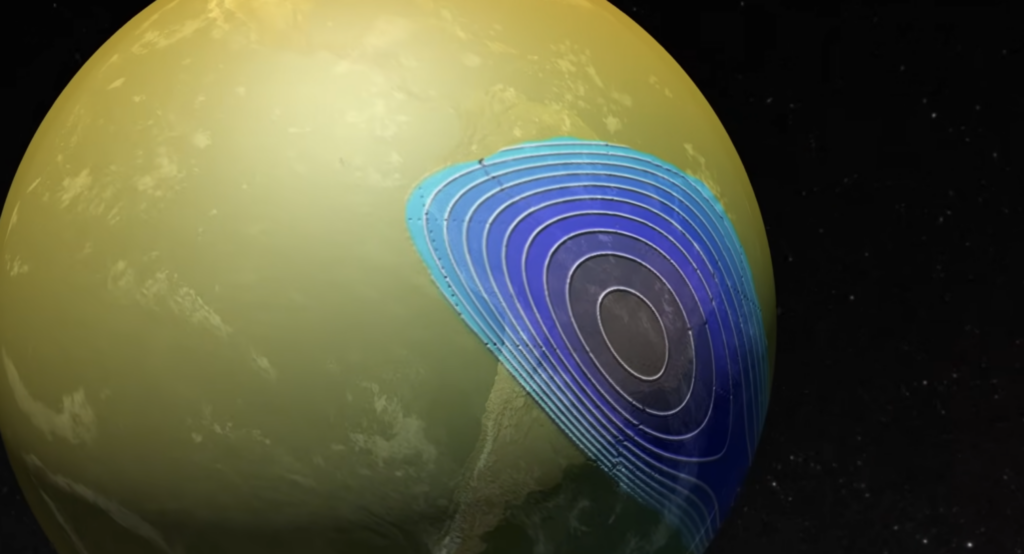
The South Atlantic Anomaly, or SAA, is a large area of weakened magnetic field strength located above the South Atlantic Ocean. It stretches broadly across a region between South America and southern Africa, roughly from Chile toward Zimbabwe. Unlike the rest of the planet’s protective magnetic shield, this zone allows high energy particles from space to come much closer to Earth than usual.
To understand why this matters, it helps to look at the Van Allen radiation belts. These are two giant zones of charged particles trapped by Earth’s magnetic field. They act like invisible protective rings, shielding the planet from harmful solar radiation and cosmic particles.
However, in the region of the SAA, that protection becomes noticeably weaker. As a result, spacecraft passing through this area are exposed to higher levels of radiation.
What happens when spacecraft pass through it?
When satellites or spacecraft travel through the South Atlantic Anomaly, they can experience a range of technical issues.

Electronic systems may glitch, sensors can produce incorrect readings, and in extreme cases, onboard computers may temporarily shut down or malfunction.
One notable example is the Japanese Hitomi satellite, which suffered a catastrophic failure in 2016. Before its loss, operators received confusing and inconsistent data from the spacecraft. It appeared to be functioning normally, even as it was undergoing serious system errors while passing through space environments influenced by the anomaly. Eventually, communication was lost and the satellite broke apart.
Even major space observatories are affected. The Hubble Space Telescope regularly passes through the SAA during its orbit. To protect its instruments, NASA schedules temporary shutdowns of sensitive systems while it crosses the region. Without this precaution, high energy particles could corrupt scientific data or damage critical components.
How astronauts protect themselves
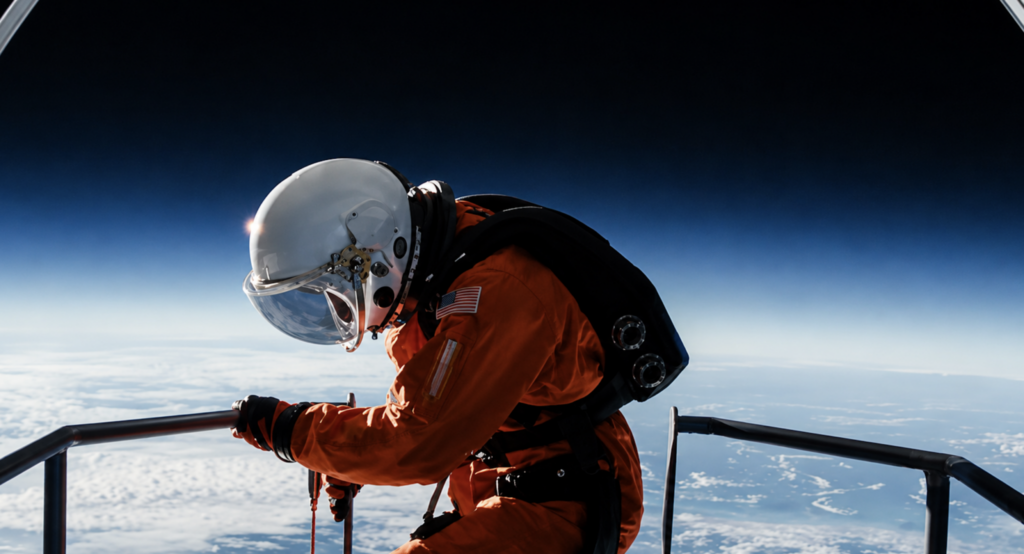
For astronauts in low Earth orbit, radiation exposure is constantly monitored, and the South Atlantic Anomaly is taken very seriously. Space agencies use protective design strategies to reduce risk during orbital passes through the region.
One such method involves water shielding. Certain areas of spacecraft are lined with containers or walls filled with water. Water is highly effective at blocking radiation because of its hydrogen content, which helps absorb and slow down energetic particles. Astronauts can position themselves in these protected areas during periods of increased exposure.
Without such precautions, long term exposure to this radiation could increase the risk of radiation sickness or even long term health effects such as cancer.
Why does this anomaly exist?
The South Atlantic Anomaly is not caused by anything mysterious. It is the result of how Earth’s magnetic field is structured.
Although Earth may look like a perfect sphere, it is slightly flattened at the poles and bulging at the equator. In addition, the planet’s magnetic field is not perfectly aligned with its physical center. The magnetic center is offset by several hundred kilometers.

This misalignment creates a weak point in the magnetic field. In the SAA region, the protective shield dips closer to Earth’s surface, allowing energetic particles from space to penetrate more deeply into orbiting spacecraft paths.
A changing and evolving region
What makes the South Atlantic Anomaly especially interesting to scientists is that it is not static. It appears to be slowly shifting and changing over time.
Measurements from space agencies such as NASA show that the anomaly is gradually drifting westward. In addition, data suggests that it may be weakening and even beginning to split into two separate regions. This could make future satellite operations more complex, as spacecraft may encounter multiple zones of heightened radiation instead of one.
Despite these changes, scientists emphasize that the SAA evolves over long geological timescales. Significant transformations would likely take thousands to millions of years.
Why it matters for the future of space travel
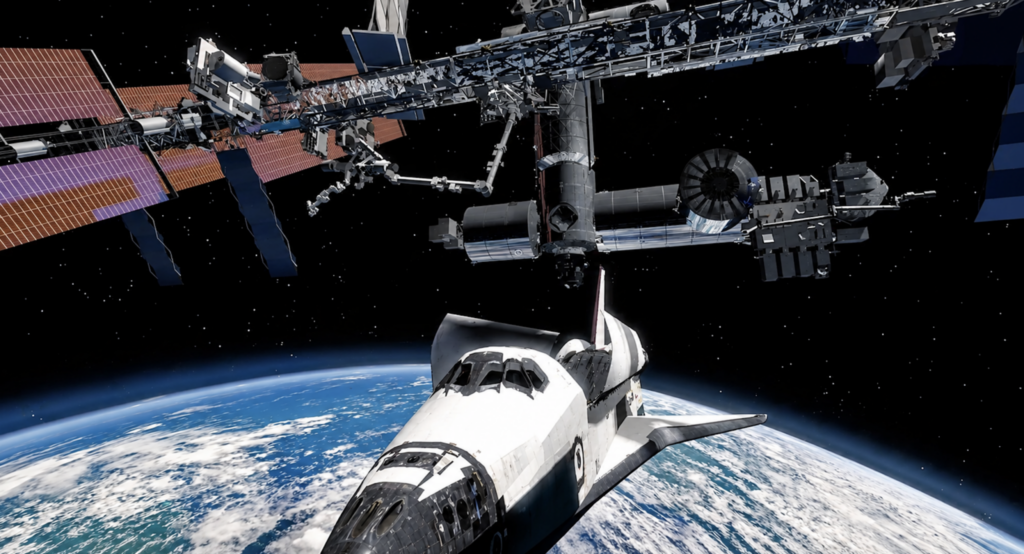
Although the South Atlantic Anomaly does not pose a danger to people on Earth, it is a critical factor in planning space missions. Satellite operators, engineers, and astronauts must carefully account for it when designing equipment, planning orbits, and scheduling communications.
If Earth’s magnetic field were ever to undergo a major shift or reversal, the effects on the SAA could become far more significant. Such changes could increase radiation exposure in orbit and complicate future missions to space.
For now, however, the “Bermuda Triangle of Space” is not a place of mystery or danger beyond understanding. Instead, it is a powerful reminder of how dynamic Earth’s space environment really is, and how much we continue to learn about the invisible forces that surround our planet.