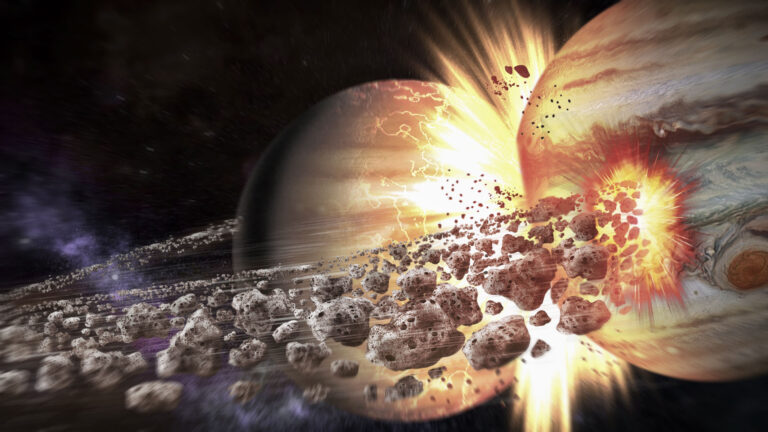
Saturn does not enter this fight alone. Hidden within its rings sit at least 150 moons and moonlets, an entire arsenal of ice and rock orbiting alongside it.
None of that helps. Bring the two gas giants close enough and Jupiter’s gravity would pull those moons toward itself, tearing many of them apart before they ever arrived.
Then it would start on the planet.
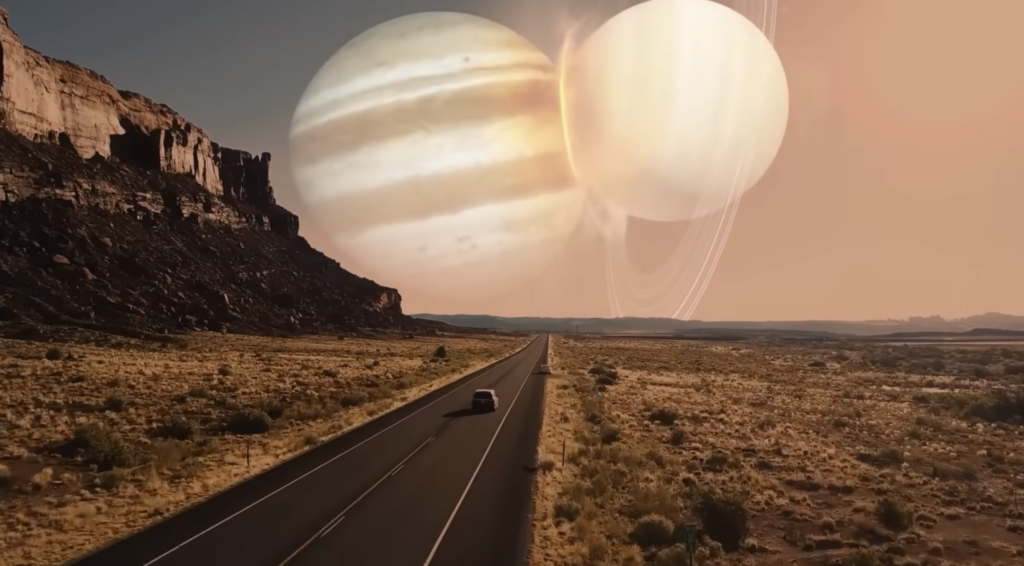
The two largest planets in our Solar System came remarkably close on December 21, 2020, in an event astronomers call a Great Conjunction. They had not been that near each other in nearly 400 years, appearing as a single star in the evening sky and fitting into one telescope view.
They were still nowhere near an actual collision. But if they ever were, this would not be the first time Jupiter went head to head with something.
Both planets are almost entirely gaseous, made primarily of hydrogen and helium. They may have solid cores, though there is no sharp boundary between the layers.
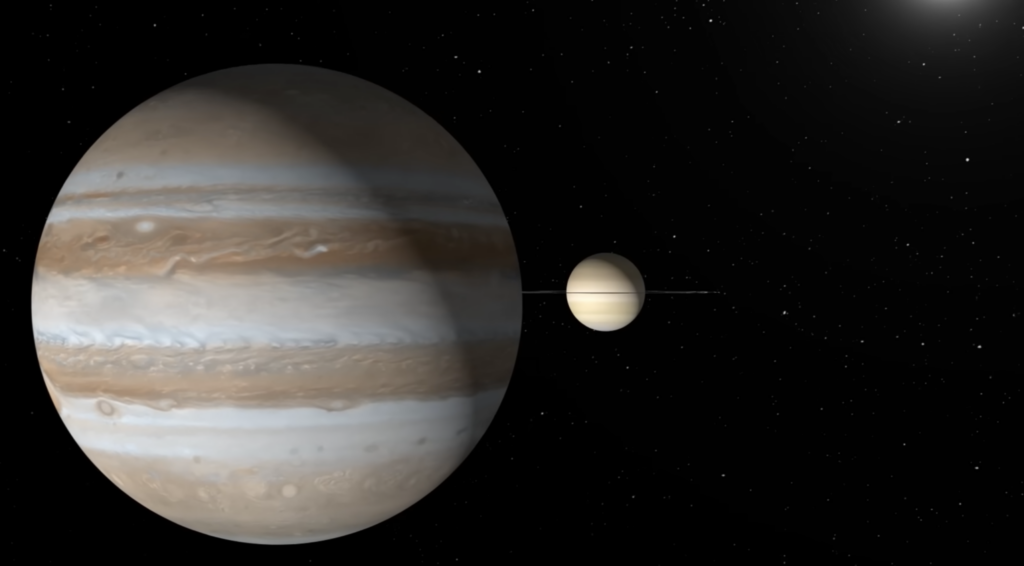
Jupiter enters with clear advantages. It is roughly three times as massive as Saturn with nearly double the volume, and it spins faster too, rotating at 13.07 km/s against Saturn’s 9.69 km/s.
We know exactly what happens to objects that get too close, because it has already happened.
In 1994, the comet Shoemaker-Levy 9 collided with Jupiter. Originally nearly 2 kilometers wide, the comet was torn to pieces by Jupiter’s gravity before impact, and those fragments struck with the force of 300 million atomic bombs, heating the planet’s atmosphere to nearly 40,000 degrees Celsius.
Now scale that up. Titan, the largest moon of Saturn, is over two thousand times larger than that comet.
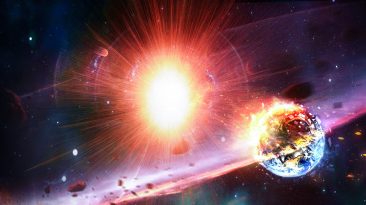
Once the planets themselves met, they would begin merging. Their atmospheres would mix, driving temperatures up through the upper layers until Jupiter underwent a chemical reaction, gaining iron, silicates, and even water in the process.
Eventually Jupiter would absorb Saturn. Or most of it.
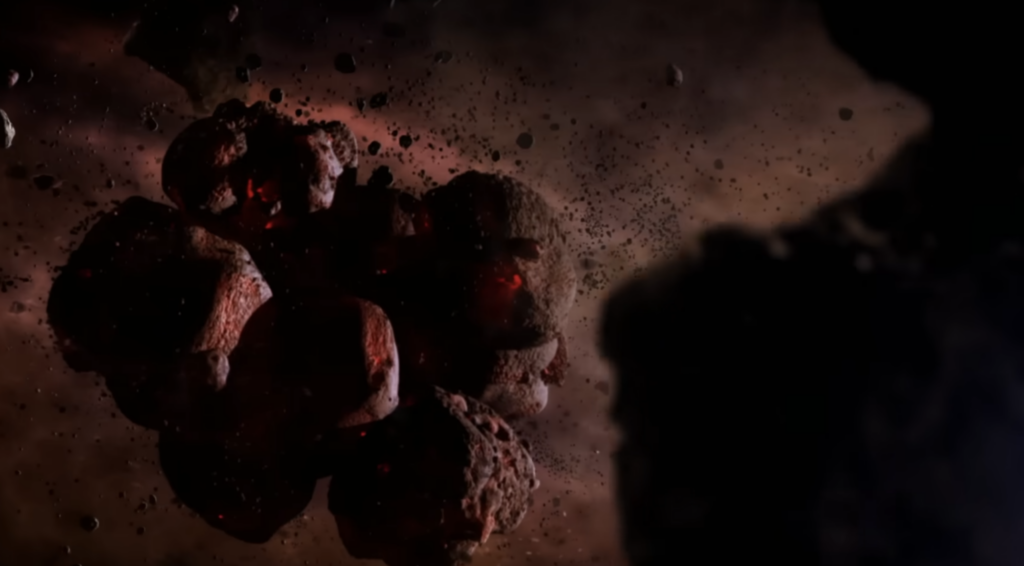
There is precedent for that too. Scientists at Sun Yat-Sen University in China modeled what happened when a planetary embryo roughly ten times the size of Earth struck Jupiter four and a half billion years ago.
The impact was energetic enough to destroy Jupiter’s original compact core, replacing it with a diluted core made of a dense mixture of liquid metallic hydrogen and helium.
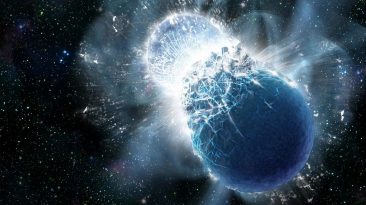
A collision with Saturn would be ten times more massive than that. Enormous quantities of material would spread out into space before gravity drew it all back together into a single object. Call it New Jupiter, or Jupiturnus.
And that new planet might cause more trouble than you would expect.
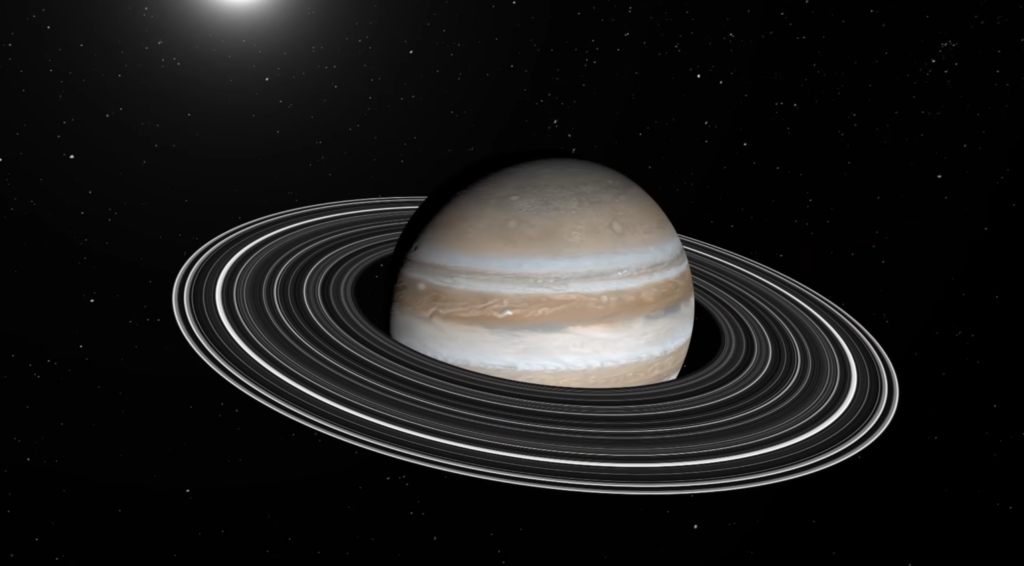
Jupiter is sometimes called a failed star, since its size and composition resemble a brown dwarf. Jupiturnus would be more massive still, with higher internal pressure, and at sufficient temperature that could trigger nuclear fusion in its core.
A second star in our planetary neighborhood would likely mean the end of life on Earth.
Fortunately the numbers rule it out. Merging both planets would produce something about 30 percent more massive than Jupiter, while igniting fusion requires the mass of 75 Jupiters.
So we would survive it. What we would get instead is a spectacular display of gas and debris flung across space, lit by the Sun, as Saturn disappeared into the planet that ate it.