Five billion years from now, the Sun will be running out.
Assuming anyone is still here to care, that becomes an urgent problem, because a star running low on fuel is a star that stops holding itself together.
Which raises a slightly absurd question with a surprisingly serious answer. Could we feed it Jupiter? To see why that idea isn’t ridiculous, it helps to know what the Sun is actually doing up there.
It runs on a delicate balance of hydrogen and helium. At the core, hydrogen converts into helium through nuclear fusion, and that reaction is exothermic, meaning it releases more energy than it uses.

That energy comes out as gamma radiation, and the outward push it creates is the only thing stopping the Sun from collapsing under its own gravity.
No hydrogen, no push. That’s the whole problem in one sentence.
Now look at Jupiter. Roughly 90 percent of its atmosphere is hydrogen, which makes it an enormous ball of exactly the fuel the Sun needs, even though it carries only 0.01 percent of the Sun’s mass.
And this arrangement already exists somewhere else.
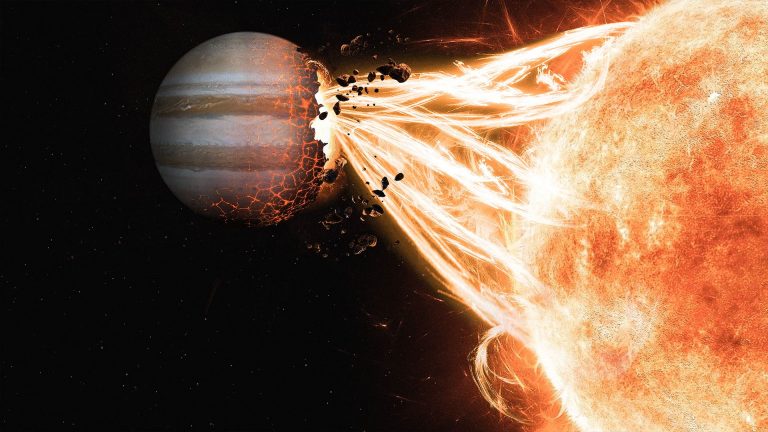
Astronomers have found a star similar to ours that’s currently eating a gas giant, a planet called WASP-12b. The star is pulling the planet’s atmosphere away from it, forming a hot ring of gas as it goes.
The effect on the planet is dramatic. As its atmosphere gets dragged outward, WASP-12b has puffed up to six times the size of Jupiter.
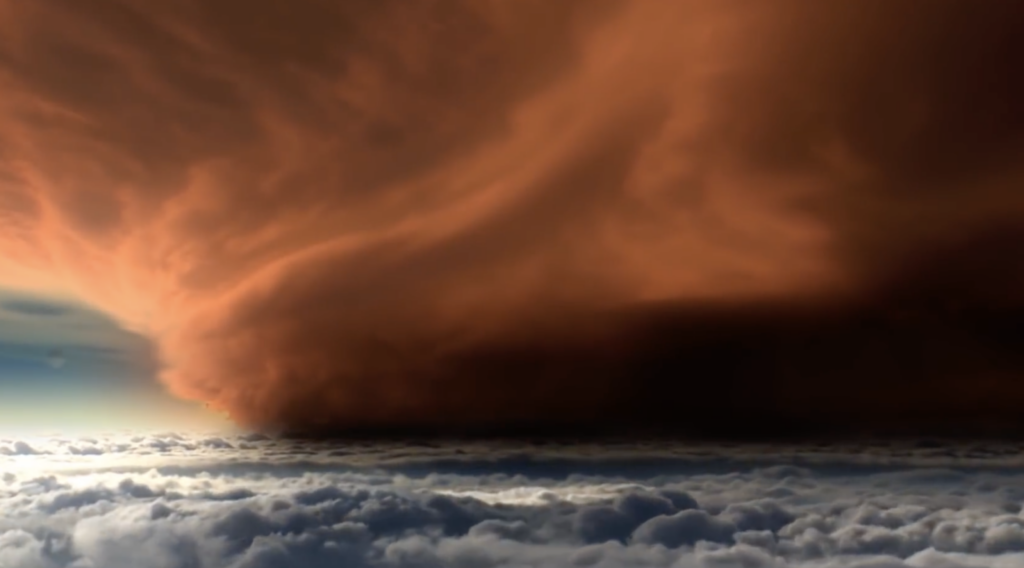
So the mechanism works. The question is whether it would buy us enough time.
Our Sun consumes hydrogen at 620 million metric tons per second, which is a difficult figure to hold in your head. Even so, with all four gas giants in our Solar System available, we could keep it burning for another 87 million years.
Jupiter being the largest, you’d start there.
The setup would need to mirror WASP-12b, positioning Jupiter close enough to deliver a steady flow of hydrogen from its atmosphere, carefully calibrated so the Sun neither gains nor loses mass overall.
Which naturally invites the more entertaining option. Why not just throw Jupiter into the Sun and be done with it?
Spectacular, certainly. Also catastrophic, because dumping that much mass in at once would make the Sun burn hotter, and global warming would become something considerably worse than warming.
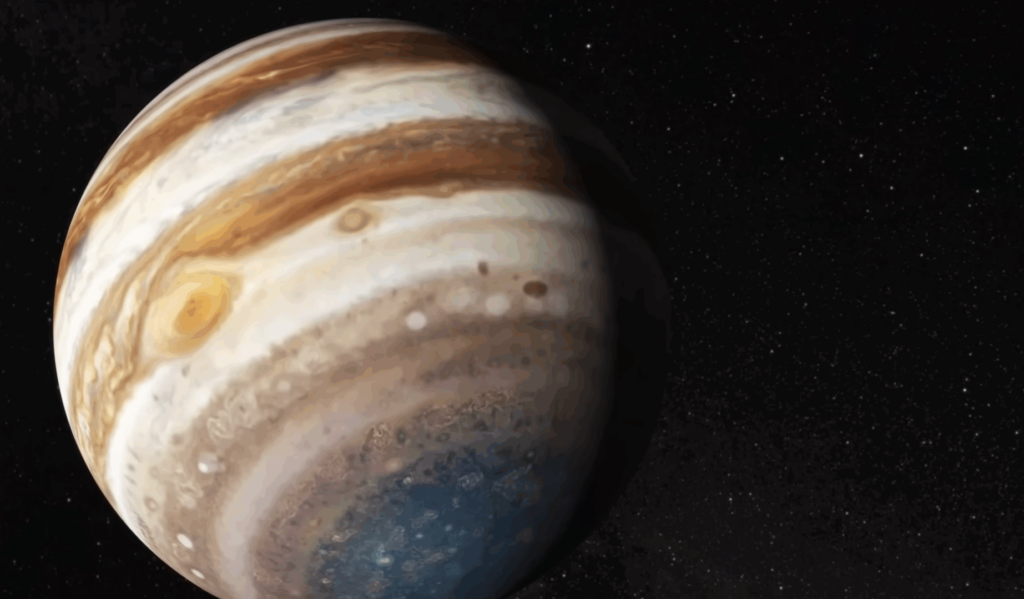
Stability is the entire point. Keep the mass steady and fusion stays consistent at the core.
There’s a bigger problem with the whole plan, though, and it has nothing to do with the Sun.
Jupiter’s gravity is currently holding the arrangement of our Solar System together. Move it and every planetary orbit gets disrupted, ours included.
We’d also lose our shield. Jupiter’s mass deflects a significant amount of the asteroid and comet traffic that would otherwise be heading our way.
So saving the Sun by relocating Jupiter means destabilizing the system we were trying to preserve.
Realistically, the answer is that we don’t refuel anything. We pack up and go looking for an Earth like exoplanet somewhere else, and leave the Sun to finish on its own schedule.