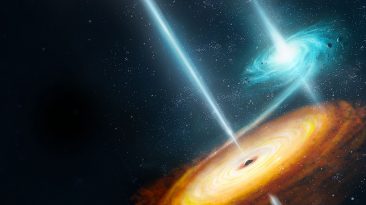
Picture a burst of energy so powerful that it can outshine entire regions of the cosmos, racing directly toward an object with gravity strong enough to trap light. A gamma ray burst meeting a black hole sounds like the ultimate cosmic showdown.
It might seem like such an encounter should tear space apart, distort time beyond recognition, or trigger an explosion capable of changing the Universe itself. But the real interaction would be governed by something far less dramatic and far more fascinating: the laws of physics.
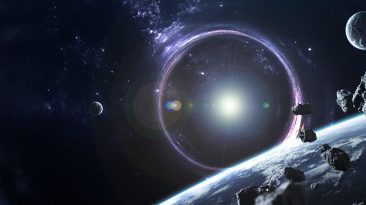
To understand the encounter, start with the black hole. It forms when an enormous amount of matter collapses under its own gravity, creating an object with an extraordinarily concentrated mass and a gravitational field unlike anything found on Earth.
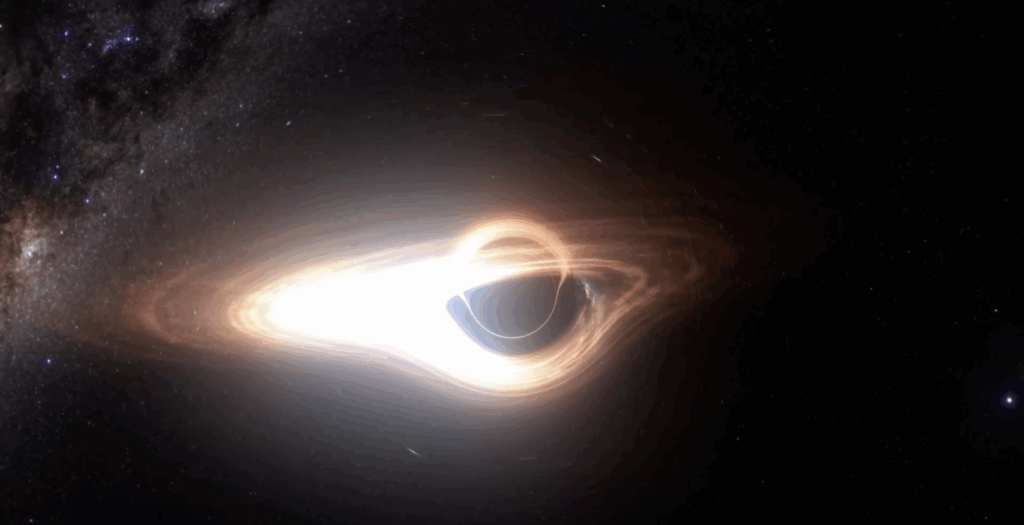
Surrounding the black hole is the event horizon, an invisible boundary beyond which escape becomes impossible because even light cannot travel back out. At the center is the singularity, where our existing understanding of physics reaches its limits.
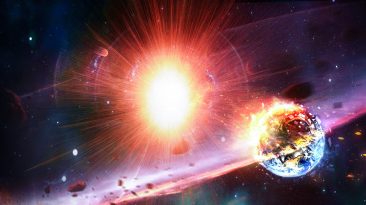
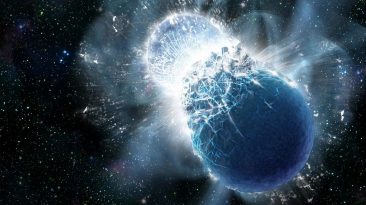
Then there is the gamma ray burst, one of the most energetic events known to astronomy. These enormous flashes of high energy radiation can release more energy in seconds than the Sun will produce throughout its entire lifetime.
If you could somehow watch such an event from nearby, however, it would not resemble a giant fireball. Gamma rays are outside the range of human vision, so your eyes could not directly see the radiation. Specialized instruments would be required to detect it.
There would be no tremendous explosion sound either. Sound requires matter through which its waves can travel, while the near vacuum of space provides no ordinary medium for sound to move across.
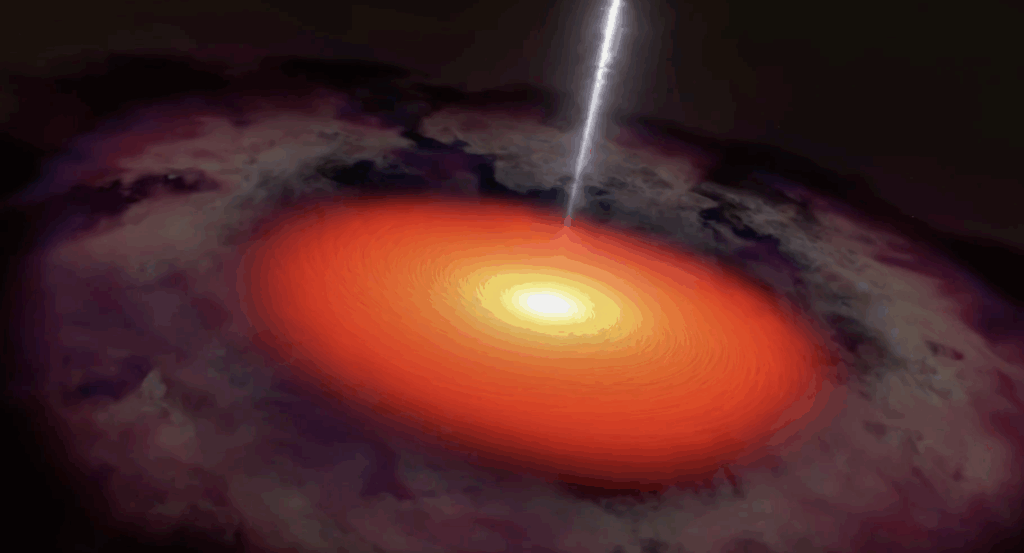
For anything caught directly in the path of the radiation, the real threat would be the enormous energy carried by the gamma rays. Powerful radiation can penetrate materials and interact with molecules inside living tissue, potentially causing severe cellular and DNA damage.
The black hole would also dramatically affect the path of the incoming radiation. Light traveling close to an extremely massive object can have its trajectory bent by gravity. Instead of moving in a perfectly straight line, the radiation could curve around the black hole.
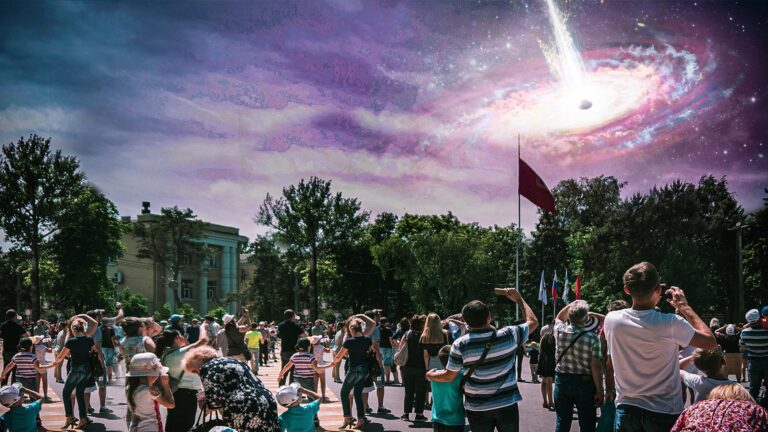
This can create strange observations for anyone watching from a safe distance. Light arriving from different directions can take different paths through curved spacetime, producing effects that may make the timing or appearance of the radiation seem unusual.
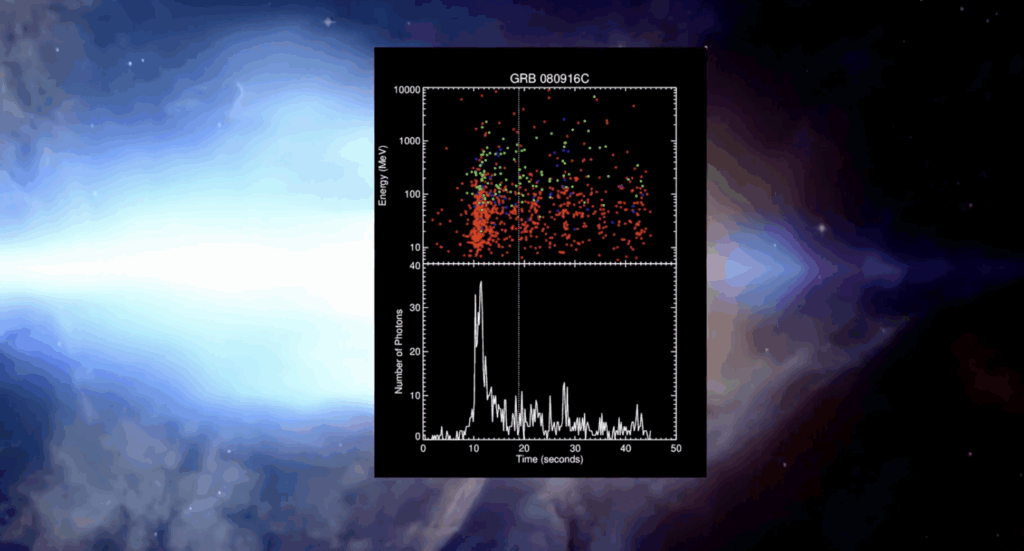
That does not mean time itself has started moving backward. Some gamma ray bursts can display complicated patterns when detected from Earth, but these effects are related to the movement of the radiation, the environment around the source, and the way the signals reach our instruments.
So what would really happen if a gamma ray burst encountered a black hole? There would be no reality destroying explosion and no sudden rewriting of the laws of nature. The radiation would instead interact with the black hole’s powerful gravitational field.
Some of the radiation could be absorbed if it crossed the event horizon, adding its energy to the black hole. Other portions could be redirected by gravity and continue traveling through space, depending on their original paths.
The result would be an extreme but perfectly physical interaction between two extraordinary cosmic phenomena. One demonstrates gravity at its most intense, while the other represents some of the greatest bursts of electromagnetic energy known to exist.
Far across the Universe, events involving intense radiation and massive black holes may already be taking place. They do not need to destroy reality to be spectacular. Their signals alone give astronomers a chance to study conditions that cannot be recreated on Earth.