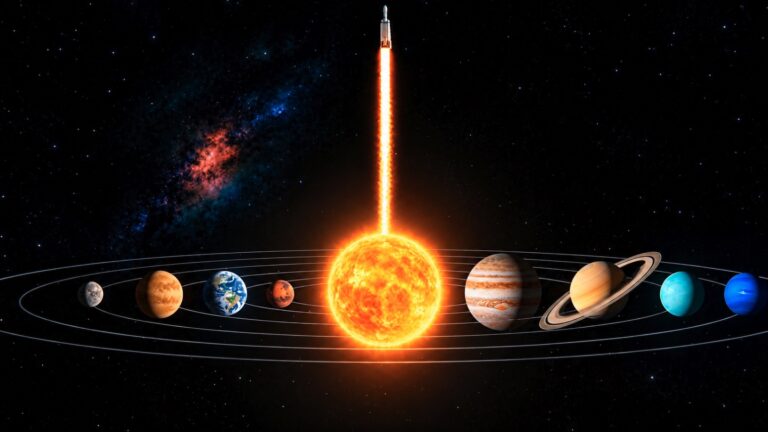
The Solar System looks flat from our perspective, but nobody has ever travelled far enough above it to see the whole thing from that angle. Getting there would be one of the most difficult things humanity could attempt. But if we could, we might be able to save thousands of lives.
So why can we send a spacecraft 25 billion kilometers away, but can’t simply travel in a different direction, up?
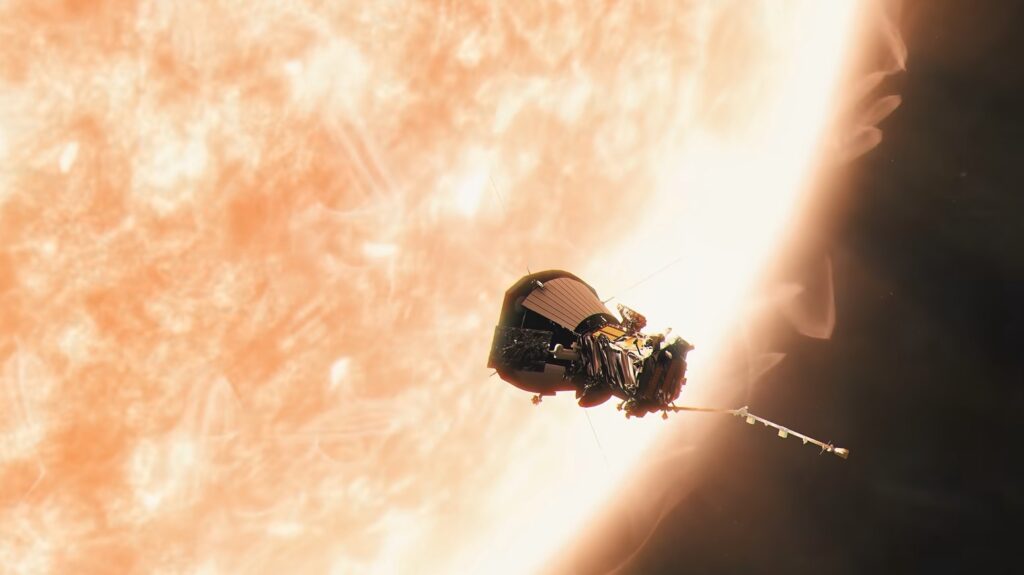
The problem isn’t distance or even heat. The Sun’s surface reaches around 5,500 degrees Celsius, while its corona can reach two million degrees. But spacecraft like the Parker Solar Probe have already survived incredible temperatures using advanced heat shields.
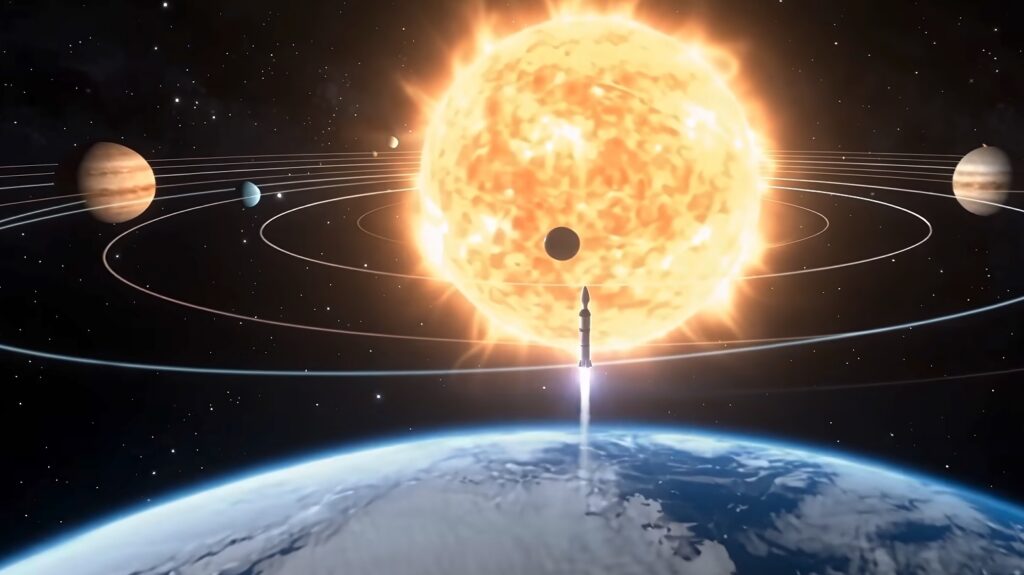
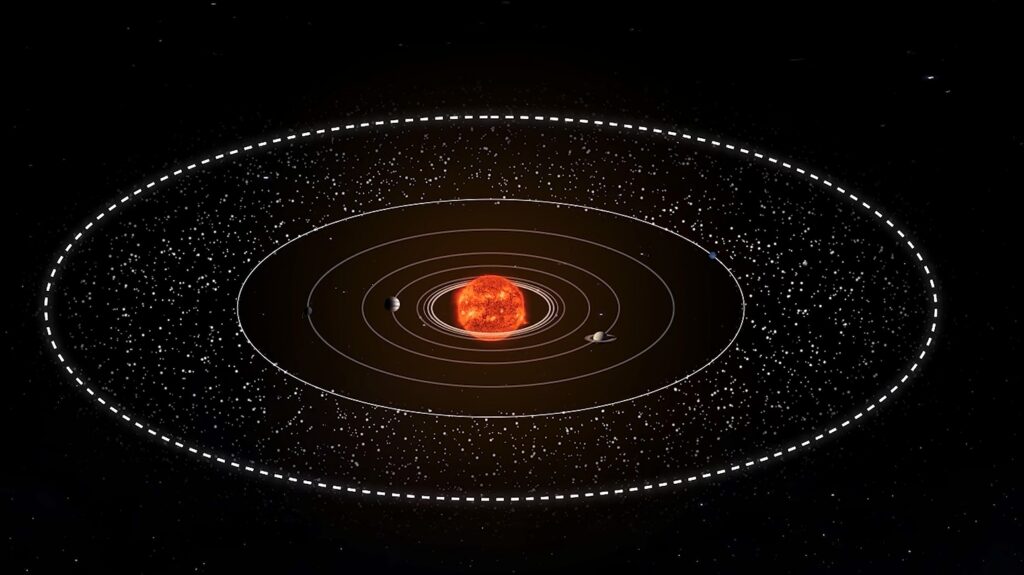
The real problem is flatness. Almost everything in our Solar System moves around the Sun on the same flat plane, known as the ecliptic plane. Every planet, asteroid, and moon follows roughly the same orbital path. Instead of imagining the Solar System as a ball, picture marbles spinning around on a giant flat table.
Trying to travel above that table is incredibly difficult because of something called delta V. It describes the change in velocity a spacecraft needs to perform a maneuver. Earth is already travelling around the Sun at approximately 110,000 kilometers per hour. When a spacecraft launches from Earth, it inherits that enormous sideways speed.
To travel directly above the Sun, a spacecraft would need to cancel much of that forward motion before changing direction. Unlike a car, which can use its tires to redirect momentum, a spacecraft has nothing to push against. Every change in direction requires rocket fuel. A 90 degree turn would demand more fuel than even the biggest rockets could carry.
But there’s a way around this problem, and it involves Jupiter.
Jupiter is the largest planet in the Solar System, 11 times wider than Earth and 318 times more massive. Its enormous gravitational pull can help spacecraft change speed and direction through a maneuver called a gravity assist.
This is exactly how the Ulysses spacecraft managed to explore the Sun’s polar regions. Launched in 1990, it used Jupiter’s gravity in 1992 to reach an incredible 80 degree inclination above the ecliptic plane. By the mid 1990s, it was measuring the Sun’s poles.
Ulysses discovered that solar wind blasts out of the polar regions at around 750 kilometers per second, much faster than the wind coming from the Sun’s equator. However, it didn’t carry a camera, so it could measure the poles but never photograph them.
That changed in March 2025. The Solar Orbiter spacecraft used multiple gravity assists from Earth and Venus to move above the ecliptic plane. After five years, it reached an angle of 17 degrees and captured the first images of the Sun’s south pole.
Even this small glimpse revealed important information about the Sun’s magnetic fields, the heliosphere, and miniature solar flares called campfires. Future observations could help scientists better understand solar weather and predict dangerous solar storms that can damage satellites, electrical grids, and communication systems.
But imagine if you could reach the full 90 degrees.
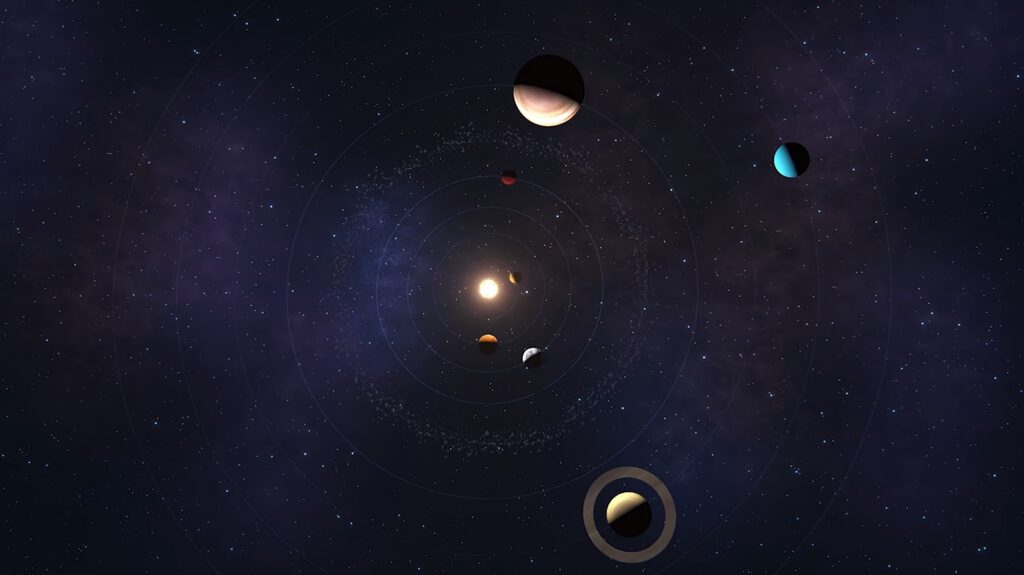
From above the Sun’s North Pole, you would finally see the entire Solar System spread out beneath you. The inner planets, the asteroid belt, and the giant outer planets would appear arranged across an enormous flat disk.
You might wonder why everything is so flat. The answer goes back 4.6 billion years, when the Solar System formed from a giant cloud of gas and dust. As gravity pulled the material together, everything began spinning. Constant collisions between particles gradually canceled out their up and down movements, leaving the material concentrated in a flat disk. Eventually, the Sun and planets formed from that rotating structure.
If you travelled even farther out, you would reach the heliosphere, a giant bubble surrounding the Solar System created by the Sun’s solar wind and magnetic field. It acts as a shield against dangerous cosmic radiation, with roughly three times as much cosmic radiation outside it as inside.
Beyond that, you would encounter the Kuiper Belt and eventually the Oort Cloud, a vast shell of icy comets that scientists have never directly observed. From such a distant position, you might finally discover its true shape.
And eventually, above and below would stop meaning very much.
The Solar System itself orbits the center of the Milky Way, tilted about 60 degrees relative to the galaxy’s plane. It also moves up and down as it travels through the galaxy. The Milky Way, in turn, moves through the Universe as part of an enormous collection of galaxies.
What started as an attempt to see the Sun from a different angle would eventually reveal just how small our entire Solar System really is.