Robert Wadlow holds the record as the tallest human ever confirmed, standing an astonishing 2.72 meters before medical complications tied to his extreme growth ended his life early. Now picture something even harder to grasp, a person reaching a full 5 meters, nearly twice Wadlow’s already record breaking height. At that scale, nearly every aspect of the human body, along with the world built around it, would need to be rethought entirely.
Scale and Perspective
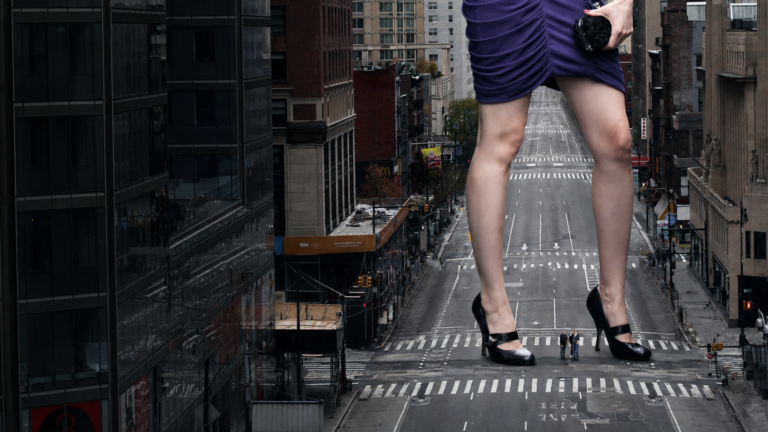
Standing 5 meters tall puts a person roughly at the height of a small building, well above most ceilings and completely outside the scale that modern infrastructure was ever designed to accommodate. Grasping that scale in practical terms is genuinely difficult.
Ordinary doors would resemble windows. Cars would look about the size of toys. Furniture built for typical human proportions would become useless entirely. Simply walking through a city would turn into a constant negotiation with space and access at every turn.

Because urban design is rooted so completely in human sized proportions, someone standing 5 meters tall would not merely stand out visually, they would be structurally incompatible with nearly every building around them. Entire cities would function like obstacle courses built for a species that no longer fit inside them.
What Could Cause This Level of Growth?
Biology as we understand it does not naturally support growth on this scale. The nearest real world comparison is gigantism, a condition typically triggered by the pituitary gland producing too much growth hormone.
Wadlow’s own life illustrates just how severe the consequences of that condition can be, even at far less than 5 meters. He dealt with ongoing joint problems, restricted mobility, and significant strain on his heart throughout his development.
Reaching a full 5 meters would demand a biological departure so extreme it goes well beyond anything documented in known medicine, testing the very structural boundaries of what a human body could physically support.
Health and Survival Challenges
At this size, the skeleton itself becomes the first major obstacle. Bone density and structural strength would fall far short of what is needed to support the added mass, leaving movement unstable and genuinely hazardous.
Even routine actions such as standing upright or taking a step would place massive strain on joints and muscle tissue, and any fall would carry far greater consequences given the added leverage and sheer weight involved.
Energy demands would climb just as dramatically. Keeping a body of this size functioning would require an enormous daily intake of food, far surpassing anything the human metabolism was ever built to process.

The nervous system would run into its own limits as well, since nerve signals would need to travel much longer distances through a body this large, likely slowing reaction time and weakening coordination in the process. That same expanded scale would reshape communication too, producing a deeper vocal resonance and altered speech patterns as a result of greater lung capacity and elongated vocal tracts, while even basic sensory perception would shift simply because input now has to be processed across a vastly larger physical frame.
Taken together, the strain on the skeleton, the extreme metabolic demand, and the slower neurological response would make anything resembling normal daily life extraordinarily difficult, quite possibly impossible, without some form of major genetic or technological intervention to compensate.
In the end, the idea of a 5 meter tall human is less about sheer size and more a demonstration of how tightly human biology is calibrated to its environment, where even a dramatic shift in scale is enough to completely redefine what surviving would actually require.