As you approached Saturn, you would be the first human to take in the glory of its rings and its swirling atmosphere in person.
Along the way, you would pass a few of Saturn’s moons. Like its outermost moon, Iapetus, the icy Enceladus and its biggest moon, Titan. You’d make a note to check that one out on your way back home..
You would fly past each ring in an order that would scramble your understanding of the alphabet. You would go from the E ring to the G ring and then rings F and A. After that, there’s a gap known as the Cassini Division. Past it, you would be onto rings B, C and D.
Finally, you’d make it through the D ring, and you would be hovering just above the planet itself. Nothing left to do but make your final descent.
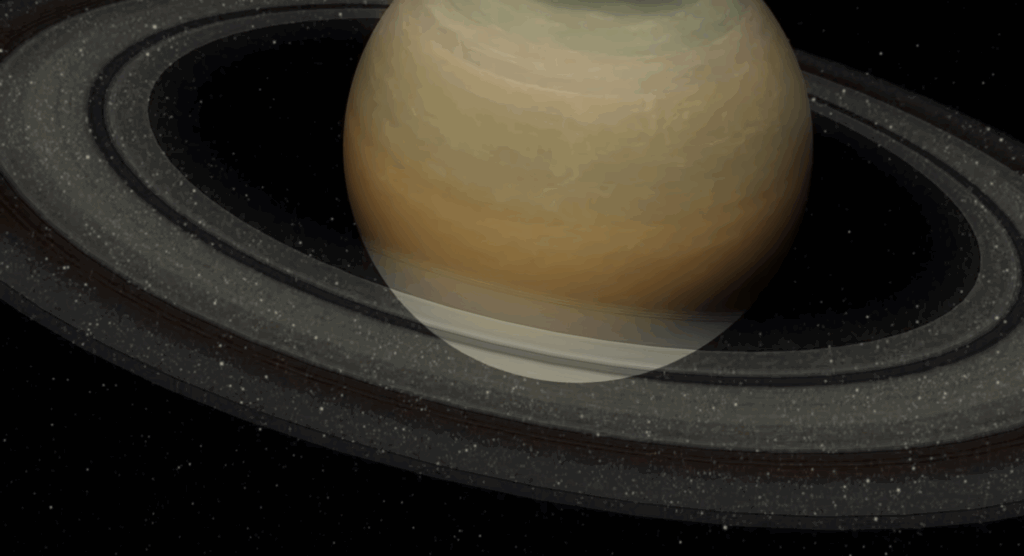
At an altitude of about 1,400 km (870 mi), you would find yourself surrounded by auras of red and purple. They’d look so different than the ones we have on Earth because of the highly energetic forms of hydrogen in Saturn’s atmosphere.
This wouldn’t be ideal either. Because as you descend, a hexagon-shaped storm would be brewing below you. And it would be huge. Spanning about 30,000 km (20,000 mi) across, you could fit about 2.5 Earths inside of it.
At least the winds here would be more favorable. But just by a little bit. At the north pole, wind speeds only reach 90 m/s (295 ft/s).
Hopefully, you dressed warm enough for Saturn’s weather because the gas giant’s troposphere has freezing cold clouds of yellow ammonia.
The temperature here is about -250 °C (-418 °F). Don’t think that sounds too bad? Well, good for you because that’s 160 °C (288 °F ) colder than the most frigid temperature recorded on Earth.
Temperatures would climb higher and higher. And at these lower levels of the atmosphere, the atmospheric pressure would be as intense as it is in the Mariana Trench, the deepest part of our oceans.

At some point, you would be wondering if you’ll ever reach Saturn’s surface. Well, you’d be disappointed to learn that you kind of already did. It just wasn’t solid. Technically, the surface of this gas giant exists where the atmospheric pressure is equal to that of sea level back on Earth. So it was way back up in the freezing cold atmosphere.
There’s not much that you could look forward to now except continuing to fall straight toward the center of the planet. Of course, the pressure and temperature would be climbing higher and higher.
Soon you would find the pressure so high that all that gaseous hydrogen and helium you’ve been surrounded by would turn into liquid.
By now, you would be near the center of Saturn. The planet’s molten rocky core could be about 10 times more massive than Earth’s. Conditions would be beyond intense. Here, it could be as hot as 11,700 °C (21,092 °F) with pressure over 1,000 times what you experience on Earth.
If you somehow did manage to escape from Saturn, you could make a quick stopover somewhere a little more manageable. Like Saturn’s moon, Titan.