The Universe is packed with worlds where sunsets don’t just fade into night, they bend the rules of physics. From double sunsets to glowing ice and strobing pulsars, each world offers a completely different finale to the day. Scientists know these phenomena are real because they’re driven by orbital mechanics, atmospheres, and extreme gravity. Let’s travel from our Solar System to the farthest reaches of space to witness the most extraordinary sunsets known to science.
Mercury
Mercury hosts one of the strangest sunsets in the Solar System thanks to its unusual orbit and slow rotation. Near its closest approach to the Sun, the star appears to stop, reverse, and set again, creating a rare double sunset. With no atmosphere to scatter light, the sky remains pitch black even during the day. This eerie spectacle happens only once every 176 Earth days.
Venus
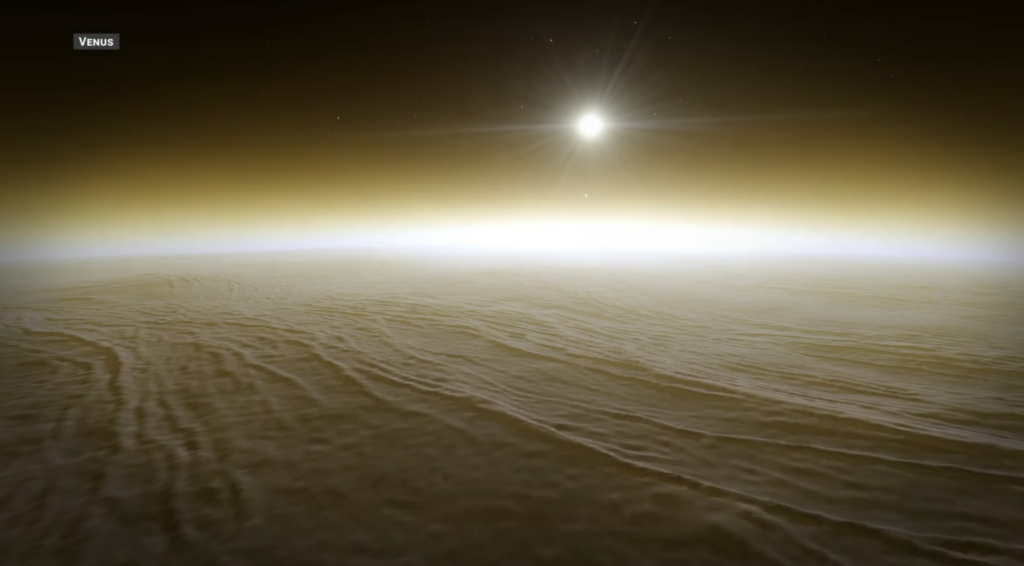
On Venus, the Sun is never visible as a sharp disk because the planet is wrapped in dense sulfuric-acid clouds. As sunset approaches, the yellowish sky gradually deepens into dark red before fading into a starless night. Because Venus rotates so slowly, the sunset can last for days. It’s a slow, suffocating fade beneath one of the thickest atmospheres in the Solar System.
Mars
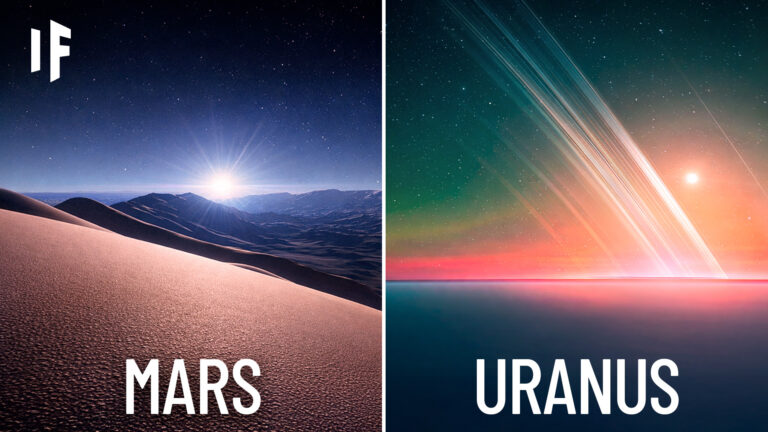
Mars delivers a surprising twist: blue sunsets. Fine dust particles in its thin atmosphere scatter red light during the day, giving the planet its rusty hue. But at sunset, those particles scatter blue light forward, creating a cool halo around the Sun. It’s the opposite of Earth’s fiery evening skies.
Jupiter
Jupiter has no solid surface, but from its cloud tops the Sun would appear tiny and intensely bright. The sky would be a deep blue, darker than Earth’s oceans. Because the planet spins so fast, sunsets happen more than twice in a single Earth day. It’s a rapid, repeating light show above swirling storms.
Io
Io’s sunset often doubles as an eclipse. Every 42 hours, Jupiter blocks the Sun for nearly two hours, plunging the volcanic moon into shadow. With only a thin atmosphere, the sky stays mostly black even during daylight. Lava plumes and glowing volcanic gases would dominate the view.
Europa
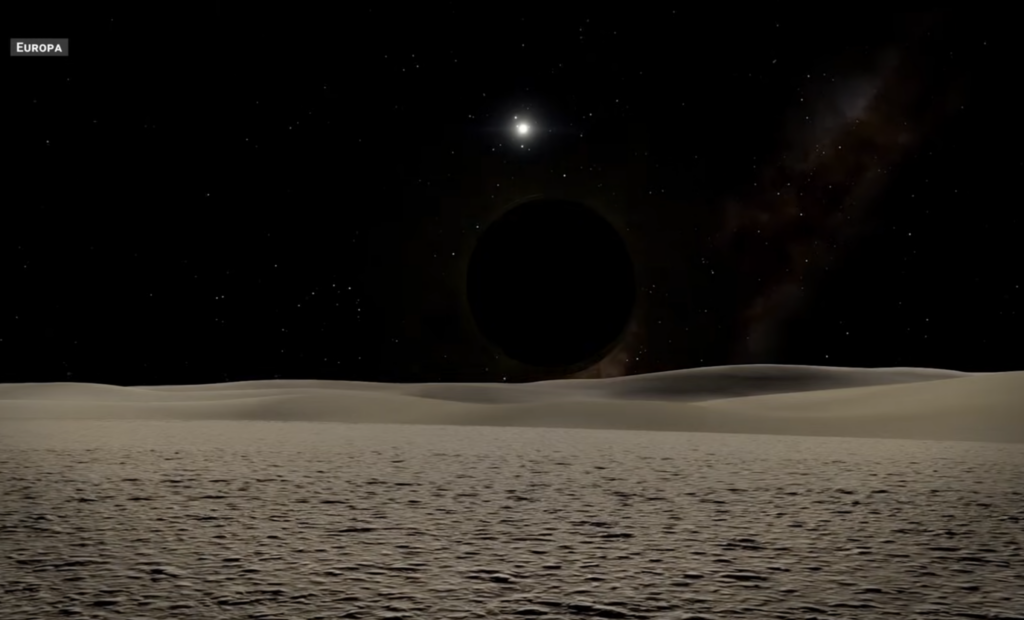
Europa’s sunsets trigger a faint glow across its icy surface. Radiation from Jupiter excites molecules in the ice, causing them to emit a soft light after dark. With its extremely thin atmosphere, the sky remains black while the ground shimmers. Twilight here literally comes from below your feet.
Ganymede
Ganymede, the largest moon in the Solar System, has its own magnetic field. As the Sun sets, charged particles create aurora-like displays near the poles. Most of this light is in ultraviolet, so it would be subtle to human eyes. Still, it’s a rare case of a moon putting on a magnetic light show.
Callisto
Callisto orbits far enough from Jupiter that eclipses are rare. Most sunsets would look calm, with Jupiter hanging large in the sky but not blocking the Sun. Only every few years would the gas giant create a dramatic shadow event. Otherwise, twilight would be quiet and distant.
Titan
Titan’s thick atmosphere turns sunsets into a hazy gradient from orange to deep brown. Lakes of liquid methane and ethane reflect the dimming light like dark mirrors. Saturn would loom large overhead, adding to the alien scenery. It’s one of the most Earth-like yet surreal sunsets in the Solar System.
Saturn
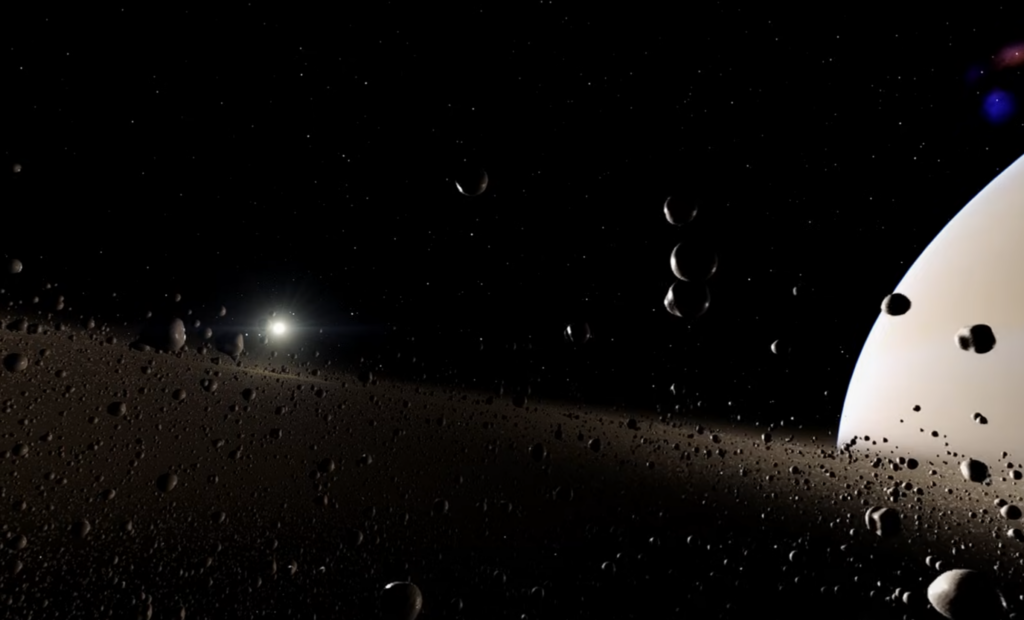
From Saturn’s cloud tops, the sunset is defined by its rings. As the Sun dips, the planet’s shadow sweeps across the rings, darkening them section by section. The effect is like watching the lights dim on a cosmic stage. The rings make the sunset feel vast and architectural.
Uranus
Uranus rotates on its side, leading to extreme seasons. Near the poles, the Sun can circle the sky for decades before finally setting. When it does, methane in the atmosphere filters out red light, turning the sky turquoise. The result is a cold, tranquil fade into darkness.
Neptune
Neptune’s sunsets are subdued due to its immense distance from the Sun. The light is faint, and the sky shifts from deep blue to black. Winds howl at supersonic speeds, but visually the transition is simple. It’s a quiet ending on a distant world.
Pluto
Pluto’s thin atmosphere creates a deep blue twilight despite its distance from the Sun. Its moon Charon hangs fixed in the sky due to tidal locking. The dim light and icy terrain make the scene feel still and frozen. Even here, sunsets carry subtle color.
Kepler-444 c
Kepler-444 c orbits very close to a small, dim star 119 light-years away. Despite the star’s size, it would appear huge in the sky because of the tight orbit. Sunsets would be brief but dramatic as the large stellar disk dips below the horizon. The light would feel intense and close.
Kepler-452 b
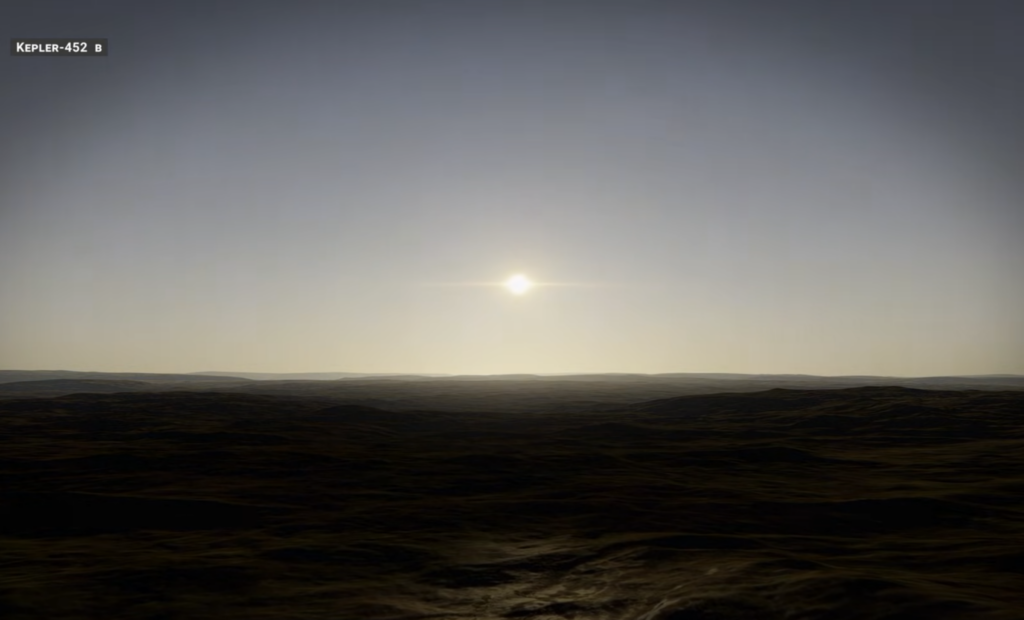
Often called an Earth-like world, Kepler-452 b orbits a star slightly older and brighter than our Sun. Sunsets there would resemble Earth’s but with a bit more brilliance. The extra stellar brightness would intensify twilight colors. It’s familiar, yet subtly amplified.
TRAPPIST-1 e
TRAPPIST-1 e likely has a dense atmosphere and potential cloud cover. With its dim red star, sunsets would glow in warm crimson tones. Auroras could appear if the planet has a magnetic field. The result would be a moody, ember-like dusk.
PSR B1257+12 c
This planet orbits a pulsar, a rapidly spinning neutron star. Instead of a steady sunset, the light would flicker like a cosmic strobe as radiation beams sweep past. The sky would alternate between brightness and darkness in rapid pulses. It’s less a sunset and more a flashing shutdown.
WD 1145+017 b
This world is being torn apart by the white dwarf it orbits. Each “sunset” happens amid streams of vaporized rock trailing through space. The star’s blue-white light would illuminate drifting debris. It’s a sunset in the middle of planetary destruction.