Everything you’ve ever stood on, every rock, every continent, every grain of sand, may have been manufactured in a single cosmic trap hiding behind the biggest planet in our neighbourhood.
How does one planet control what gets built billions of miles away? What exactly was being manufactured out there, and for how long? And what does any of this have to do with the ground beneath your feet right now?
We’re talking about Jupiter creating the raw ingredients of planets – chunks of rock and ice that clumped together over millions of years until they became worlds. Without them, there’s no Earth. No Moon. No you.
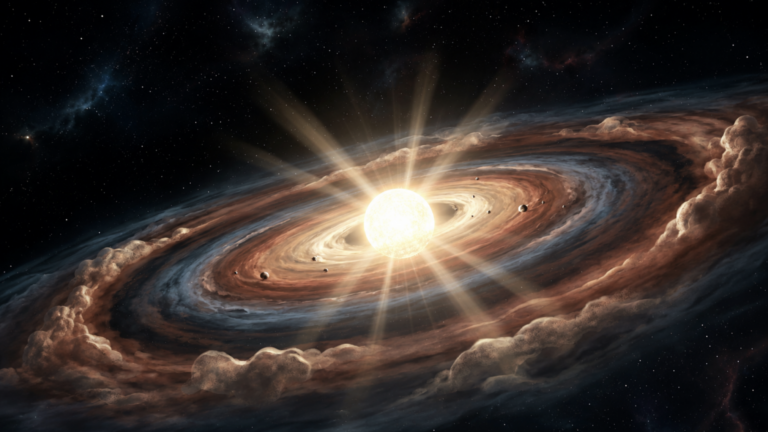
Here’s how Jupiter pulled it off. We know our solar system was born from a giant spinning cloud of gas and dust because we can see the exact same process happening around other young stars right now. Most of that cloud collapsed inward to form the Sun, but the leftovers kept spinning in a flat disk around it.
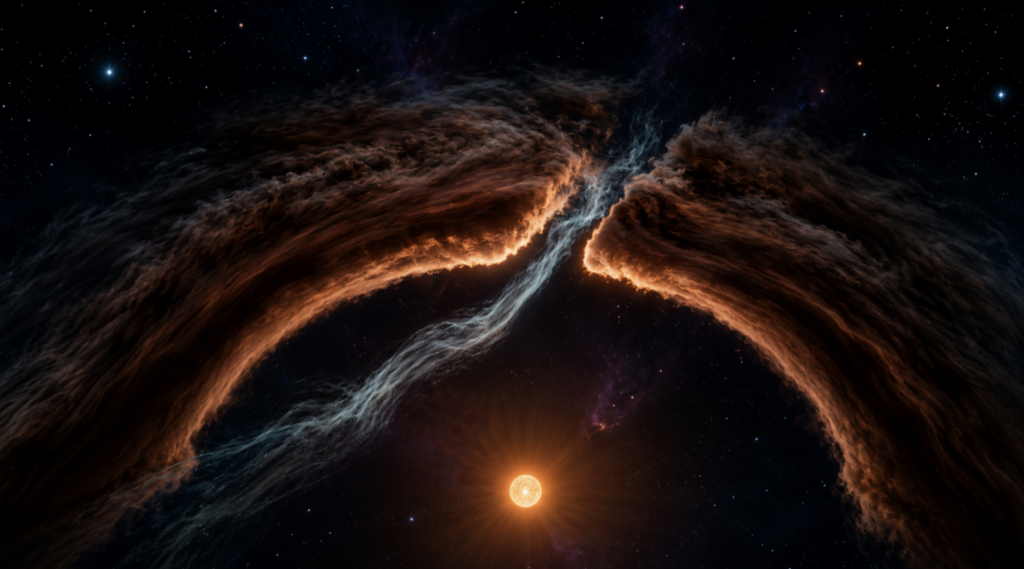
Jupiter formed as part of that disk, orbiting the Sun along with everything else, and the more gas and rock it pulled in, the bigger it got, and the bigger it got, the stronger its gravity became, until it was powerful enough to clear a lane around its own orbit, like a snowplow clearing a path and pushing snow into a ridge on either side.
That compressed ridge of gas acted like a barrier, because dust particles drifting through the disk naturally get pushed toward zones of higher pressure, the same way air rushes into a vacuum.
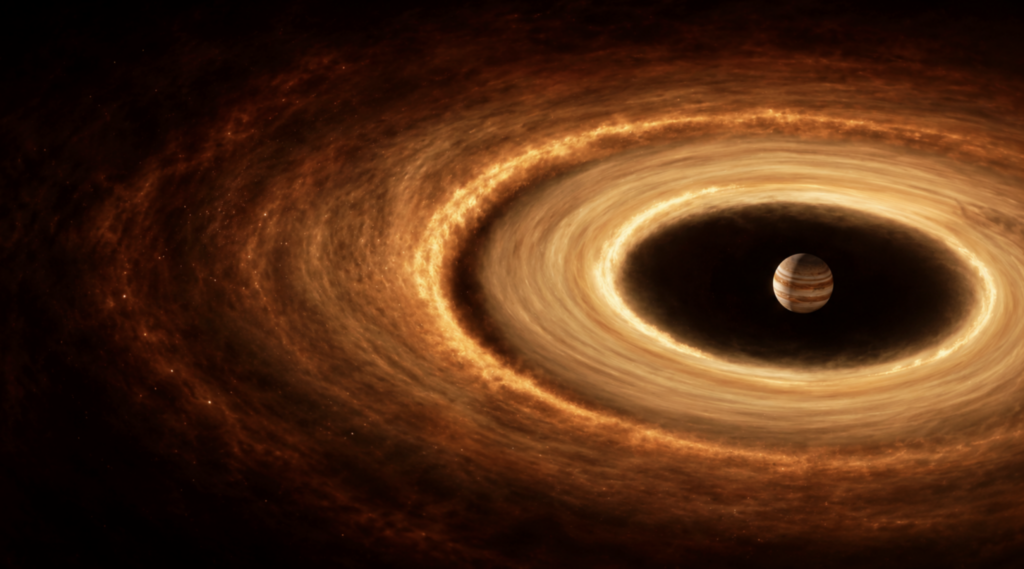
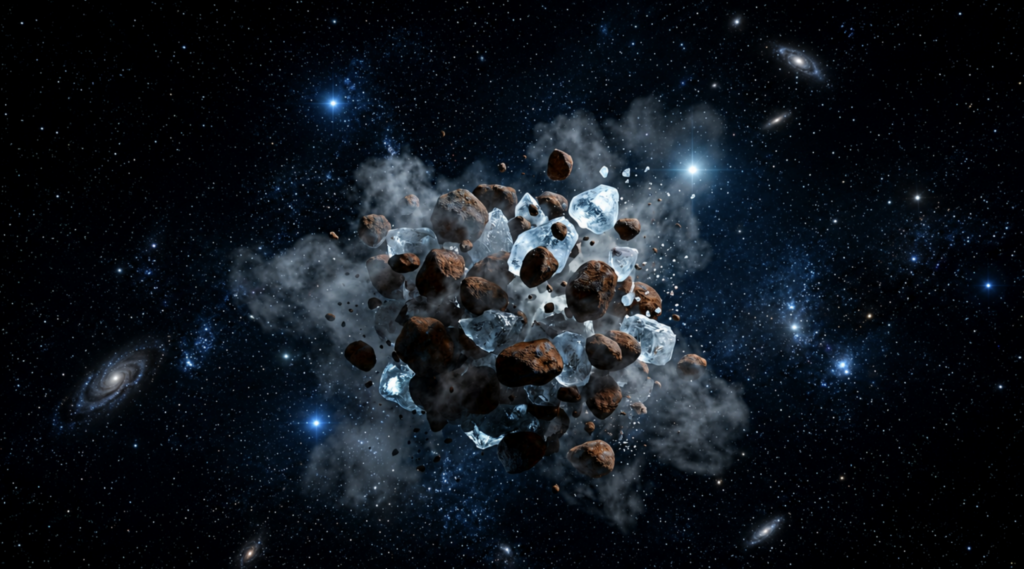
Every time a dust particle tried to drift past, the pressure wall pushed it back. Dust piled up against it, more kept arriving, and with nowhere to go, it started clumping. First into pebbles, then boulders, then chunks of rock and ice big enough that their own gravity reached out and grabbed everything nearby, pulling in more and more material until they had grown into the seeds of entire worlds.
The very smallest, lightest dust grains were fine enough to slip through the gap and continue drifting toward the Sun, but anything larger got pushed back and stayed trapped on the outer side. Not just in the beginning, but continuously, over roughly two million years, as the trap kept pulling in fresh dust and producing new generations of building blocks after the previous ones had drifted away to seed other parts of our solar system.
Two completely different types of building blocks formed in the same region. Rocky, crumbly fragments close in, and dense ice-and-rock chunks further out, each one destined for a different corner of our solar system. The atoms in your body may have passed through that ancient trap on their long journey to Earth.
And, here’s why we’re talking about this right now. Researchers from the Max Planck Institute just published a study in The Astrophysical Journal confirming that this dust trap beyond Jupiter’s orbit was real, and their simulation shows it operating like a conveyor belt, cycling through generations of planetary building blocks across two million years.
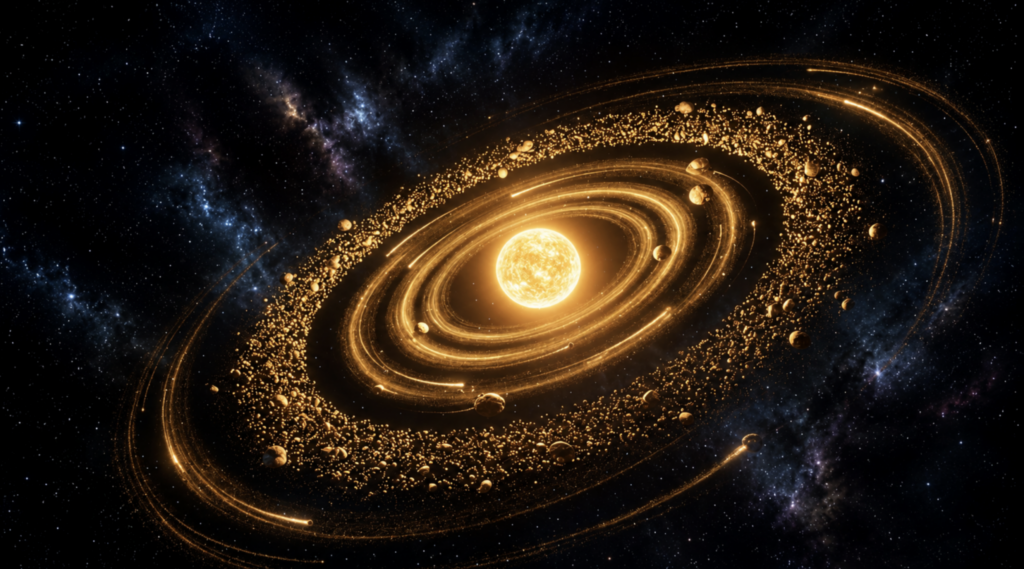
And here’s the part worth sitting with. We’ve always pictured our solar system forming in a single chaotic burst, everything happening at once, randomly. But what this actually describes is something far more structured, evolving in stages over millions of years. Our solar system wasn’t the result of an explosion.
It was built by an assembly line, and Jupiter was the foreman who never even knew it was in charge.
But let’s imagine those building blocks had been flung outward instead of inward, and the ingredients for Earth never arrived. Well, that’s a story for another What If.