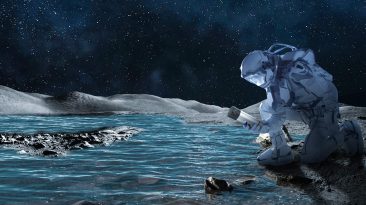
Far beyond Earth, orbiting the giant planet Jupiter, lies one of the most fascinating places in the Solar System. At first glance, Europa appears to be nothing more than a frozen, lifeless moon covered by a thick shell of ice. But beneath that icy surface, scientists believe an enormous ocean may be hiding one of the greatest discoveries in history.
Could we be closer than ever to exploring it?
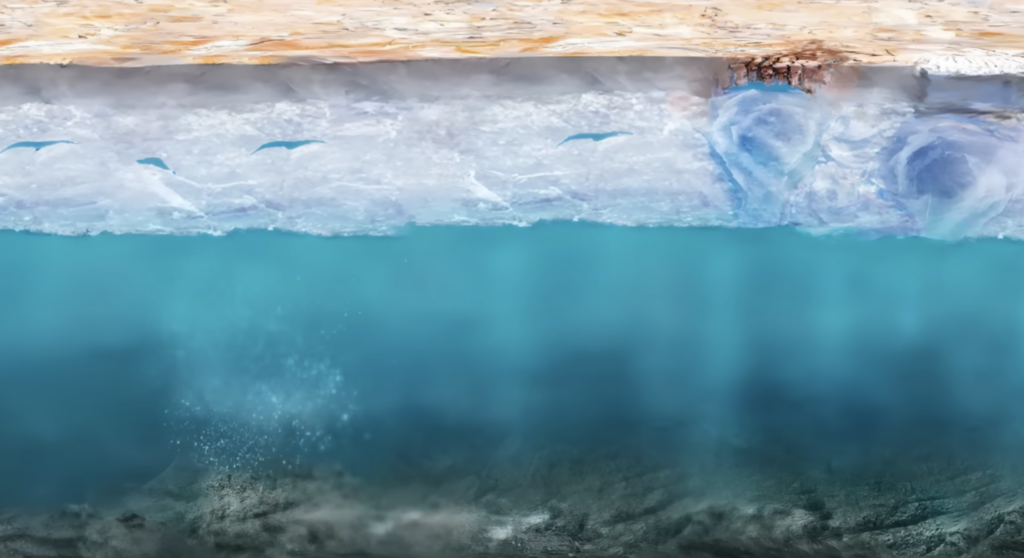
Europa’s frozen crust is estimated to be several kilometers thick, protecting a global ocean that may contain more liquid water than all of Earth’s oceans combined. Unlike frozen lakes on Earth, this hidden ocean has remained isolated for billions of years, making it one of the most promising places to search for extraterrestrial life.
The biggest question is simple. If there is so much water beneath the ice, could anything actually live there?
Scientists think the answer might be yes.
Life needs three basic ingredients: liquid water, a source of energy, and the right chemical building blocks. Europa may have all three. Evidence suggests that deep beneath the ocean, the moon could have a rocky seafloor where hydrothermal vents release heat and minerals into the water. Similar environments exist on Earth, where entire ecosystems thrive without any sunlight.
Instead of relying on photosynthesis, these organisms survive using chemical reactions powered by the hot water flowing from the seafloor.
If life developed on Europa, it could have evolved in a similar way.
Of course, no one expects to find cities or advanced civilizations beneath the ice. If anything exists, it is more likely to be microscopic organisms, simple aquatic life, or completely unfamiliar creatures unlike anything found on Earth. Because Europa has spent billions of years evolving in total darkness, any life there would have adapted to conditions humans have never experienced.

Reaching this hidden ocean would be one of the greatest engineering challenges ever attempted.
A spacecraft could not simply land and start drilling. The ice above the ocean is incredibly thick, and temperatures on the surface are cold enough to freeze almost anything instantly. Future missions may need to carry robotic melting probes capable of slowly working their way through the ice before releasing small underwater vehicles into the ocean below.
Those robotic explorers would become the first machines ever to swim in an alien ocean.
What they discover could completely change our understanding of life in the Universe.
Even if they find nothing living, Europa would still teach us how oceans evolve on icy worlds. But if scientists discovered even a single microscopic organism, it would prove that life can emerge in more than one place. That would dramatically increase the chances that life exists elsewhere throughout the galaxy.

Exploring Europa also comes with enormous responsibility.
Any mission must avoid contaminating the moon with Earth’s microbes. Likewise, if samples were ever returned to Earth, they would require strict quarantine procedures to ensure that no unknown organisms entered our environment. Protecting both worlds would be just as important as making the discovery itself.
For now, Europa remains one of the Solar System’s greatest mysteries. Hidden beneath its frozen shell could be an ocean unlike any we’ve ever explored, preserving secrets that have remained untouched for billions of years.
Whether that ocean contains strange life forms or nothing more than dark, silent water, one thing is certain. The first journey beneath Europa’s ice could become one of humanity’s most important adventures, revealing that the next great frontier is not on the surface of another world, but deep beneath it.