Ask a human when we will walk on Mars and you get a dream. Ask the data and you get a date.
Feed everything we know into the analysis, current space agency roadmaps, technological trends, funding patterns, and projected development timelines, and a surprisingly specific answer emerges. Not a prophecy, but a structured prediction of when the first boot presses into the red dust of another planet.
The machines have run the scenario. Here is the countdown they see, phase by phase, and it has already started.
Phase 1: The Return to Deep Space (2026 to 2030)
The prediction begins with a twist. The road to Mars does not start at Mars. It starts at the Moon.
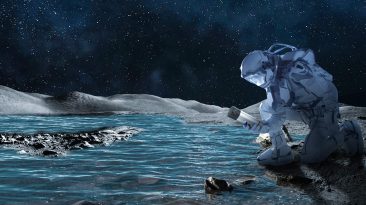
In these opening years, space agencies and private companies flood the lunar surface with missions. The Moon becomes a rehearsal stage for everything Mars will demand: survival systems, long duration habitats, and living off the land. Water ice hidden in lunar craters gets converted into breathable oxygen and rocket fuel, proving for the first time that humans can sustain themselves beyond Earth.
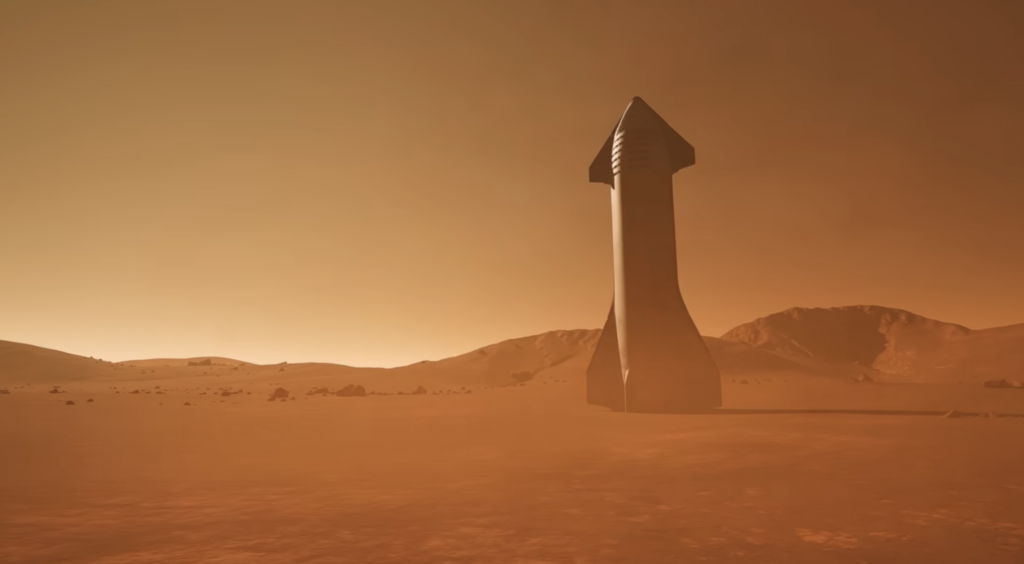
Meanwhile, the hardware race accelerates. Heavy lift rockets, reusable boosters, and nuclear propulsion research stretch mission capabilities far beyond anything in history. Somewhere in this phase, Mars quietly changes category, from distant fantasy to engineering target.
Robots lead the invasion. Orbiters map out landing zones. Rovers hunt for buried ice. Weather stations on the Martian surface stream back detailed climate data, building the survival manual for the humans to come.
By 2030, the question is no longer if. Only how soon.
Phase 2: The First Human Missions Prepare (2030 to 2033)
Now Mars moves from theory into blueprints.
Agencies lock in their crewed mission architectures, and the approach is clever: instead of one enormous rocket, multiple spacecraft are assembled in orbit and travel together. Modular, larger, and far safer.
The astronauts face a different kind of preparation. They disappear into isolation habitats on Earth built to imitate Martian life, complete with artificially delayed communications that mimic the real interplanetary lag, up to 22 minutes for a message to travel one way.
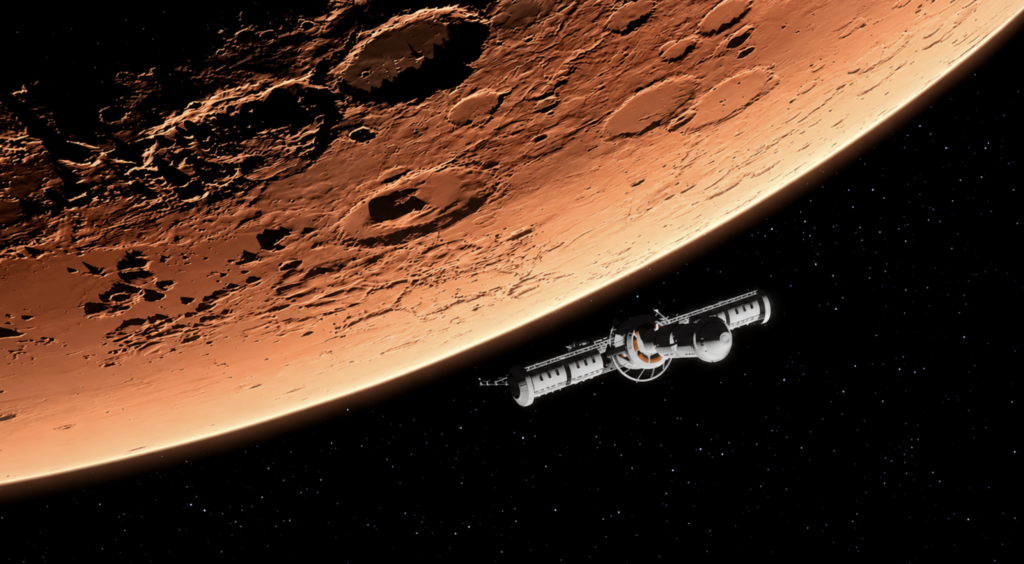
Private industry moves in parallel, launching automated cargo ships years ahead of any crew. These robotic missions deliver habitats, power systems, and oxygen production units straight to the Martian surface, so that everything is waiting before a single human leaves Earth.
Propulsion takes its own leap. Nuclear thermal engines promise to shrink the journey from half a year to perhaps 3 or 4 months.
Every piece is now on the board.
Phase 3: The First Launch Window (2033 to 2035)
Mars runs on a cosmic timetable. Every 26 months, Earth and Mars align in a configuration that slashes fuel requirements. In this timeline, one of those windows becomes the most famous date in human history.
The first crewed mission launches.
A small fleet leaves Earth carrying astronauts, supplies, and landing modules. What follows is a voyage unlike anything our species has attempted: months sealed inside an artificial world, every breath and every meal depending on machines, with home shrinking to a pale dot behind them.
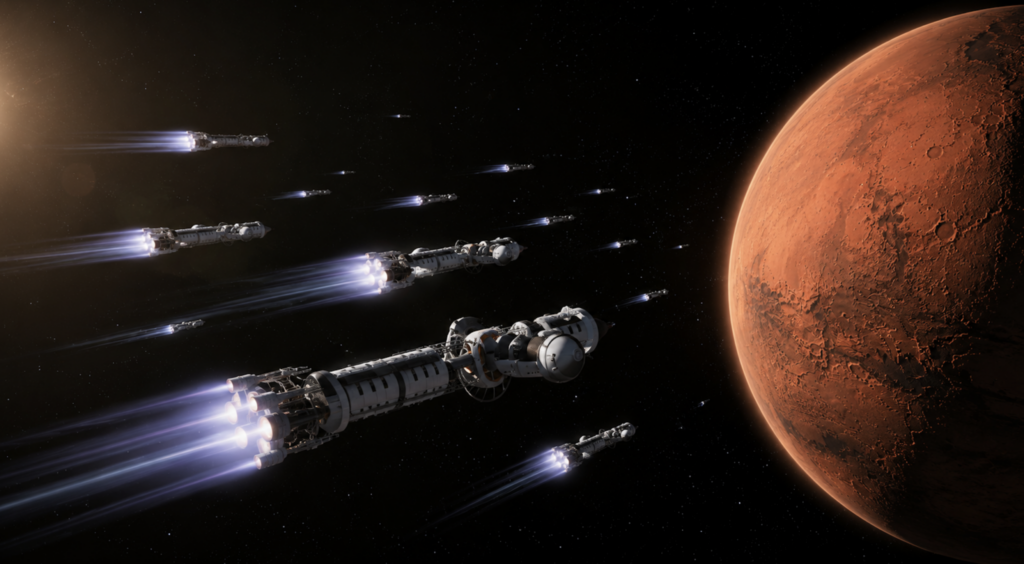
Real conversation with Earth becomes physically impossible. Every message crawls across space for minutes before arriving. For the first time ever, human beings are truly alone between planets.
Then Mars swells from a red spark into a world filling the window, and the deadliest moment of the entire mission arrives.
Descent.
The Martian atmosphere is too thin to slow a spacecraft properly, so everything depends on heat shields, retro rockets, and flawless precision. One error means no rescue, no second attempt, nothing.
In this scenario, the systems hold.
Humans are standing on Mars.
Phase 4: The First Martian Settlement (2035 to 2040)
The first mission has one priority above science, above exploration, above everything: stay alive.
The founding habitat is compact, pressurized, and utterly dependent on its machines. Solar panels unroll across the rust colored plain. Chemical processors pull oxygen directly out of the Martian air. Drills tap underground ice for water.
Outside, the astronauts move through gravity only 38 percent as strong as Earth’s. Every step is a small bounce. Around them stretches a landscape that is silent, frozen, and endless.
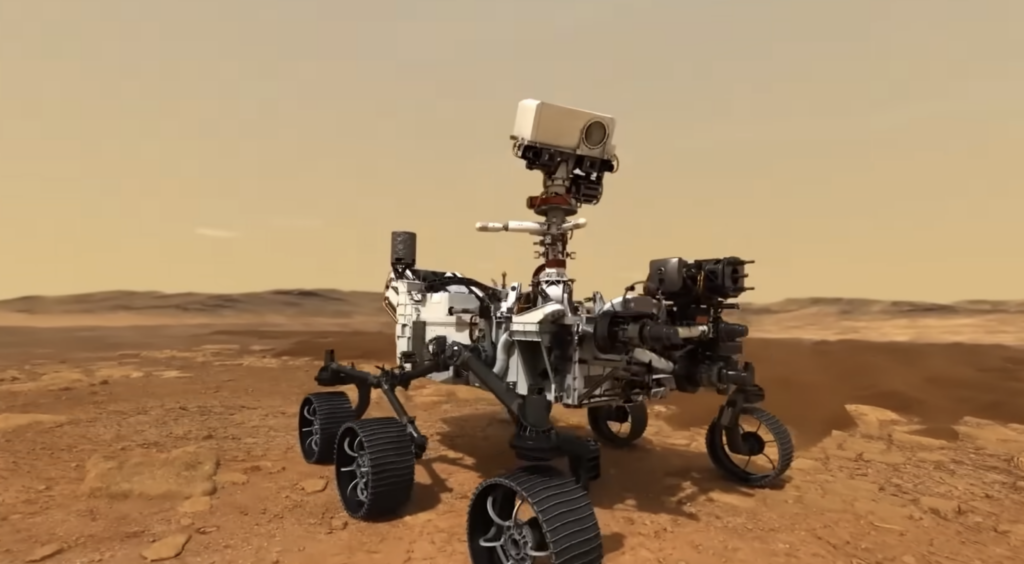
The science begins on day one. Samples are gathered, soil is analyzed, and drills probe beneath the surface hunting for the biggest prize of all: traces of ancient microbial life. Any positive result would rewrite the story of life in the universe.
And the outpost refuses to stay small. New modules keep arriving, and by the late 2030s Mars has stopped being a destination. It has become an address.
Phase 5: A Permanent Human Presence (2040 and Beyond)
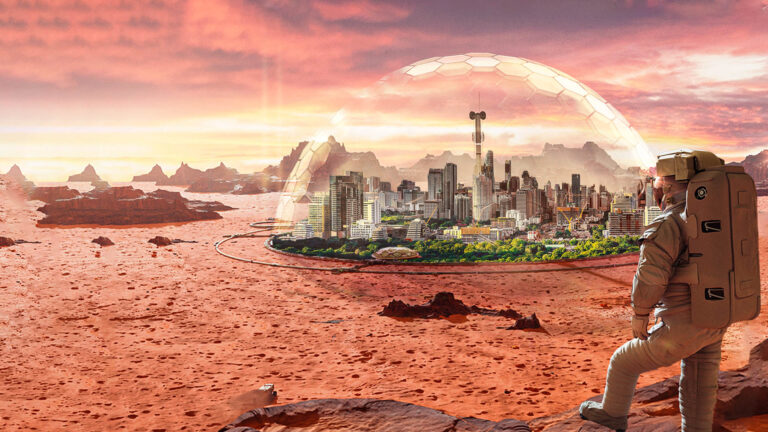
With missions turning routine, Mars evolves into a semi permanent colony.
Larger habitats move underground, shielded from radiation and dust storms. Greenhouses start producing local food using Martian soil in controlled environments. Fuel plants convert the carbon dioxide atmosphere into rocket propellant, and suddenly the trip home is no longer a one way problem.
Traffic between the two planets becomes scheduled. Cargo ships fly regular routes. Science teams rotate like crews on a remote research station. Relay satellites spread across the Solar System, tightening the communication link.
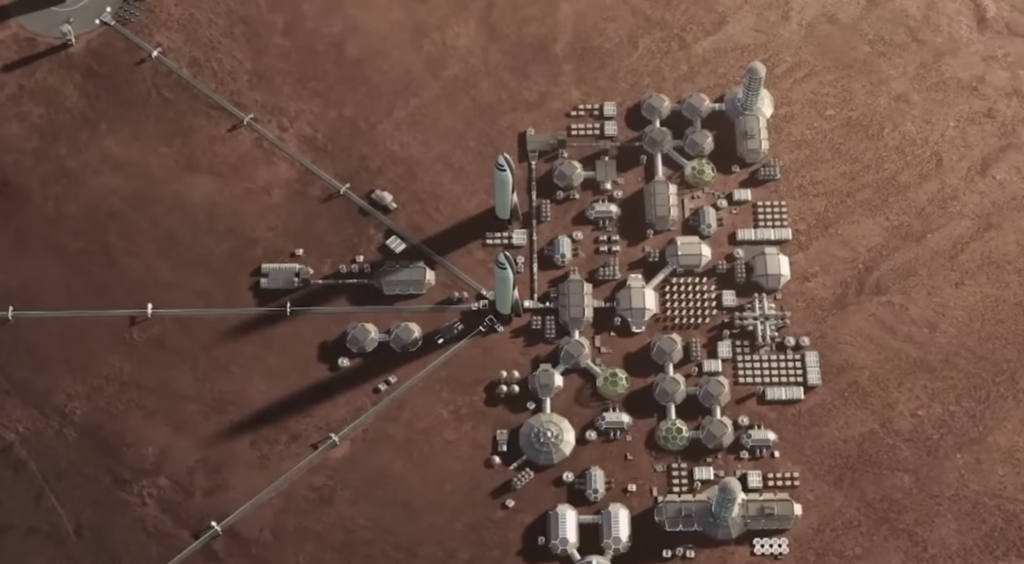
At this point, something fundamental has changed. Humanity is no longer a single planet species.
And Mars reveals its true role: not a finish line, but a launchpad, pointing toward the asteroid belt and the moons of Jupiter and Saturn.
So When Does It Happen
Here is the verdict the data delivers: the first human footprint on Mars most likely lands sometime in the 2030s or early 2040s, with the exact year hinging on technology and stable funding.
But hidden inside that prediction is something bigger than a date. It marks the moment our species stops belonging to one world and starts becoming a multi planet civilization.
The machines can calculate the when. What they cannot capture is the weight of that first step, because when a human boot finally presses into Martian dust, it will not just mark a landing.
It will mark the moment human history split in two: everything before Mars, and everything after.