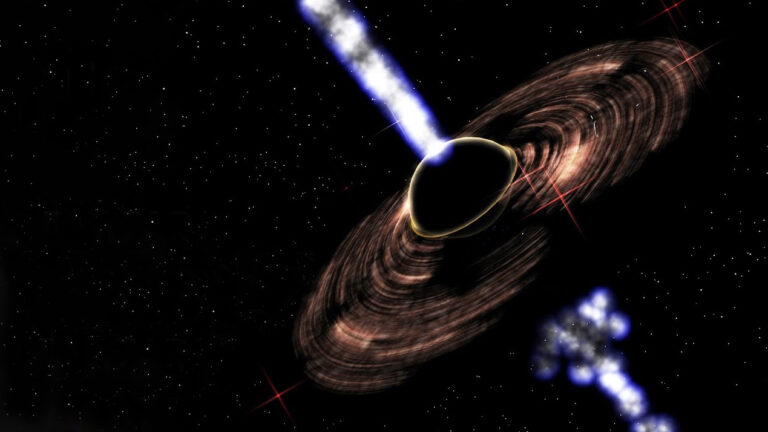
Here is the part that unsettles astronomers. Every blazar we can see is already pointing its jet directly at Earth.
Not most of them. All of them. Any blazar aiming its lethal radiation beams somewhere else is simply invisible to us, which means the ones we have catalogued are the ones lined up with our planet.
The distances are the only reason we are still here.
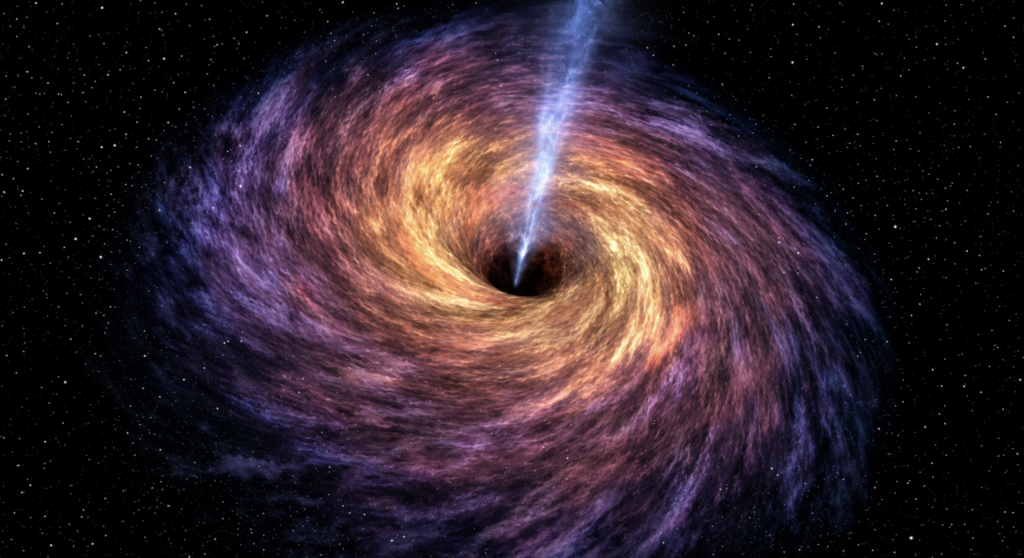
Black holes sit at the center of most galaxies. Ours holds one about four million times the mass of the Sun, which sounds enormous until you look further out.
Take PSO J0309+27, the oldest galaxy ever discovered at around 13 billion years old. Given that the Universe itself is 13.8 billion years old, this thing has been around almost since the beginning.
The supermassive black hole at its center could swallow 250 black holes the size of ours. That is what qualifies it as a blazar, the most extreme type of active galactic nuclei.
So what exactly is an active galactic nucleus?

They come in several types, with blazars being one. Broadly, they are galaxies whose supermassive black holes pour out staggering amounts of energy, from radio waves all the way up to gamma rays, which makes them the brightest objects in the Universe.
Blazars are rare even among those. There are somewhere between 200 billion and 2 trillion galaxies out there, and only one in every 10,000 is a blazar.
What sets them apart are the jets firing from the top and bottom of their rotating disks, supercharged with magnetic fields and radiation, with material inside travelling just under the speed of light.
And those jets are aimed at us.
So which one would be most likely to reach our Solar System? The closest is Markarian 421, sitting 400 million light years away.

We would know it was coming almost immediately, because its light would shift from red to blue.
That shift comes down to the Doppler effect, which is easiest to explain with an ambulance. As it races toward you the siren rises in pitch, and as it speeds away the pitch drops.
Sound and light both behave as waves, so the same principle applies. A galaxy moving away from us has its wavelengths stretched toward red, while a galaxy moving toward us has them compressed toward blue.
Most galaxies are redshifted, because the Universe is expanding and everything is drifting apart.

So the moment Markarian 421 turned blue, astronomers would understand exactly what was happening.
How much time would that buy us? Even travelling at light speed, the blazar itself would need 400 million years to arrive.
Except it never has to arrive. Its jet could stretch hundreds of thousands of light years, and our entire galaxy is only 100,000 light years across. Markarian 421 would be flooding our Solar System with radiation long before it entered the Milky Way at all.
Blazars also flare without warning, releasing giant bursts that last anywhere from minutes to months.
If Markarian 421 flared while within range of our galaxy, its jet would punch straight through the Solar System, and nothing we could build would matter.
That is the doomsday version. The reassuring version is the distance, which is why this particular way of dying sits very low on the list of things worth worrying about.