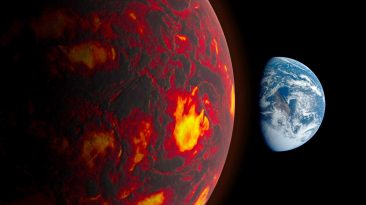
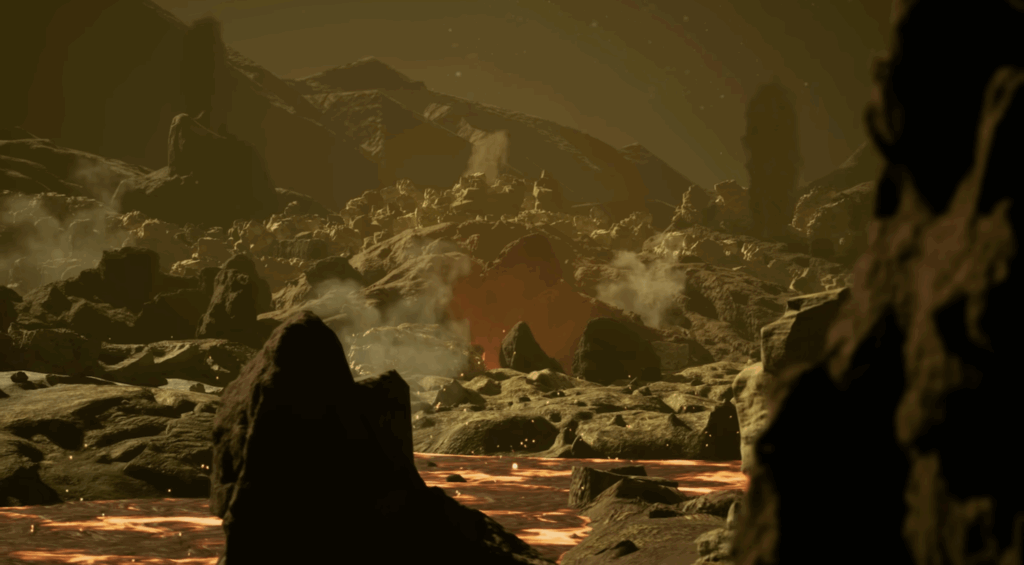
Imagine stepping onto a moon where almost every direction hides a deadly hazard. That is Io, the fiery satellite orbiting Jupiter. It looks like a glowing world forged inside a giant furnace, covered with rivers of molten rock, towering volcanic plumes, and colorful plains stained by sulfur.
Beneath its beautiful appearance lies one of the most violent places ever discovered. Every moment, the surface is changing as powerful eruptions reshape the landscape, making Io one of the last places any astronaut would ever want to visit.
Reaching this dangerous moon would already test the limits of modern engineering. Jupiter circles the Sun hundreds of millions of kilometers away from Earth, meaning even our fastest robotic explorers require well over a year to arrive. A crewed spacecraft would need to carry food, oxygen, fuel, radiation shielding, and countless life support systems, making the voyage much longer. Current technology would likely require several years before astronauts could even enter Jupiter’s neighborhood.
Long before landing, another problem appears. Jupiter possesses the strongest planetary magnetic field in the Solar System. Io travels directly through this enormous magnetic environment, where streams of charged particles constantly bombard its surface. The interaction strips material away from the moon and fills the surrounding space with electrically charged plasma. Radiation levels become so intense that unprotected electronics could fail, while a human exposed directly would receive a fatal dose almost immediately.

If an astronaut somehow managed to touch down, the surface itself would become the next nightmare. Io contains more active volcanoes than any other known world. Massive eruptions launch glowing lava dozens of kilometers above the ground, while enormous lava fields spread across the landscape. Constant gravitational squeezing from Jupiter and neighboring moons keeps Io’s interior molten, endlessly fueling fresh volcanic activity and reshaping the crust almost nonstop.
The temperatures are equally unforgiving. Much of the surface remains colder than Antarctica, dropping to around -130 °C (-202 °F). Yet only a short distance away, fresh lava can exceed 1,600 °C (2,900 °F), hot enough to melt many metals. Adding to the danger, Io’s incredibly thin atmosphere consists mostly of sulfur dioxide gas, offering no breathable oxygen and little protection from the harsh environment.
Five seconds on Io could already become a life-or-death struggle. Extreme radiation would begin damaging cells instantly, while the lack of breathable air and brutal temperatures would overwhelm even advanced protective equipment. Any failure in a spacesuit would rapidly become fatal. Remaining conscious for long would be unlikely, and surviving beyond the first minute without extraordinary technology would be virtually impossible.
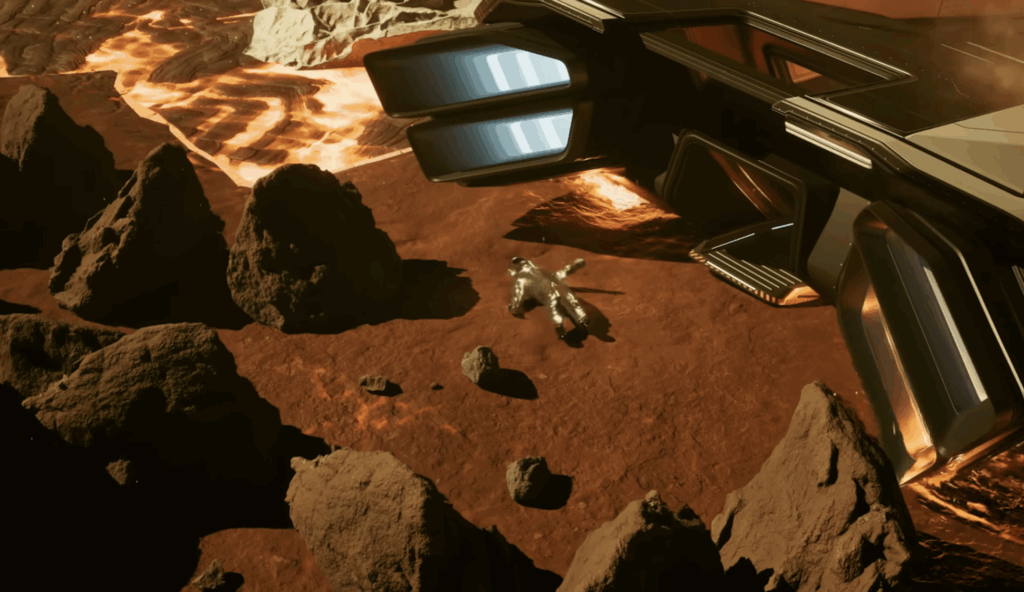
Although Io continues to fascinate scientists with its incredible volcanic activity and constantly changing surface, it remains one of the most hostile destinations humans could ever imagine. Robotic probes can study this remarkable moon from a safe distance, but sending people there would require breakthroughs far beyond today’s capabilities. Until then, Io stands as a breathtaking reminder that some of the most spectacular places in our Solar System are also the most dangerous.