THE BEGINNING – 4.5 BILLION YEARS AGO
On Mars, this stage is called the Pre Noachian era. Mars had just formed from dust and gas inside the early solar disk, the same way Earth was born. Small pieces of material slowly stuck together until a full planet formed, with a heavy core, a rocky mantle, and a solid crust. Early Mars was constantly being struck by massive space rocks.
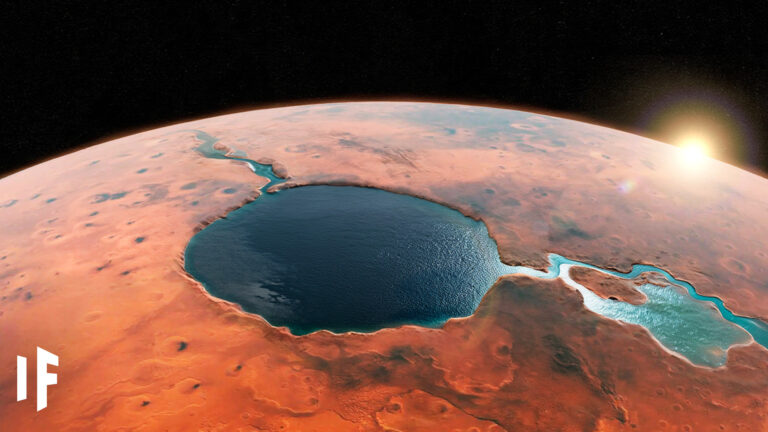
In its earliest phase, Mars had a thick atmosphere and a huge global ocean that may have covered nearly one third of the surface. At first, the planet was extremely hot. But over time, between 4.3 and 4.4 billion years ago, it began to cool.
During this stage, asteroid impacts and volcanic eruptions were extremely common. Every process that could release gas, vapor, and dust into the sky was active at once. Conditions were unstable, but also potentially suitable for the first steps toward life.
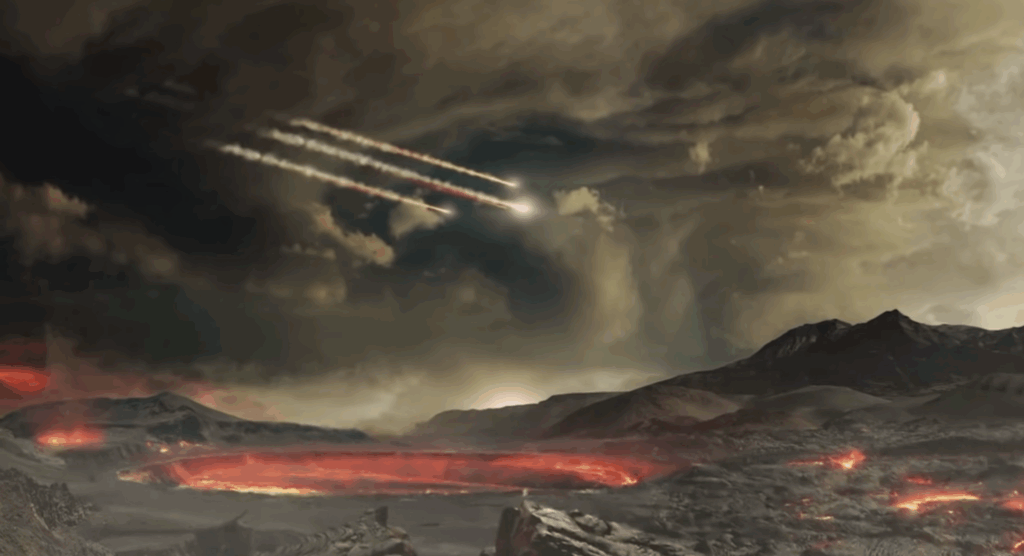
All these gases helped build a thick atmosphere. The greenhouse effect trapped heat and raised surface temperatures. Mars may have had clouds, rainfall, river valleys, and lakes. Some of the rain may have been acidic due to volcanic gases.
Between 4.1 and 3.7 billion years ago, the planet started to change in a major way. The interior cooled, and Mars slowly lost its global magnetic field.
LIFE BEGINS (MAYBE) – 3.7 BILLION YEARS AGO
After losing its magnetic shield, Mars became far less protected from space radiation. Around 3.7 billion years ago, the planet entered the early Hesperian period.
Even so, Mars may still have held large bodies of water, including a northern ocean that was gradually shrinking. This was one of the most promising eras for possible microbial life.
Between 3.2 and 3.8 billion years ago, scientists found clues that something unusual may have happened. Potential chemical signatures were detected in Martian rocks that could hint at past biological activity. This interest grew after NASA Perseverance explored Jezero Crater, an ancient lake region that once fed into a river delta. The rover also studied the dried river channel of Neretva Vallis.
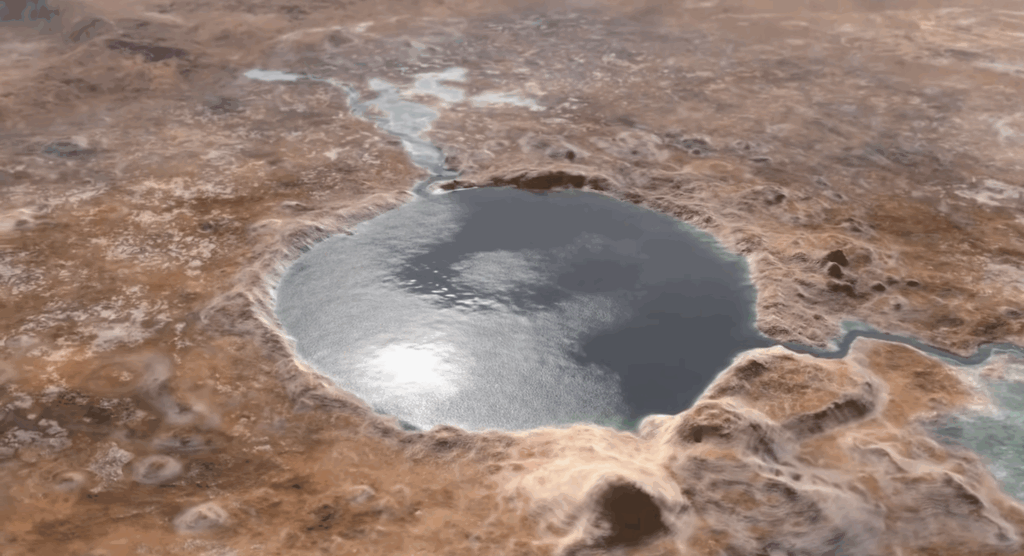
In this region, Perseverance examined fine grained sedimentary rocks such as clay and silt, which are excellent at preserving traces of ancient microbial activity. Some mudstone samples showed unusual patterns that attracted attention.
Scientists identified possible traces of iron rich minerals such as vivianite and greigite. These minerals can sometimes form through biological processes on Earth, which makes them especially interesting.
The small colorful markings seen as leopard like spots in the rocks could be preserved evidence of ancient microbial ecosystems on Mars billions of years ago.
TURNING INTO A DESERT – 2.9 BILLION YEARS AGO
By the late Hesperian period, Mars was entering a long decline. While Earth was becoming more complex and active with life, Mars was losing the conditions that support habitability.
Around 2.9 billion years ago, the Martian magnetic field was gone completely. Without it, solar wind slowly stripped away much of the atmosphere. As the air became thinner, it could no longer hold heat effectively. The planet cooled quickly and dried out.
If microbial life ever existed, it may have moved underground, surviving in protected spaces such as deep aquifers, caves, or near geothermal heat sources. These environments would have offered warmth, water, and protection from radiation.
THE RED PLANET – 1 BILLION YEARS AGO
This stage of Martian history is called the Amazonian period. It began about 2.9 billion years ago and continues today. Mars has remained mostly unchanged for a very long time, staying cold, dry, and covered in rust colored dust.
Even one billion years ago, the surface would have looked very similar to how it appears now. The atmosphere is extremely thin and made mostly of carbon dioxide. Surface pressure is only about one percent of Earth’s. Liquid water cannot remain stable on the surface for long, and quickly turns into vapor. Temperatures are extremely low, averaging around minus 60 degrees Celsius.
Occasionally, volcanic activity from Olympus Mons may have slightly warmed nearby regions.
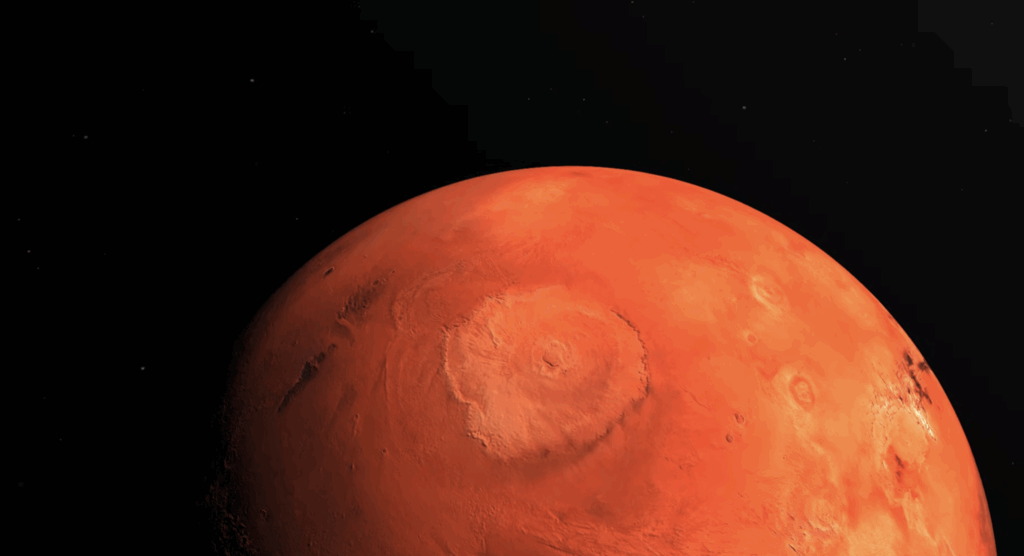
Olympus Mons is the largest volcano in the solar system, rising about 22 kilometers high. It is roughly three times taller than Mount Everest and covers an area similar to a large region on Earth.
Today it is inactive, but it remains one of the most impressive geological features ever discovered. A massive shield volcano frozen in time on a world that no longer erupts.
From this point onward, Mars changed very little. Without oceans or a thick atmosphere, erosion became the main force shaping the surface. Wind continues to move dust, carve dunes, and smooth plains. There may still be traces of ice or water underground, but no stable oceans exist on the surface.