Every winter, brave souls around the world cut holes in frozen lakes and jump in for a few seconds of icy glory. They call it extreme.
The universe finds that adorable.
Because far out in the Solar System, orbiting Saturn like a frozen jewel, there is a moon offering the true ultimate version of that challenge. Titan, wrapped in a thick orange atmosphere, is covered in lakes that look eerily like home at first glance.
Then you learn what fills them. Not water. Liquid methane.
Your mission today: dive into one of those lakes for exactly five seconds. It sounds almost easy, until you remember where you are going and what that swim actually means.

The first problem is the commute. Titan never comes closer to Earth than about 1.2 billion kilometers, which turns this trip into a chapter of your life rather than a journey.
A realistic mission means roughly seven years sealed inside a spacecraft, depending on speed and trajectory. Seven years of trusting life support systems, hiding from radiation, and quietly hoping nothing critical breaks a billion kilometers from the nearest repair shop.
Then, after all those years, the reward fills your window: Saturn, an enormous ringed world hanging in the blackness like something from a dream.
But the rings are not your destination. Your target circles below them.
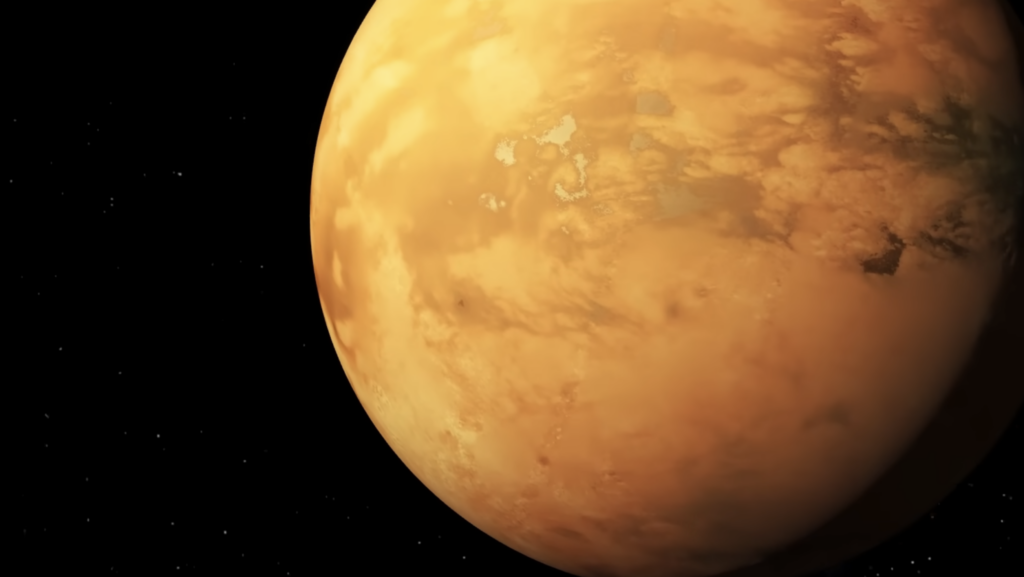
Titan deserves its reputation as one of the strangest moons in existence. It is larger than our own Moon and even bigger than the planet Mercury. It is the only moon in the Solar System with a thick atmosphere, and the only known world besides Earth with stable liquid resting on its surface.
Liquid, but never water. Methane and ethane flow there instead, carving rivers, filling lakes, and pooling into seas across a frozen alien landscape. The eeriest part is how familiar it all behaves: rain falls, liquid evaporates, clouds form, a complete cycle just like Earth’s, except every drop of it would kill you.
Getting down there is its own ordeal. The descent through Titan’s dense atmosphere takes hours, and the landing demands precision, because vast stretches of the surface are liquid. One navigation error and you skip the ceremony, splashing straight into a methane sea ahead of schedule.

Touch down safely, and you step into a world that refuses to feel real. The temperature hovers around minus 180 degrees Celsius, cold enough to freeze pure oxygen into a solid and turn everyday materials brittle as glass.
Yet Titan hands you one gift: gravity at only about 14 percent of Earth’s. Every step becomes a slow, floating leap. You would bounce across this deadly wonderland feeling nearly weightless.
Do not let that playfulness fool you into removing your helmet. The atmosphere is mostly nitrogen, deceptively similar to home, but the rest is methane. There is nothing to breathe. Your oxygen supply is the only thing keeping this adventure from ending early.
Even the rain here has forgotten how to behave. Methane drops fall from the thick orange clouds, but the low gravity and dense air slow them into a gentle drift, drifting down around you in silence instead of striking the ground.
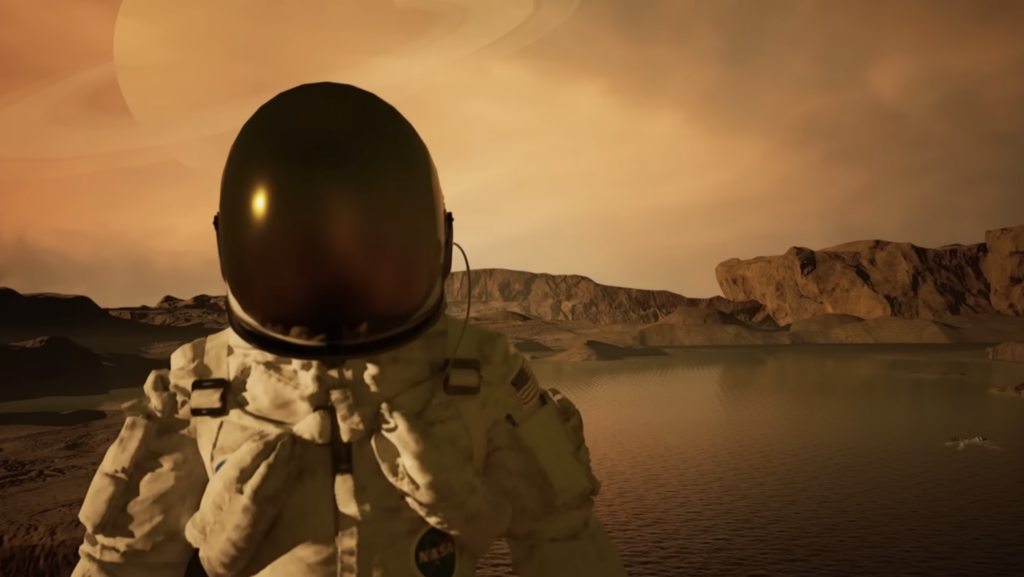
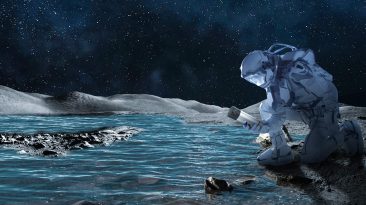
And then, finally, you stand at the shore. The coldest swimming pool in the known universe waits at your boots.
Understand what you are about to enter. A dip in liquid methane is nothing like swimming on Earth. It is immersion in a cryogenic chemical bath where normal biology simply stops working, almost on contact.
Without protection, your survival would be measured in moments. The unimaginable cold would shut your body down nearly instantly, with oxygen loss racing close behind to finish the job.
Even with a suit, you get only a thin buffer. Liquid methane behaves nothing like water, and minus 180 degrees pushes every material, every seal, every layer of engineering to its absolute limit. Five seconds is not a swim. It is a countdown.
Three. Two. One. Dive.
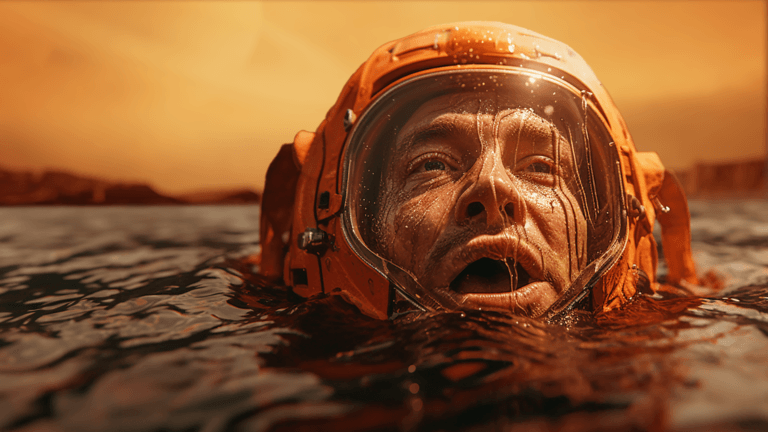
For five heartbeats, you float inside one of the most alien environments in the Solar System, a lake on a frozen moon where chemistry has replaced biology and nothing behaves the way your instincts expect.
Then you surface, and the coldest swim imaginable is over. The ice hole jumpers back on Earth can keep their frozen lakes. You just swam on Titan, and no one will ever call their winter dip extreme in front of you again.