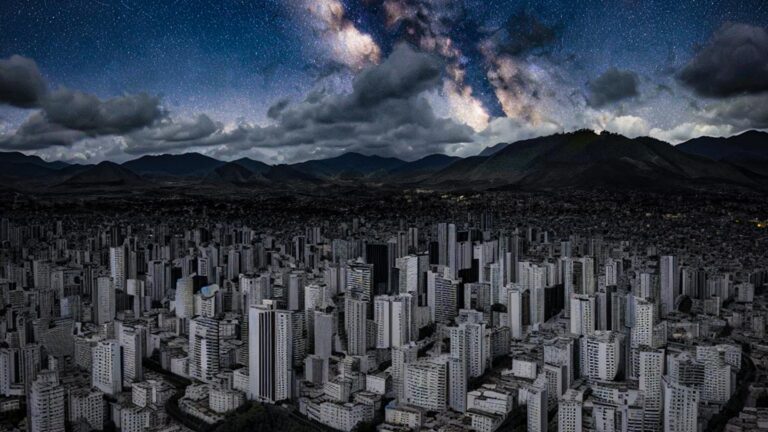
The good old days before electricity… Did we actually have it better before the first power plant started running? What if everyone on Earth tried getting by with all their lights turned off?
We’d start the challenge with a perfect Earth Hour. Sixty minutes of complete darkness, with no artificial light allowed. Would we reduce light pollution enough to see the Milky Way in the night sky? How much electricity would we save? And would it help us fight climate change?
Humanity has spent the last 100 years increasing its dependence on electricity. Look around. Your computer, air conditioner, microwave, fridge, elevator, traffic lights, and public transportation all rely on electrical power. Going completely without power, even for an hour, would be pretty uncomfortable. So let’s just limit humanity’s light usage.
On average, humanity consumes over 62,000 terajoules of electricity per hour. That’s how much energy your gas powered car would need to drive to Pluto and back twice! One fifth of all this energy goes toward lighting. That’s a lot of electricity, and producing it means releasing carbon dioxide into the atmosphere.
Of course, clean energy from the sun, wind, and water doesn’t increase CO2 concentrations in the air. But these sources only make up one third of global electricity production. The rest releases greenhouse gas emissions.
The thinking is that if we gave our power plants an hour break, we’d significantly reduce those emissions on a global level. What an easy way to fight climate change together! Or is it?
Turns out, it’s rather complicated. If this worldwide Earth Hour caught you at night, getting by with the light of some cozy candles wouldn’t be the best idea. Not only are candles 100 times less efficient than light bulbs, but they also emit CO2. In theory, you could even the score by using just one candle for every light bulb you turned off. But if you lit twice as many candles, you’d actually be emitting more carbon dioxide.
What if you didn’t light any candles? You might think we’d release less carbon dioxide into the air. But you’d be wrong again. That’s not how power plants work.

Coal burning power stations would emit less CO2 during the dark hour. But then everyone would turn their lights back on. For power stations, this sudden increase in demand would mean firing up more generators. As a result, they could emit even more CO2 than before.
And that’s assuming power plants could cope with such a rapid increase in demand. In the worst case scenario, they could experience an emergency shutdown, leaving us without electricity for days.
At least you would get to enjoy a spectacular view of the Milky Way at night. Light pollution currently prevents one third of the world’s population from seeing it.
So maybe plunging the entire planet into darkness isn’t the best way to fight climate change. There are better alternatives. For starters, try replacing incandescent light bulbs with compact fluorescent ones, or take public transportation more often.
You don’t need to turn off every light on Earth to make a difference.