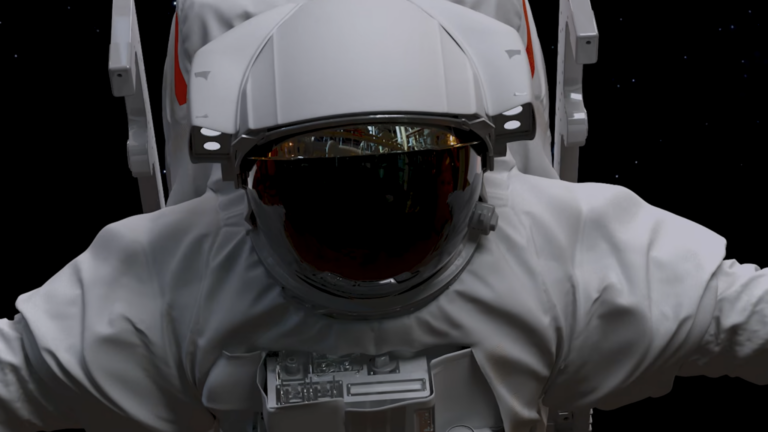
Imagine pointing the fastest spacecraft imaginable toward a destination so distant that even light would need hundreds of millions of years to reach it. After an unimaginably long journey, you would finally arrive at your destination, only to discover that you had entered one of the emptiest places known to science.
This enormous region is called the Boötes Void, and it lies in the direction of the Boötes constellation. While the Universe already appears almost completely empty from our perspective, this particular region takes that emptiness to another level.
To understand the scale, consider Andromeda, our nearest major galactic neighbor, which is about 2.5 million light years away. The Boötes Void is roughly 280 times farther away, meaning that even light would require around 700 million years to travel there.
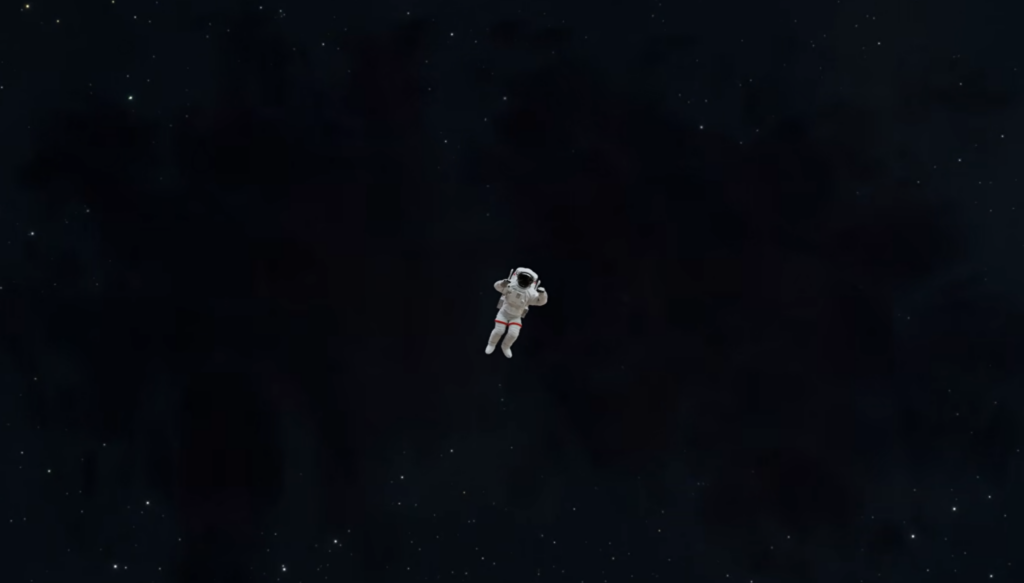
But reaching the region would only be the beginning. The Boötes Void stretches for approximately 330 million light years, making it difficult to comprehend even when compared with the enormous distances between galaxies.
At light speed, traveling from its outer boundary toward the center would take roughly 165 million years. The region is so enormous that countless collections of galaxies could theoretically fit inside it.
And despite what the name suggests, the void is not completely empty. Astronomers have identified roughly 60 galaxies within the enormous region, but they are extraordinarily spread out compared with galaxies in more crowded parts of the cosmic web.
What Would You See?
Entering the Boötes Void would not feel like passing through a giant invisible barrier. There would be no sudden change, no boundary in space, and no dramatic sensation telling you that you had crossed into the void.
Instead, the difference would become obvious when you looked outside your spacecraft. There would be remarkably few nearby stars and galaxies to provide visual landmarks. The sky would appear extraordinarily dark, with enormous stretches containing almost nothing visible.
Your spacecraft would still be moving through microgravity, just as a spacecraft does elsewhere in deep space. You would not suddenly become weightless because of the void itself. The real difference would be the astonishing lack of nearby objects.
The environment would also be incredibly cold. Deep space in such a region would remain only a few degrees above absolute zero, around minus 270 degrees Celsius. Your spacecraft would therefore need reliable life support, power, heating, and protection from the surrounding environment.
If your lights failed, the darkness would become almost complete. Without nearby stars or galaxies, there would be very little outside the spacecraft to help establish your position.
A Journey Without Landmarks
That lack of reference points could make the journey psychologically strange. You might travel for years and see almost no obvious change in the view outside your spacecraft.
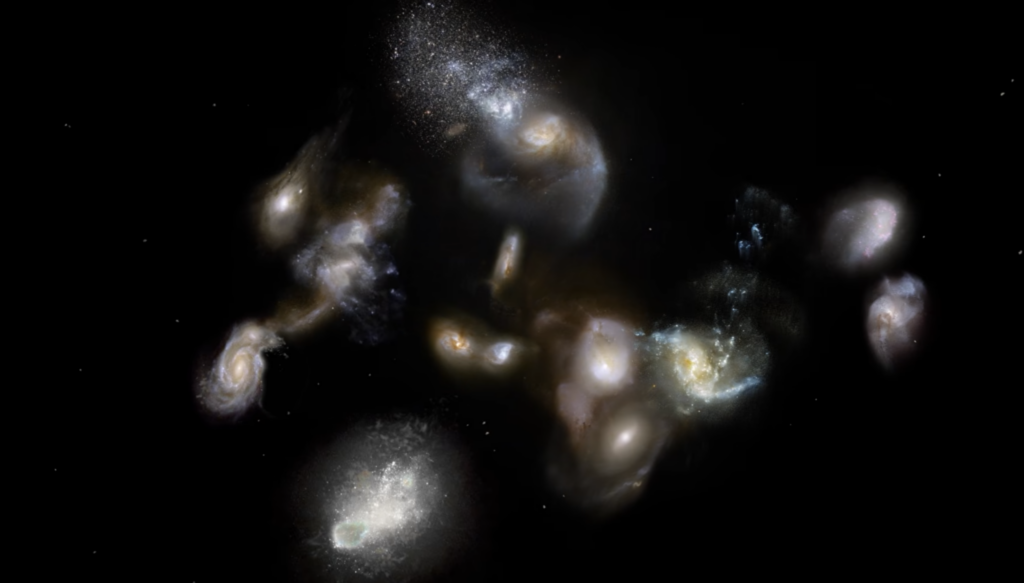
Even if you were traveling at enormous speeds, the surrounding landscape would remain nearly unchanged for extraordinarily long periods. A galaxy might be so distant that it would take millions of years before your position relative to it noticeably changed.
Finding one of the galaxies inside the void would therefore be incredibly difficult without precise navigation. You could not simply point your spacecraft toward a visible galaxy and assume you would eventually reach it.
Why Does the Void Exist?
The Boötes Void provides astronomers with an unusual look at the way matter is distributed across the Universe. Galaxies are not scattered randomly through space like points on a perfectly even grid.
Instead, enormous structures known as the cosmic web connect galaxies into clusters and long filaments. Between these structures are huge regions where galaxies are much less common.
These regions are called cosmic voids, and although they contain far less matter than galaxy clusters, they can occupy an enormous portion of the Universe’s total volume.
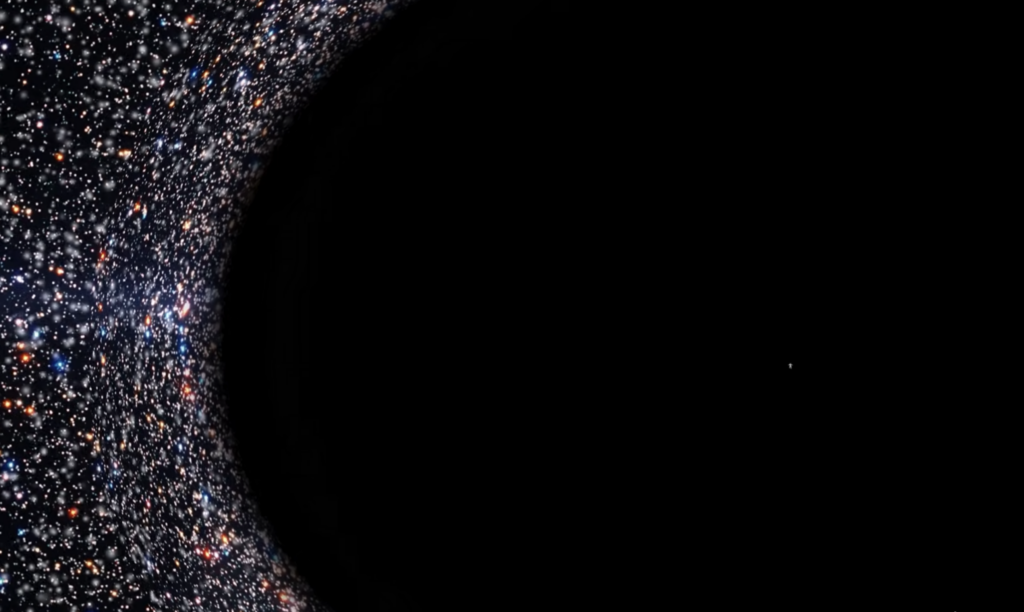
The Boötes Void is one of the most famous and extreme examples. Its enormous dimensions make the relatively small number of galaxies inside it seem almost impossible.
For a traveler stranded deep inside this region, the experience would be unlike almost anything imaginable. There would be no nearby planets, no bright stars filling the sky, and no dense collection of galaxies surrounding the spacecraft.
There would simply be darkness stretching in every direction, with enormous distances separating the few galaxies that exist within the void.
The Boötes Void is a reminder that the Universe is not merely enormous. Much of that enormous space is almost completely empty, leaving vast regions where billions of years could pass without another major object coming anywhere near you.