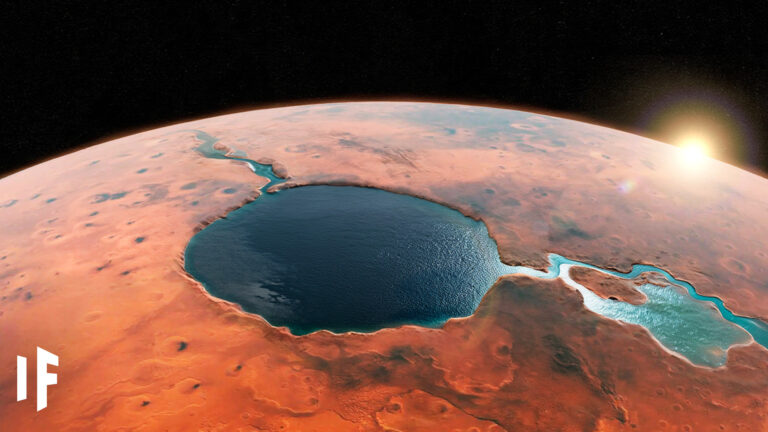
THE BEGINNING – 4.5 BILLION YEARS AGO
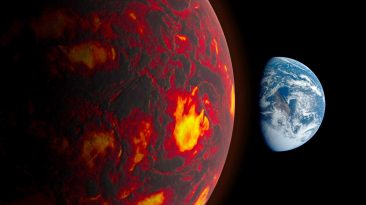
On Mars, this period is known as the Pre-Noachian era. Mars has just formed from dust and gas in the protoplanetary disk, just like Earth did. Pieces of debris clamped into a planet with a dense core, a rocky mantle and a crust. And this planet was slammed with swirling space rocks.
In its early years, Mars had a very dense atmosphere and an ocean so big it covered one-third of the planet. At first, the planet was super hot. But slowly, between 4.3 and 4.4 billion years ago, it cooled down.
This was a time of heavy asteroid and comet bombardments and widespread volcanic activity. So basically… everything that could blast gas, vapour and dust into the atmosphere, was doing it. It was a perfect place for life to put down roots.
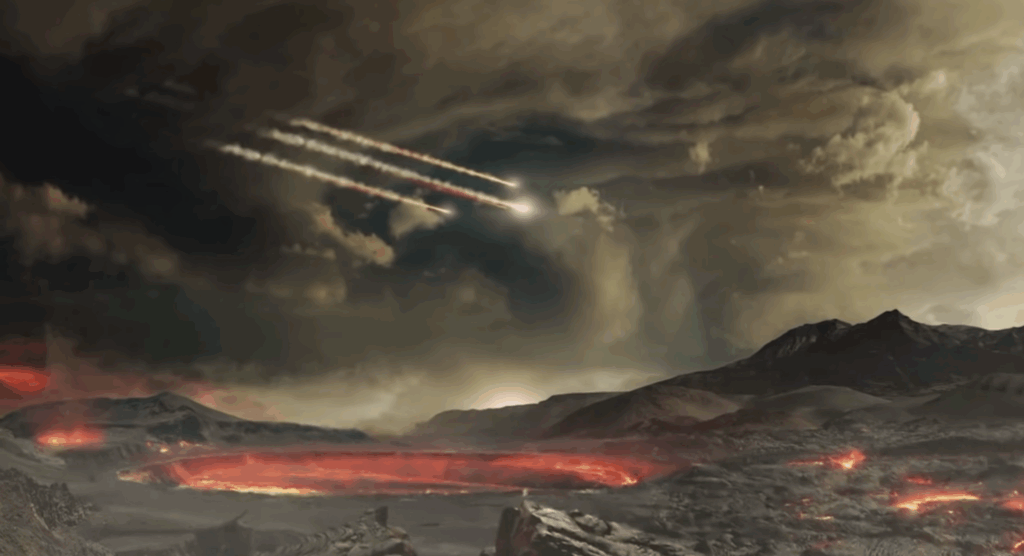
All these gases created a thick atmosphere, and the planet heated up thanks to the good old greenhouse effect. Suddenly, Mars had clouds, valleys, lakes, and even rain – likely acid rain.
Then, somewhere between 4.1 and 3.7 billion years ago, things started going downhill. The interior of Mars cooled off, and its magnetic field dissipated.
LIFE BEGINS (MAYBE) – 3.7 BILLION YEARS AGO
Not long – in cosmic terms, after losing its magnetic field, Mars started to look more like Earth today. Yeah, 3.7 billion years ago was a great time for this red rock. It was the beginning of the Hesperian period.
Mars may still have had a northern ocean around this time, though scientists think it was shrinking fast. Still, this was a perfect place for Mars to be teeming with early, tiny Martians.
It’s also the period of time, between 3.2 and 3.8 billion years ago, when something mysterious happened on Mars. Something that left potential biosignatures in the Martian rocks. This discovery started when NASA’s Perseverance Rover was out cruising the Jezero Crater, which used to be a huge Martian lake and a river delta. Perseverance rolled through the Neretva Vallis, which is basically Martian for now-dry Neretva Valley.
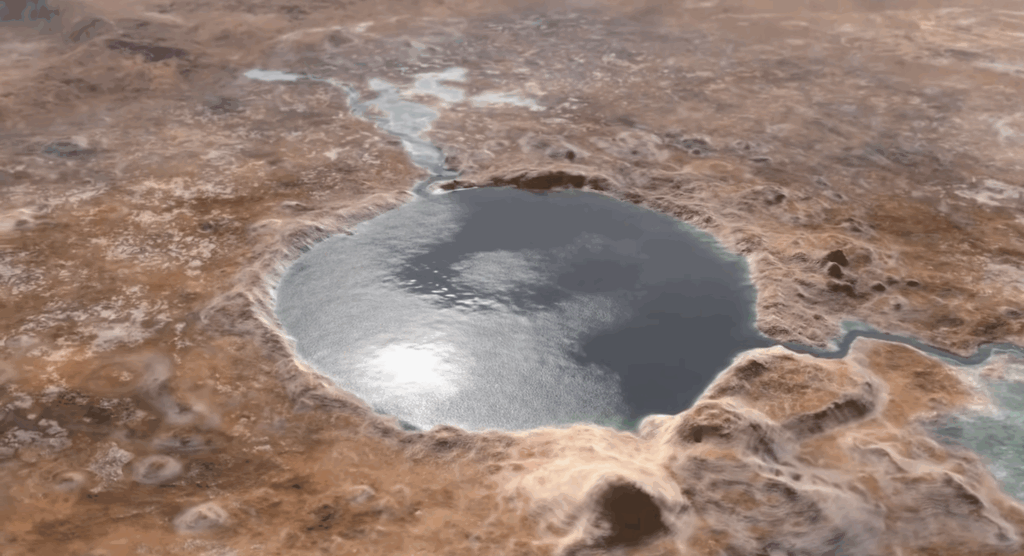
And it was here that Perseverance investigated sedimentary rocks like clay and silt, which are really good at preserving evidence of previous microbial life. Perseverance poked around some odd-looking mudstone rocks and found what could be the signatures of two iron-rich minerals, vivianite and greigite.
The ‘colourful ‘leopard spots’ in this image could be fossilized signs that microbial life existed on Mars billions of years ago.
TURNING INTO A DESERT – 2.9 BILLION YEARS AGO
By the end of the Hesperian period, things started going downhill for Mars. While its neighbour, Earth, was welcoming life, changing its atmosphere and reshaping its surface, Mars was losing all the things that life could hold onto.
2.9 billion years ago, the Martian magnetosphere was gone. And without it, solar winds did what solar winds do and stripped much of the atmosphere. The air had become thinner and could no longer retain heat. Very quickly, Mars was becoming cooler and drier.
If any Martian microbes survived, they likely abandoned the surface and retreated underground into aquifers, caves, or close to geothermal hot spots, shielded from the radiation and the freezing air above.
THE RED PLANET – 1 BILLION YEARS AGO
This period of Martian history is called the Amazonian. It started 2.9 billion years ago, and it’s still going on as of today. Yeah, that’s right. Mars has looked like this for a very long time. Dry, dusty, and rusty-red. Whether it was two billion years ago, or one billion, or 2 years ago, if you lived on Mars, life would be the same.
The atmosphere is thin, composed mostly of carbon dioxide. And the surface pressure is low, about 1% of Earth’s. Surface water doesn’t exist, or if it does, it doesn’t last; it vaporizes. Plus – it’s freezing. By now, the average surface temperature has plummeted to around -60 °C – that’s -76 °F. But occasionally, Olympus Mons erupts and warms the surrounding area.
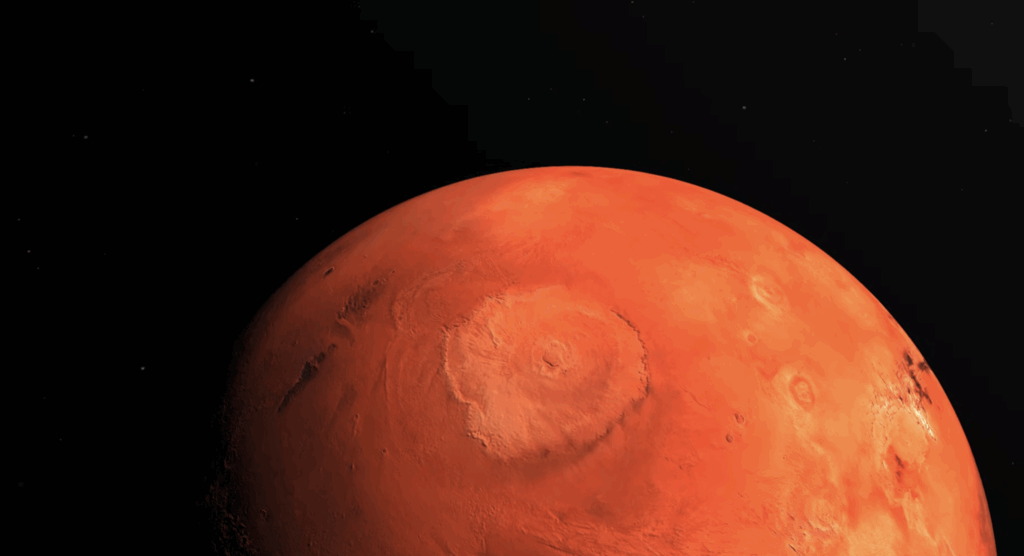
If you don’t know, Olympus Mons isn’t your average volcano. At about 22 km, or 14 mi, high, it’s the largest volcano in the Solar System. Yeah, three times taller than Mount Everest and about the size of the entire state of Arizona.
Today, Olympus Mons is silent. Just a giant pimple on the Martian surface, one that’s visible from space. I had one of those before senior prom.
From this point on, Mars didn’t change much. Now, without a thick atmosphere or water, its surface is primarily changed by erosion, some late-stage volcanism and lava flows. Strong winds also shape Mars, creating sand dunes and flattening the plains. There could be underground water, but no oceans.