There is a place in our Solar System where stepping outside without a suit kills you twice in the same instant. Your blood starts boiling while your skin starts freezing.
That place is Triton, Neptune’s enormous backwards orbiting moon, and for reasons I still question, I volunteered to stand on it for five whole seconds.
But before we get to the dying part, I owe you an embarrassing confession about how this trip started.
You see, this was supposed to be my triumphant arrival at Triton. Instead, my last mission ended with me standing on Titan. Which, as I have now been informed several times, is a completely different moon orbiting a completely different planet.
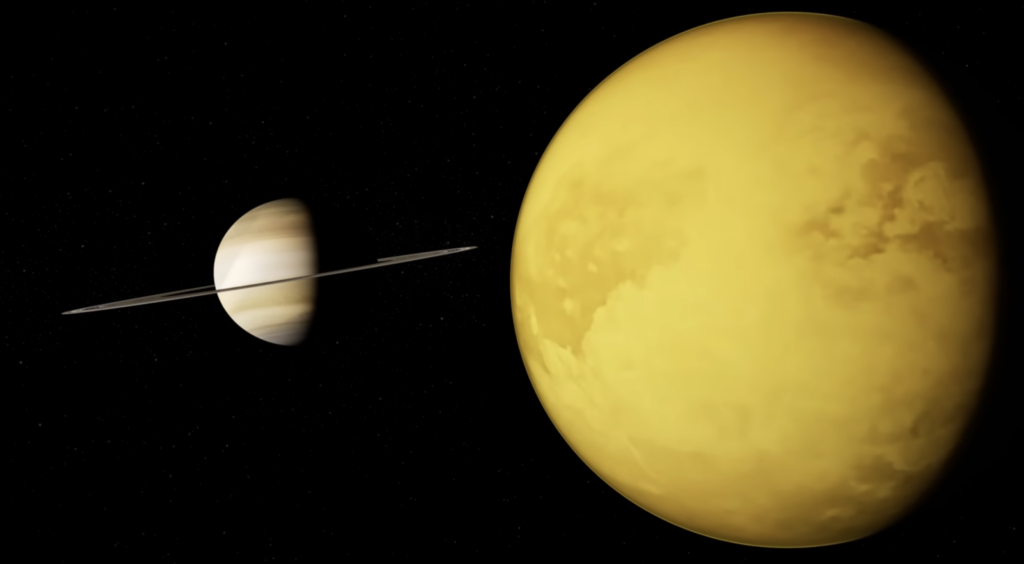
In my defense, the names are one letter apart. In the universe’s defense, the destinations are not. Titan circles Saturn. Triton circles Neptune. Triton sits about 4.5 billion kilometers from the Sun, while I was parked at roughly 1.4 billion. That is a gap of over 3 billion kilometers, which is only close in the way that galaxies are kind of near each other.
Worse, Saturn and Neptune refuse to cooperate. Saturn loops the Sun every 29 years, Neptune every 165, and at the wrong points in their orbits these two moons can drift nearly 6 billion kilometers apart.
So yes. Slight miscalculation. After some professional disappointment and a stern talk with the navigation system, I was finally reassigned to the correct frozen nightmare.
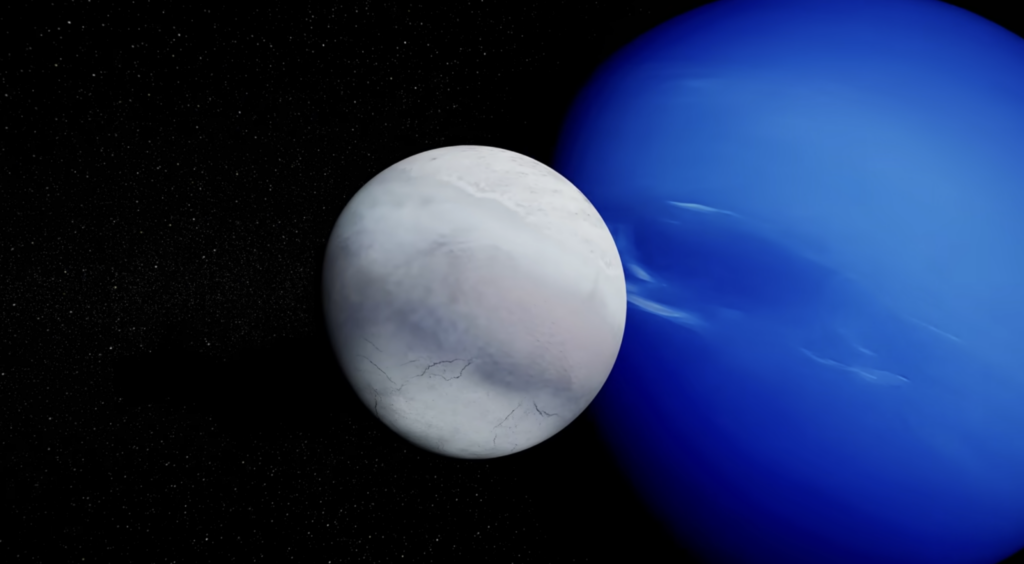
Triton. The real one this time.
And what a destination it is. At about 2,700 kilometers across, Triton is bigger than Pluto, though still smaller than our own Moon. For a moon, it is a giant. But its size is honestly the most boring thing about it.
Triton is the only large moon in the entire Solar System that orbits in reverse. It travels against the direction of Neptune’s own rotation, a rare motion called retrograde orbit, and that single detail exposes its dark secret.
Triton was never Neptune’s moon at all.
Scientists believe it formed out in the Kuiper Belt and wandered too close billions of years ago, until Neptune’s gravity grabbed it and never let go. A kidnapped world, locked in orbit around its captor.
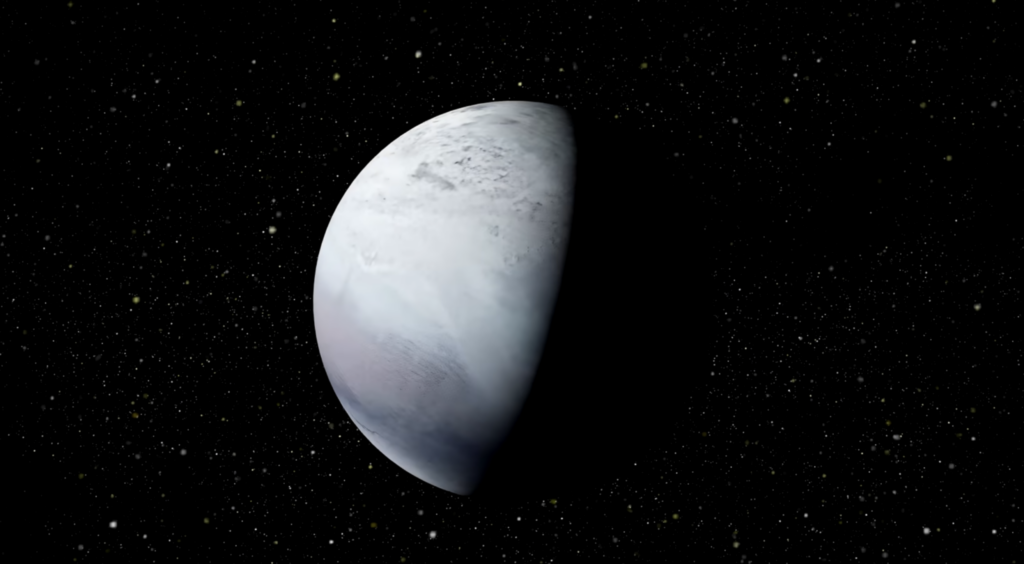
The evidence keeps piling up. Its orbit is tilted at an absurd 157 degrees, exactly the kind of angle you would expect from an outsider that crashed the party. And when Triton arrived, it did not arrive politely. Its capture likely wrecked Neptune’s original family of moons, shattering some, warping the orbits of others, and hurling a few out of the Solar System entirely.
Astronomers have a nickname for it: the moon killer.
Today the killer sleeps under ice. Surface temperatures hover around minus 235 degrees Celsius, just a whisper above absolute zero, the coldest measured surface of any large world in the Solar System. The ground is a frozen cocktail of nitrogen, methane, and water ice.
And yet, somehow, this place is still alive.
Not with creatures, but with eruptions. Triton has volcanoes, except they refuse to follow the rules. These are cryovolcanoes, and instead of molten rock they blast slushy mixtures of nitrogen and water ice kilometers into the sky.
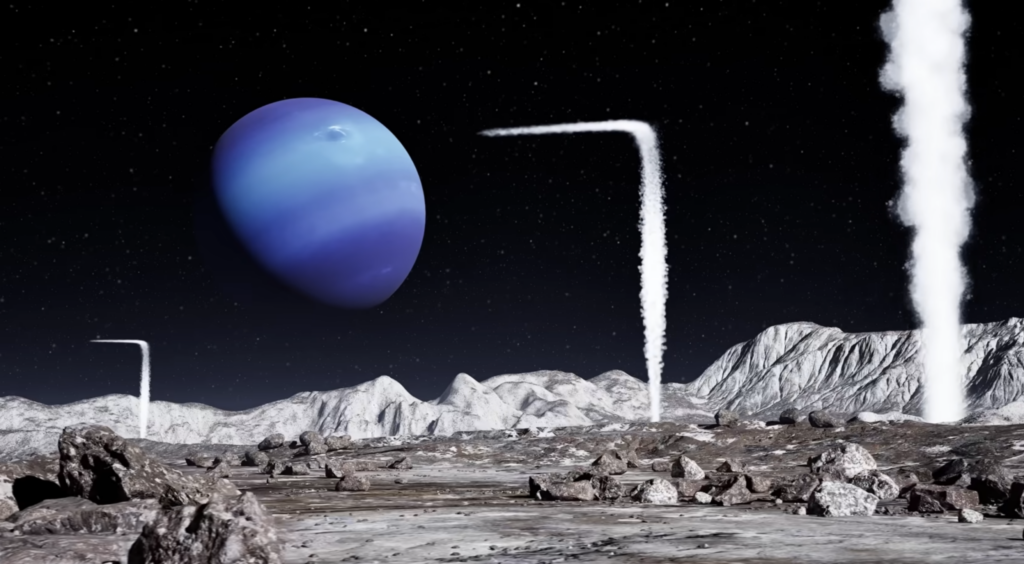
That sky, by the way, technically counts as an atmosphere. Barely. It is roughly 70,000 times thinner than Earth’s, mostly nitrogen with hints of methane and carbon monoxide, much of it refilled by those same icy plumes.
Which brings us to the part you came for. What does this place actually do to a human body?
Remove your helmet on Triton and physics executes you with horrifying efficiency. There is no air to breathe, but suffocation is the least of your problems. The pressure is so close to zero that the liquids inside your body begin to boil on the spot. Not from heat, but because nothing is pressing against you to hold them stable. Violent decompression, unconsciousness within seconds.
And while your blood boils, the cold moves in. At minus 235 degrees, exposed skin freezes almost instantly. Boiling and freezing, simultaneously. The coldest death in the Solar System is also one of the fastest.
Only one machine has ever seen this world up close. In 1989, Voyager 2 swept past at about 40,000 kilometers and photographed roughly 40 percent of the surface before sailing on toward interstellar space. One visit. One look. Nothing has been back since.
What Voyager saw was gloriously weird, including a landscape of icy ridges and pits nicknamed cantaloupe terrain, because it genuinely looks like melon skin stretched across a frozen moon.
But the biggest mystery hides below. Beneath kilometers of ice, scientists suspect a rocky core wrapped in a subsurface ocean of liquid water, kept warm by internal heat and radioactive decay. If that ocean is real, it could hold the raw ingredients of life. Nothing complex, most likely, just microbes in the dark. But life, in one of the least likely places imaginable.
Which brings us, finally, to my five seconds.
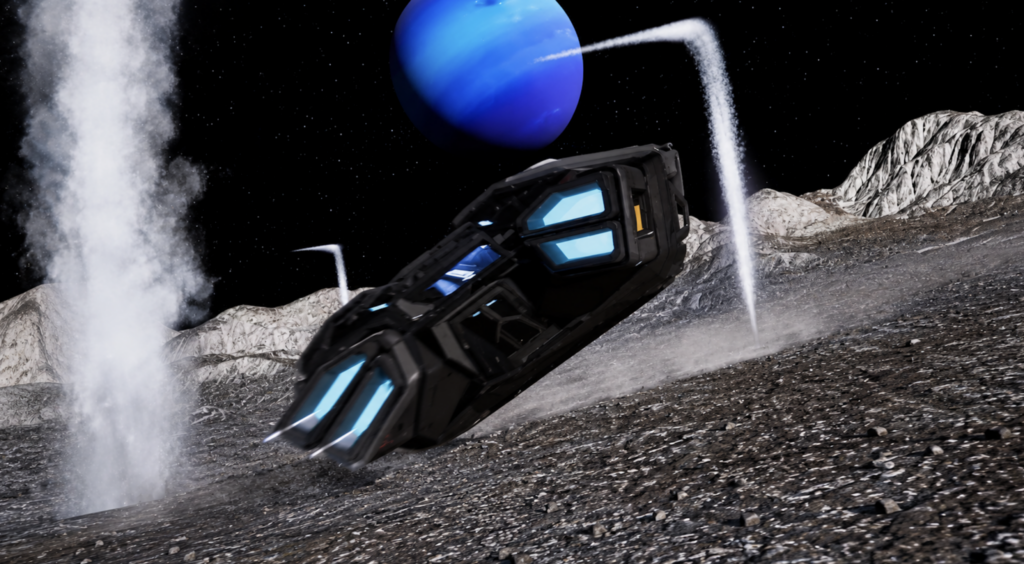
The descent alone is a fight. The thin atmosphere is unstable, laced with nitrogen plumes venting from below. Gravity is a mere 8 percent of Earth’s, so one careless push could send me drifting into a frozen trench with no easy way back.
My landing zone sits near Leviathan Patera, a colossal frozen caldera carved by ancient eruptions of ice.
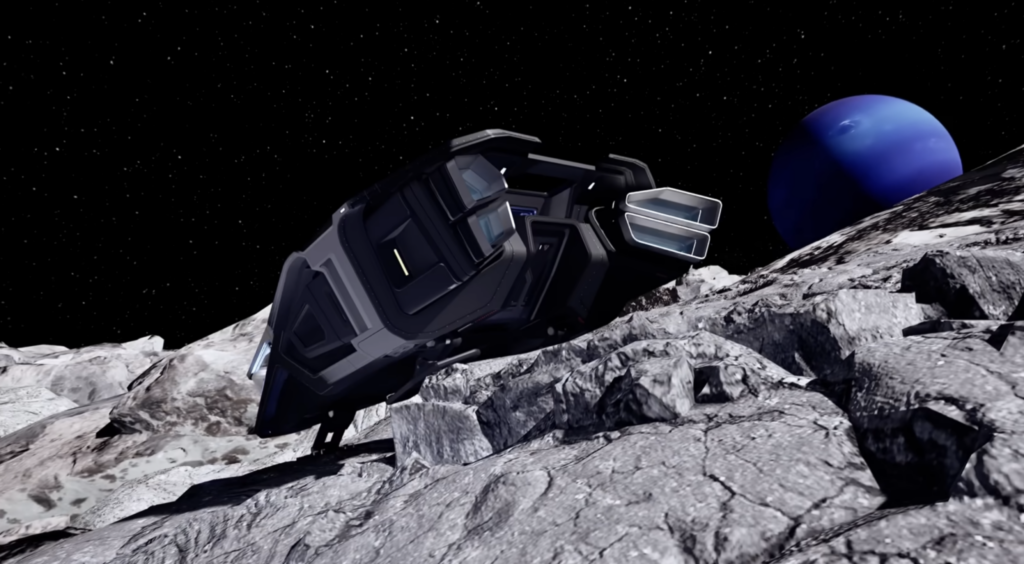
From orbit it looks peaceful. Up close, the truth is unsettling. The ground shifts as the lander settles. Fractures in the ice creak wider. The whole region grinds and moves like something enormous turning in its sleep.
Then, off in the distance, the surface explodes.
A plume of cryomagma tears upward, nitrogen and water ice launched skyward as sunlight warms dark material trapped beneath the surface until the pressure finally wins. A geyser, on a world where everything should be frozen beyond motion.
And somewhere far below my boots, that hidden ocean may be waiting, carbon, hydrogen, nitrogen, and energy stirring in the blackness. Microbes, strange chemistry, or nothing at all. Triton keeps its secrets.
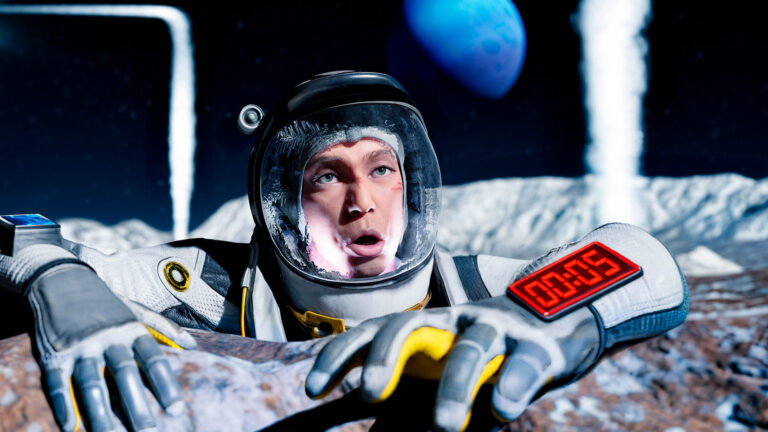
The countdown starts.
Five seconds.
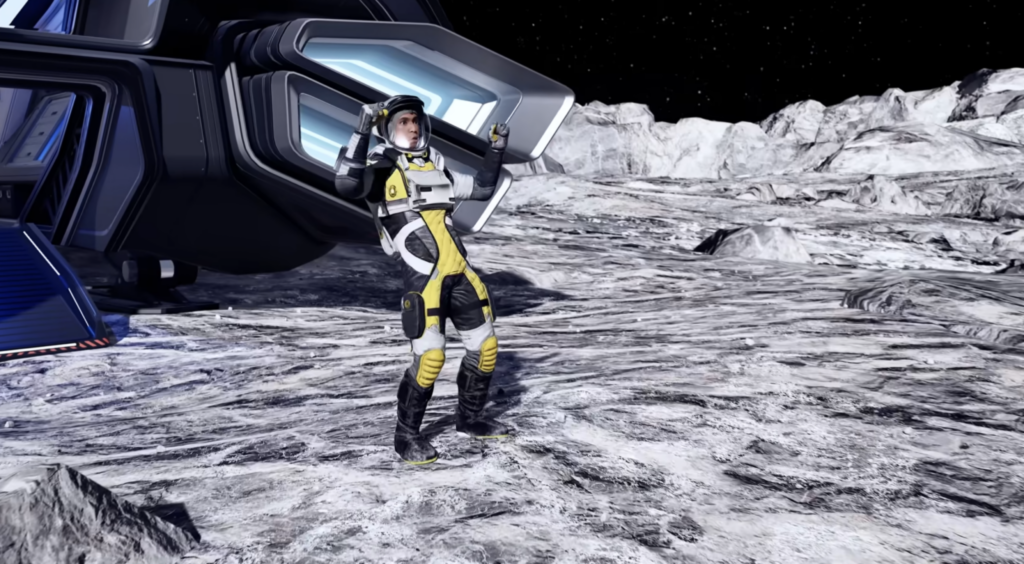
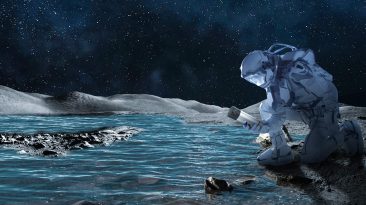
Boots crunch into ancient ice. The horizon glows in pale blues cut by black ridges. Far away, plumes climb into the thin sky like smoke signals from a world that should not be alive.
And then it is done.
Five seconds on Triton. Long enough to stand on a moon that flies backwards, long enough to watch ice erupt like fire, and long enough to understand why this frozen kidnapped world, with its buried ocean and violent past, might be one of the most fascinating places we have ever found.
As for me, I survived with my blood unboiled and my skin unfrozen, which I am counting as a complete success. Next time, I am just triple checking the navigation system before it sends me to Tritan. Which had better not be a real place.