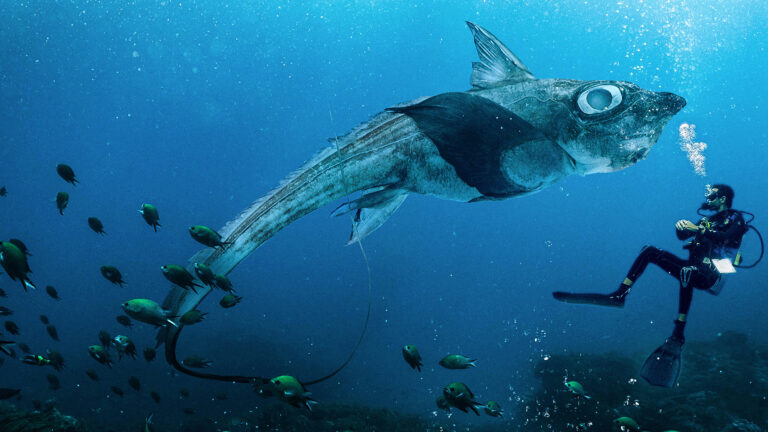
Two thousand six hundred meters below the surface, where sunlight has not reached for millions of years, something is looking back at you.
Pale. Translucent. Drifting silently across the seafloor with fins spread like a cloak. And its eyes are glowing.
The creature has a name that fits perfectly, and a name that is also completely wrong. We call it the ghost shark, and it is not a shark at all.
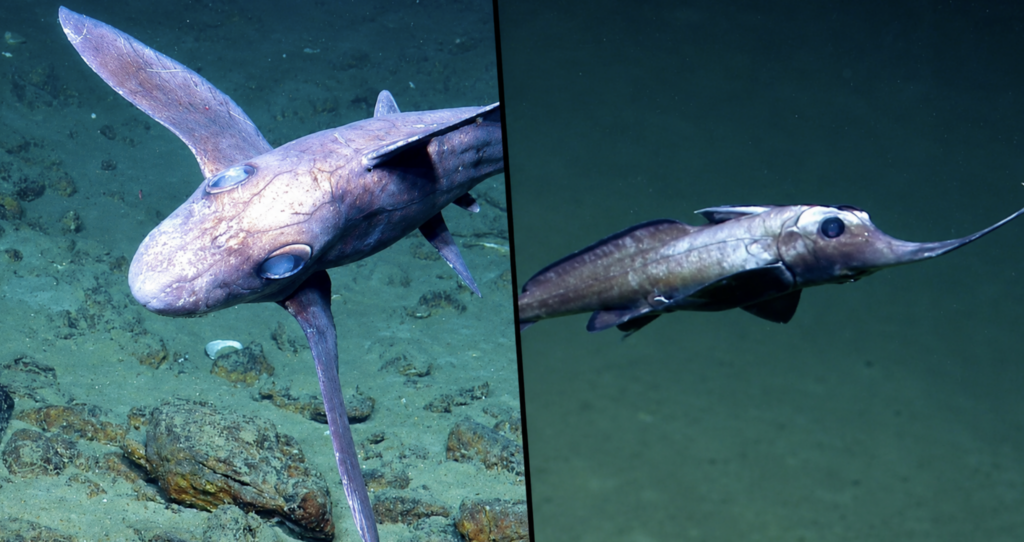
Scientists know it as a chimaera, a deep sea fish whose entire skeleton is built from cartilage, the same flexible tissue in your ears and the tip of your nose. That single detail gives it remarkable flexibility, and it is also the reason people confuse it with sharks, since both groups share that cartilage skeleton.
But the two split apart hundreds of millions of years ago and went in completely different directions. Chimaeras are distant relatives at best, and today they stand as one of the most distinctive groups of fish in the ocean.
More than 50 species exist right now, spread through oceans worldwide at depths ranging from about 200 meters down to 2,600.
The name comes from Greek mythology, where the Chimera was a monster assembled from pieces of different animals, and honestly the label has never been more accurate. Depending on the species, these fish come equipped with duck like snouts, rat like tails, or trunk shaped noses that look borrowed from a tiny elephant.
Evolution built these things out of spare parts, and it works.
Most measure between 0.3 and 1.5 meters long, gliding over the seabed with broad pectoral fins that ripple like flowing fabric. Along their bodies run specialized sensory structures that let them detect movement and hunt in a world where light simply does not exist.
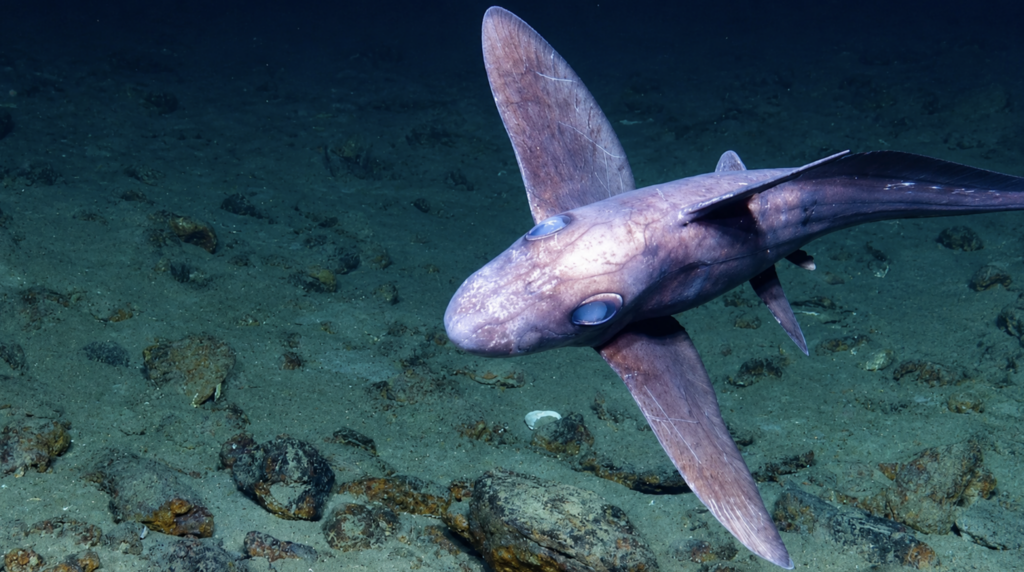
Which brings us to those eyes.
Large, cloudy, and unmistakably glowing in the darkness, they are the reason this fish earned the word ghost in its name. Everyone who sees footage of one has the same reaction: it looks haunted.
The truth is more interesting than the myth. The glow is not produced by the fish at all. Behind each retina sits a reflective layer that bounces incoming light back through the eye a second time, wringing every possible photon out of an environment that offers almost none.
Those eyes are not supernatural. They are precision instruments for surviving where seeing should be impossible.
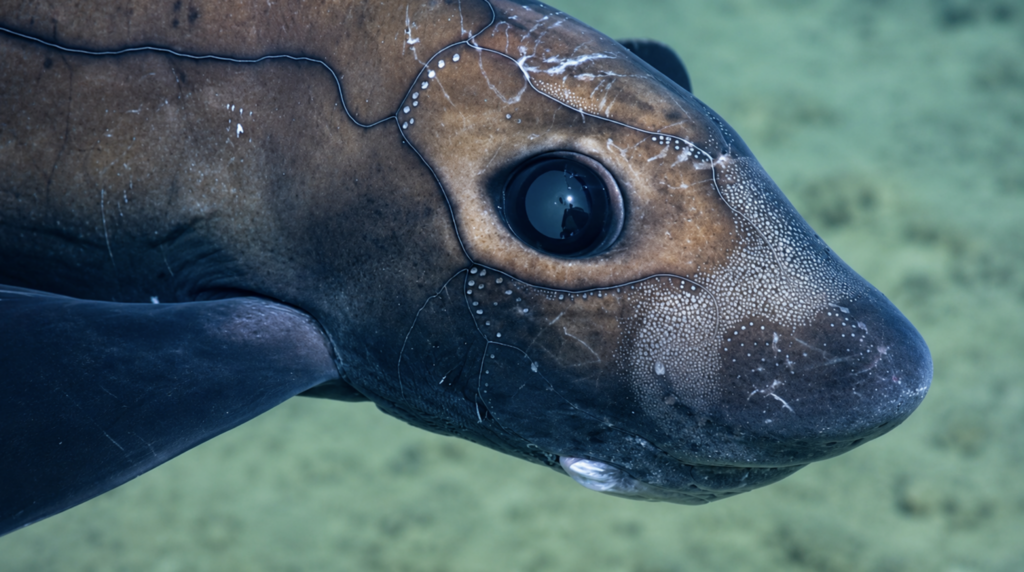
The hunting equipment continues the theme of looking terrifying while being quietly practical.
Ghost sharks feed on smaller fish, crustaceans, and other invertebrates. But instead of rows of dagger teeth, they carry powerful tooth plates built for crushing. That design lets them eat hard shelled prey that most predators cannot break into, opening up a food supply nobody else is competing for.
And despite every horror movie instinct the appearance triggers, they pose almost no threat to people. They live far below where humans swim or dive, so encounters are extraordinarily rare. Some species carry a venomous spine near the dorsal fin, but it exists for defense, and while a sting hurts, it is generally not considered dangerous to humans.
The danger runs entirely in the other direction.
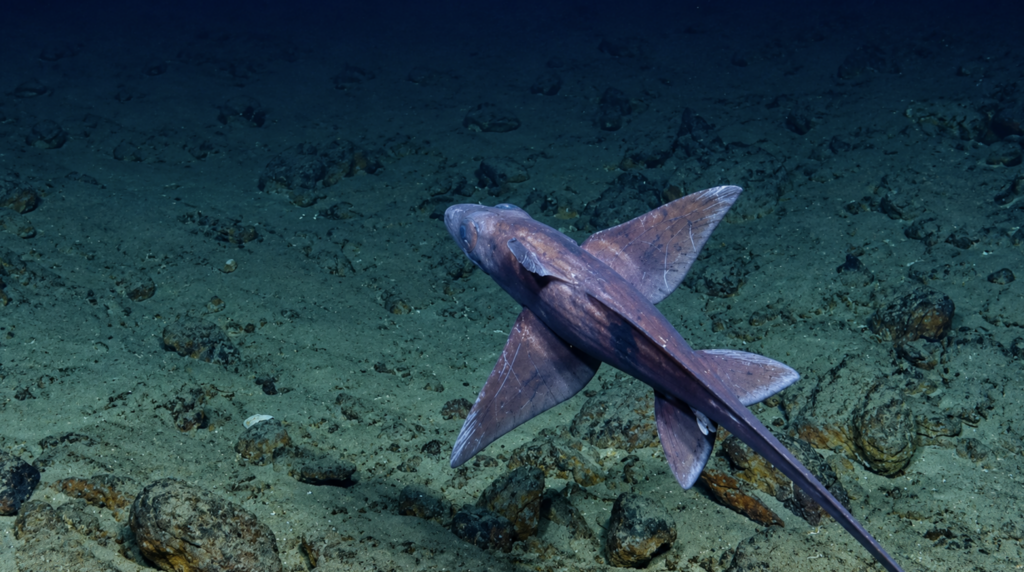
Deep sea commercial trawling catches these fish accidentally, damaging populations that science barely understands in the first place. Because they hold no commercial value, most are simply discarded once they reach the surface.
An animal that survived hundreds of millions of years in the crushing dark is now being killed as an afterthought.
Researchers are still working to understand their behavior, reproduction, and life cycle, and the discovery of young specimens in recent years has offered valuable clues. But most of the ghost shark’s existence remains completely hidden.
That is the real story here. A creature this strange, this ancient, and this widespread has been sharing the planet with us the entire time, and we have only recently started to learn how it lives.
The eyes are not haunted. They are just built for a world we have barely visited, staring back at us from a depth where our own understanding runs out.