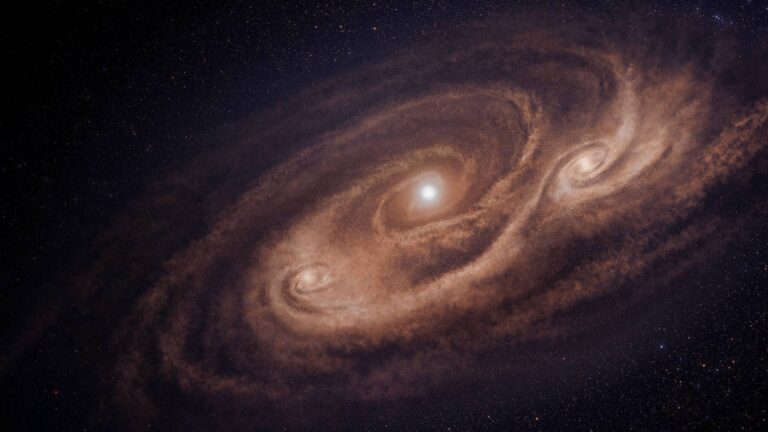
Picture a change beginning somewhere far beyond our reach, spreading through space before anyone could even know it had started. Nothing would announce its arrival. There would be no explosion visible from Earth, no warning from astronomers, and no chance to prepare.
According to one possibility in modern physics, the Universe could suddenly shift from its current state into another one with completely different rules. The process is called vacuum decay, and if it ever happened, the change could travel across the cosmos at the speed of light.
The idea sounds like science fiction, but it comes from questions about one of the most important fields in physics: the Higgs field. Understanding that field helps explain why scientists even consider such a strange end to reality.
The Higgs boson was detected at the Large Hadron Collider in 2012, giving scientists strong evidence for the existence of the Higgs field. This invisible field extends throughout space and is responsible for giving many fundamental particles their mass.
Like other physical systems, the Higgs field has an energy state. The lowest possible state is called the true vacuum, where the field would be completely settled. But physicists have considered another possibility in which our Universe is sitting in a higher energy state known as a false vacuum.
That situation can be compared to a ball resting in a shallow dip while a deeper valley exists nearby. The ball may remain where it is for an incredibly long time, yet a quantum event could potentially push it into the lower state. If something similar happened to the Higgs field, the consequences would be enormous.
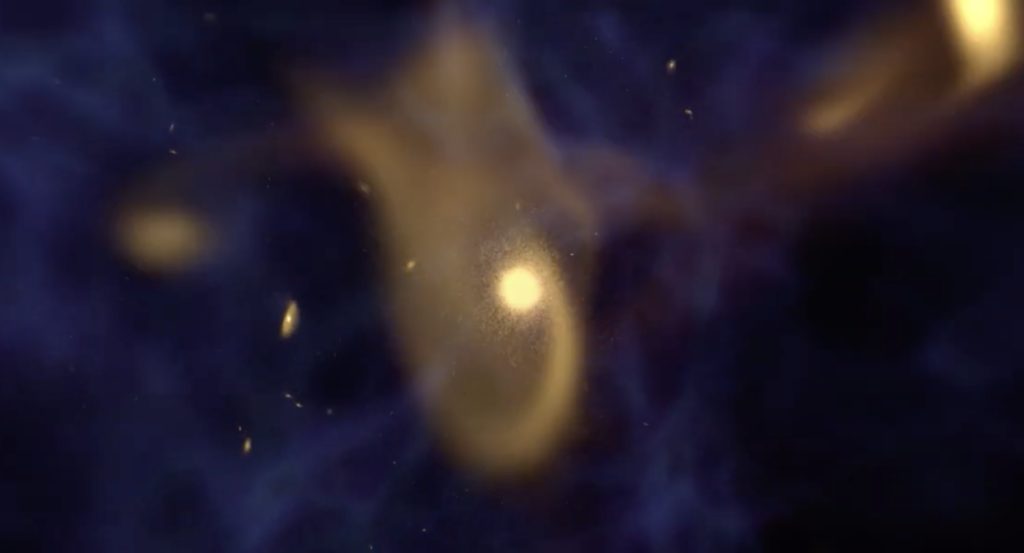
A tiny region of true vacuum could appear somewhere in space and then expand outward at the speed of light. Everything inside that growing region would experience the new vacuum state, meaning the physical conditions that currently shape our Universe could be replaced.
The constants that determine how particles and forces behave might no longer have their present values. Atoms could become unstable, chemical reactions could stop making sense, and the structures we recognize as planets, stars, and galaxies could no longer exist in their current forms.
What makes the scenario especially unsettling is the lack of advance notice. Since the boundary of the new vacuum could move at light speed, nothing outside its path would have time to observe it approaching. By the moment it reached Earth, there would be no opportunity to react.
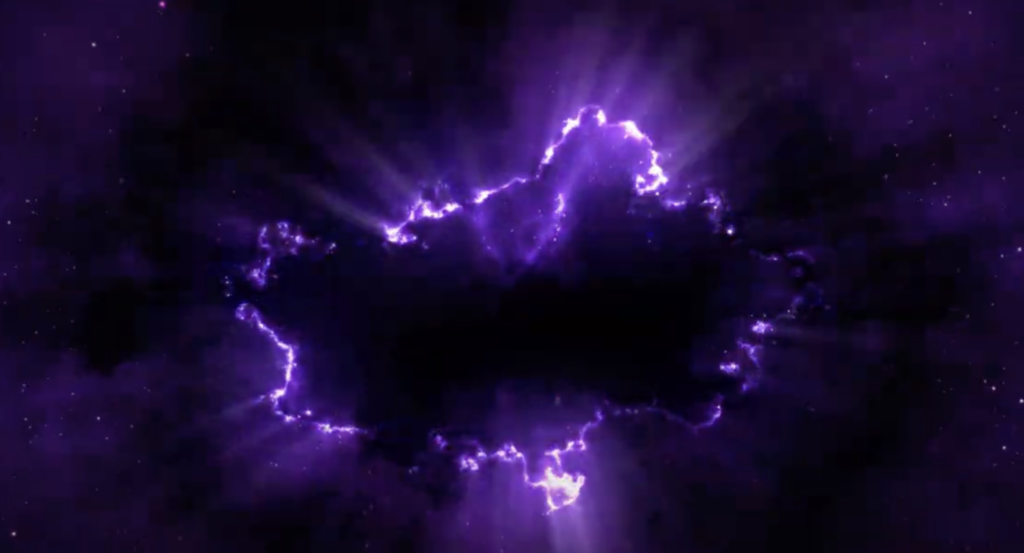
Could humanity somehow prevent vacuum decay? Current physics gives us no known method. The process would involve fundamental quantum behavior rather than something controlled by machines, governments, or any technology humans could build.
There is also an important reason scientists do not expect particle accelerators to accidentally trigger such an event. Cosmic rays regularly strike Earth’s atmosphere with energies far beyond those produced by human made accelerators, yet the Universe has continued to exist. That makes an artificial trigger extremely unlikely.
Scientists also do not know exactly what the Universe would look like after such a transition. Some possibilities involve radically altered physical laws, while other theoretical ideas describe a much stranger final state. These outcomes remain speculative because vacuum decay has never been observed.
There is, however, an important reason not to lose sleep over the idea. Even if our vacuum were only temporarily stable, calculations suggest that it could remain in its present state for a period enormously longer than the current age of the Universe.
The Universe is already about 13.8 billion years old, and nothing observed so far indicates that a vacuum transition is approaching. The possibility exists within certain physical models, but that does not mean such an event is expected to happen.
For now, galaxies continue moving through space, stars continue shining, and the Higgs field continues operating beneath the surface of everything we know. Vacuum decay may describe one possible way reality could change, but for the moment, our Universe remains remarkably stable.