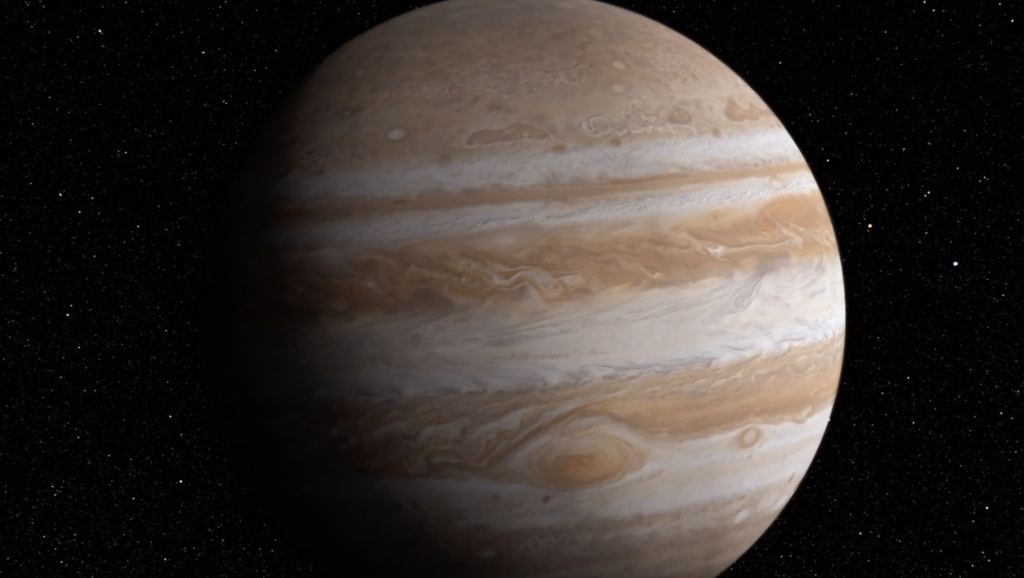
Jupiter is the largest planet in the Solar System. It is more than 300 times more massive than Earth, yet it is far less dense. Unlike Earth, it does not have a solid surface you could stand on. Instead, it is made almost entirely of swirling gas and deep atmospheric layers that become denser the further you go down.
Its atmosphere is mostly hydrogen, around 90 percent, with about 10 percent helium and small traces of methane and ammonia. Because hydrogen is often associated with flammability on Earth, it is natural to wonder if Jupiter could somehow ignite if exposed to a spark.
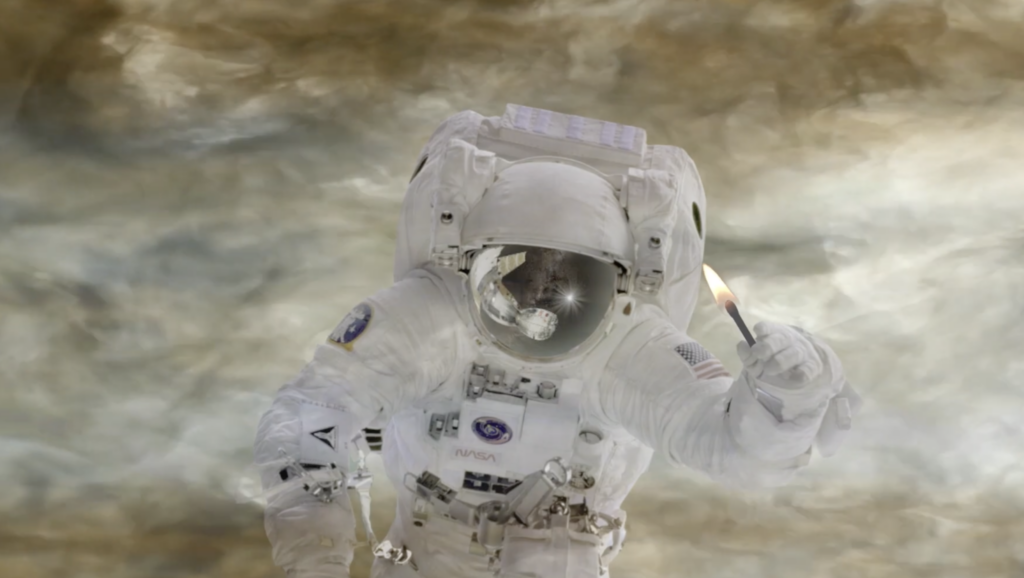
So what would actually happen if you tried to light a match there? Would anything burn, or would the entire planet react in some dramatic chain of fire?
On Earth, a match works through a carefully controlled chemical reaction. When you strike it against the rough strip on a matchbox, friction triggers a reaction involving phosphorus compounds that quickly produces heat and flame. This process depends heavily on oxygen in the surrounding air.
Without oxygen, a match cannot sustain a flame. That immediately creates a problem on Jupiter, where conditions are nothing like Earth. There is no breathable oxygen in the atmosphere to support normal combustion.
To even imagine a match lighting in such an environment, the process would need to be completely redesigned. It would not rely on atmospheric oxygen at all. Instead, it would have to carry its own oxidizing agents, essentially supplying everything needed for combustion internally.

Even if we assume a hypothetical match capable of burning without external oxygen, the real question becomes what it would be burning in. Jupiter’s atmosphere is mostly hydrogen gas, which is only flammable under very specific conditions involving oxygen and an ignition source in the right proportions.
To trigger large scale combustion, you would need an enormous amount of oxygen mixed with hydrogen in the correct ratio. In chemical terms, hydrogen combustion requires roughly two parts hydrogen to one part oxygen.
The problem is scale. Jupiter contains an almost unimaginable amount of hydrogen, on the order of 10 to the power of 27 kilograms. To fully react with that hydrogen, you would need an oxygen supply comparable in magnitude, far beyond anything available in the entire Solar System.
Even if oxygen could somehow be introduced, it would not simply cause a planet wide fire. Gas giants do not behave like a contained atmosphere on Earth. The environment is constantly mixing, compressing, and shifting under extreme pressure and temperature gradients.
In reality, there is no scenario in which Jupiter could ignite like a giant bomb or fireball. The chemistry simply does not support a sustained combustion reaction across the planet.
This has already been tested in nature in a way. In 1994, Comet Shoemaker Levy 9 collided with Jupiter in one of the most powerful impact events ever observed in the Solar System.
The comet broke into multiple fragments before striking the atmosphere, some measuring around a kilometer across. Each impact released energy far greater than any nuclear weapon ever detonated on Earth.
Yet even with that level of force, there were no planetary fires, no chain reaction, and no ignition of the atmosphere. Instead, the impacts created massive dark scars in the clouds that slowly dissipated over time.
Jupiter may be filled with flammable material in a simple Earth based sense, but the conditions required for fire as we know it simply do not exist there. The planet is too vast, too dynamic, and too different for a match to ever make a difference.