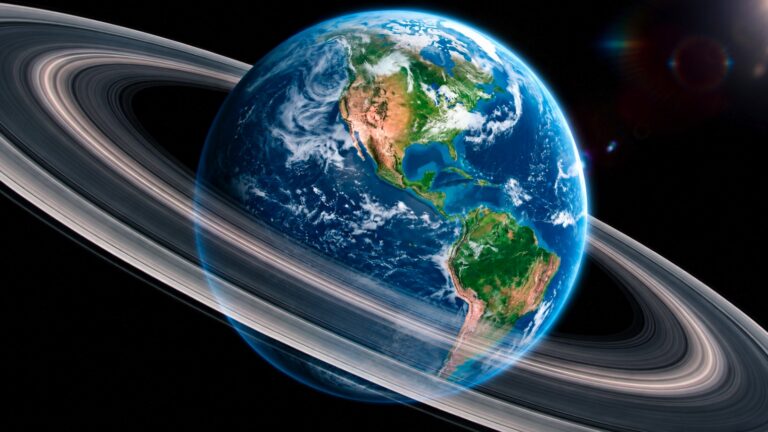
What if Earth looked more like Saturn? Imagine looking up at the sky and seeing enormous rings stretching across the horizon. It might sound like something from another planet, but Earth actually had rings around 466 million years ago.
These rings weren’t just pretty decorations. They hid a terrible secret, and they were as deadly as they were beautiful. So where did they come from, and what happened to them?
To understand how Earth got its rings, we need to go back to the birth of the Solar System, around 4.6 billion years ago. Back then, there was no Solar System as we know it today, just a dense cloud of cosmic gas and space dust.
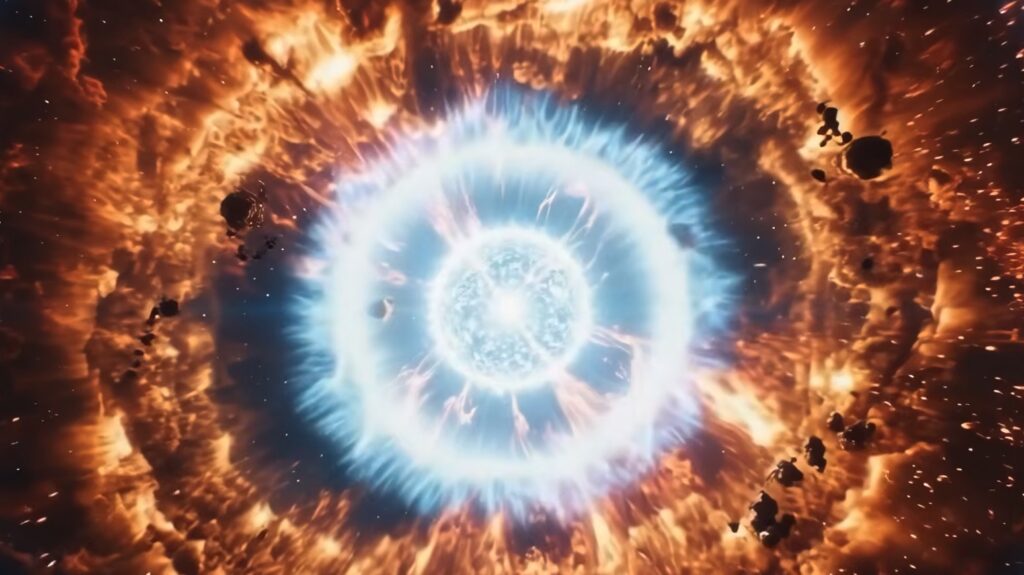
A nearby star eventually ran out of fuel and exploded in a supernova. Its shockwaves smashed into the dust cloud, pushing material inward and starting the process that would create our Solar System.
As the gas and dust collapsed, everything began spinning. Gravity pulled more and more material toward the center until hydrogen atoms were compressed enough to fuse into helium. The Sun ignited, while leftover material continued clumping together to form the planets, moons, asteroids, and comets.
There was plenty of debris flying around, and some of it eventually collided with Earth. Around 60 million years after the Solar System began forming, an object called Theia slammed into our young planet. The impact threw an enormous amount of superheated rock into space, which eventually came together to form the Moon.
But that wasn’t what created Earth’s rings. Instead, the material from Theia was swept up by the Moon’s gravity.
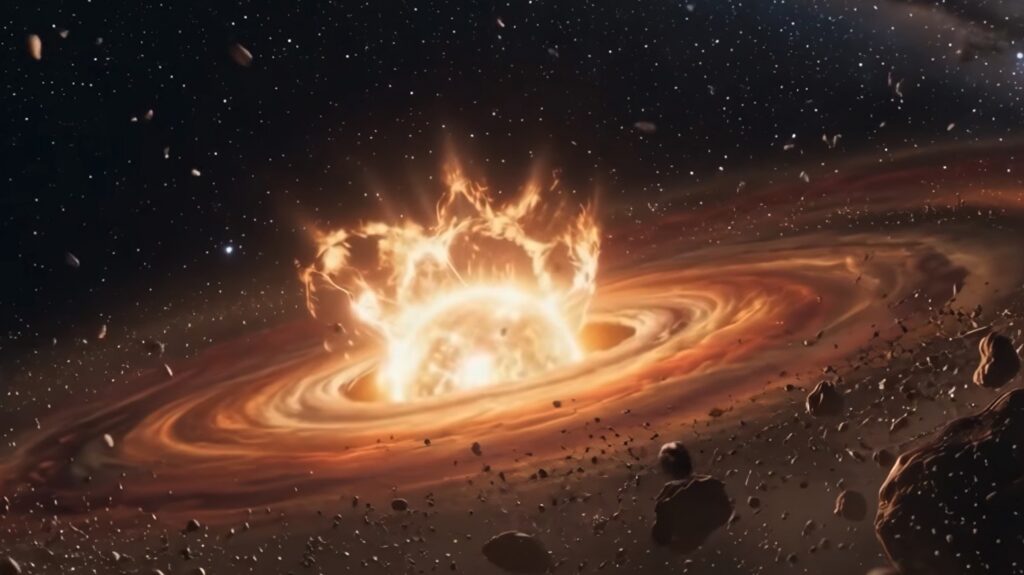
Hundreds of millions of years later, during a period of intense meteorite bombardment known as the Ordovician impact spike, another asteroid approached Earth. This time, it didn’t collide with the planet. It passed too close and crossed something called the Roche limit.
The Roche limit is the gravitational boundary around a large object where the tidal forces can tear apart a smaller object that gets too close. As the asteroid crossed this boundary, Earth’s gravity pulled it into millions of pieces. The fragments were scattered around the planet and eventually formed a ring.
For a while, Earth looked like a miniature Saturn.
But these rings weren’t harmless. They were dense enough to cast a huge shadow over the planet, contributing to an intense cooling period known as the Early Paleozoic Icehouse. Temperatures dropped dramatically, and massive sheets of ice covered the surface. It was the coldest period in the last 500 million years.
The cooling coincided with a devastating extinction event that wiped out up to 85 percent of marine life at the time.
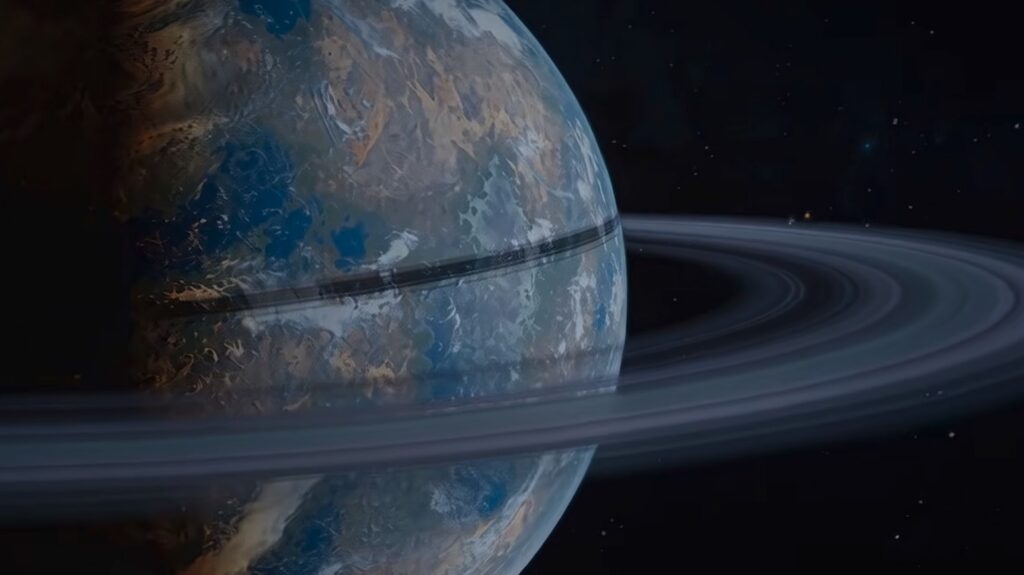
So how do we know Earth actually had rings? Scientists studied the geological record and examined meteor impact craters from the Ordovician period. Instead of finding craters distributed randomly across the planet, they discovered that they were concentrated in a huge band following Earth’s equator.
This pattern strongly suggests that fragments from the rings eventually fell back to Earth, creating impacts along the same orbital path. Over millions of years, the rings disappeared.
Even Saturn’s rings won’t last forever. They are relatively young in planetary terms, and material is constantly falling from them toward the planet. In another 100 to 200 million years, they could disappear completely.
Could Earth ever have rings again? If the Moon somehow broke apart after approaching Earth’s Roche limit, its fragments could be captured by our planet’s gravity and form another enormous ring.
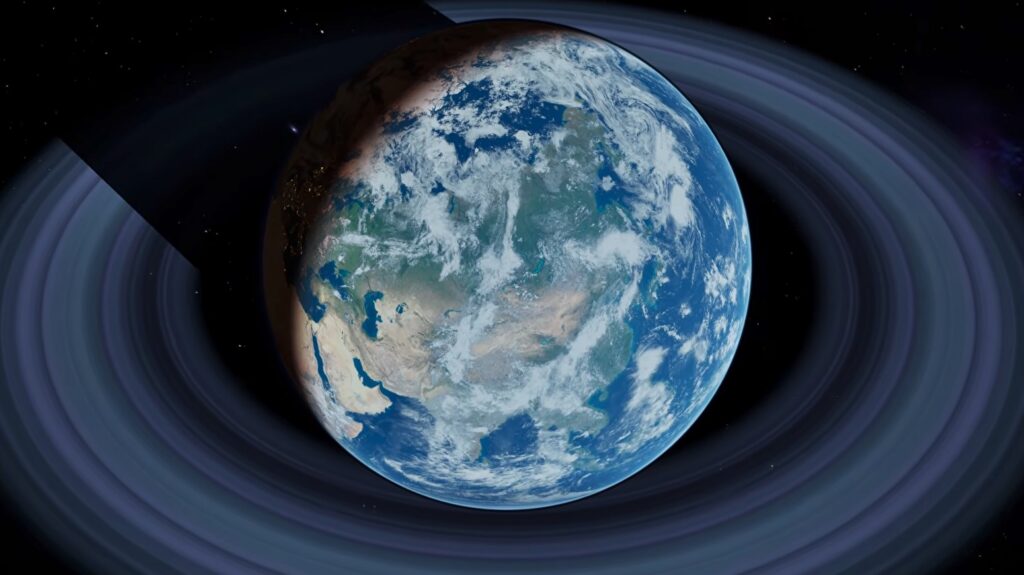
It would certainly look spectacular, but it would also be disastrous. The dense material would block sunlight, creating an even colder and longer ice age. As the fragments gradually fell toward Earth, the planet would also experience constant meteor strikes.
So, while Earth’s rings might have made our planet look extraordinary, losing them was probably for the best. Sometimes the most beautiful things in space come with a terrible price.