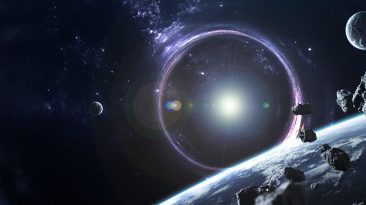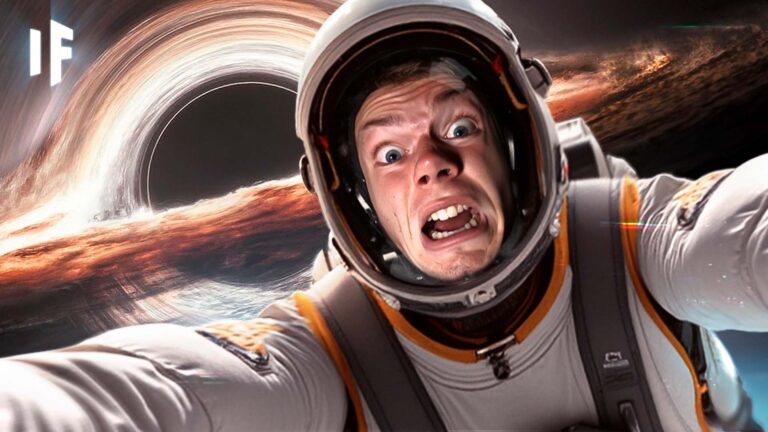
Physicists gave the process a slightly absurd name, which does nothing to soften what it actually describes. They call it spaghettification.
Cross the boundary of a black hole and gravity pulls the near side of your body far harder than the far side. You do not get crushed. You get stretched into a thin stream of matter, drawn out until nothing about you resembles a person.
And you would not need long to experience it. A nanosecond is more than enough.
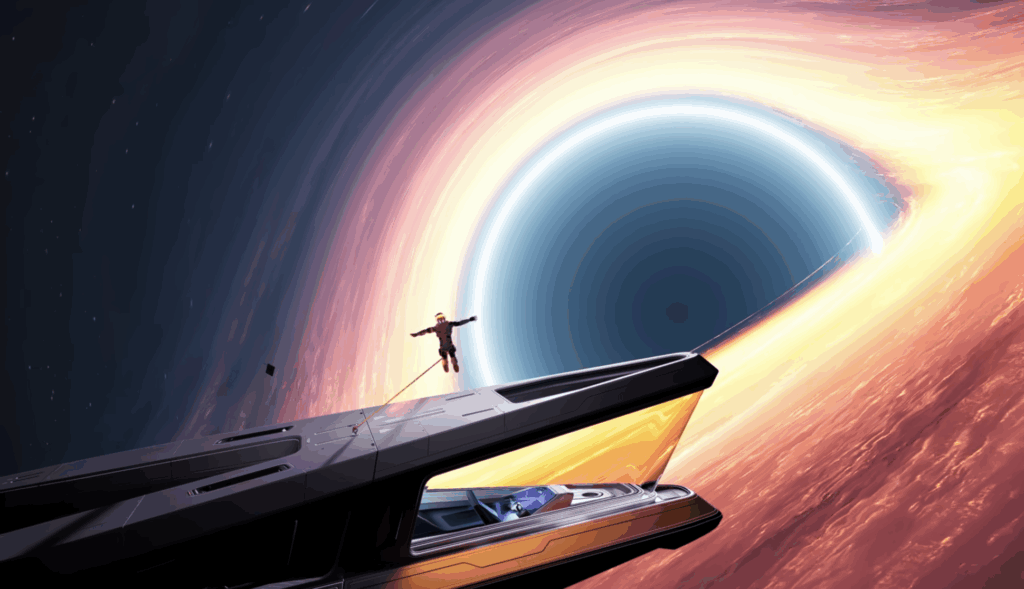
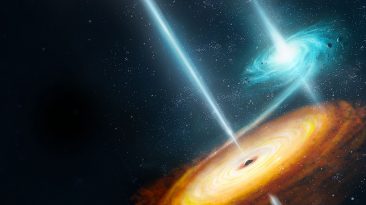
We usually picture black holes as cosmic vacuum cleaners swallowing everything nearby. The reality is stranger, because the danger comes from how differently gravity pulls on one part of you compared to another.
Approach a massive black hole and its gravity warps space and time around it. Cross the threshold known as the event horizon and the stretching begins immediately, elongating every fiber of your body beyond recognition.
It sounds like science fiction exaggeration. It is what physics predicts.
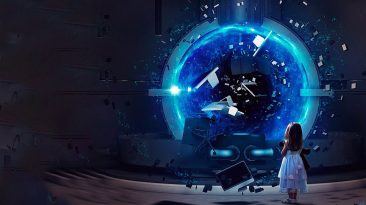
For a moment you might hope to find a wormhole instead, a tunnel through spacetime capable of depositing you somewhere else entirely. The black hole as a gateway to a parallel universe is a favorite piece of speculation, and if such a wormhole existed, a brief passage could theoretically move you into another world without destroying you first.
Even then, nothing about being near an event horizon is safe.
Time itself starts behaving strangely. Strong gravitational fields slow the passage of time relative to distant observers, an effect called time dilation. From where you stand everything feels normal, while the universe outside races ahead without you.
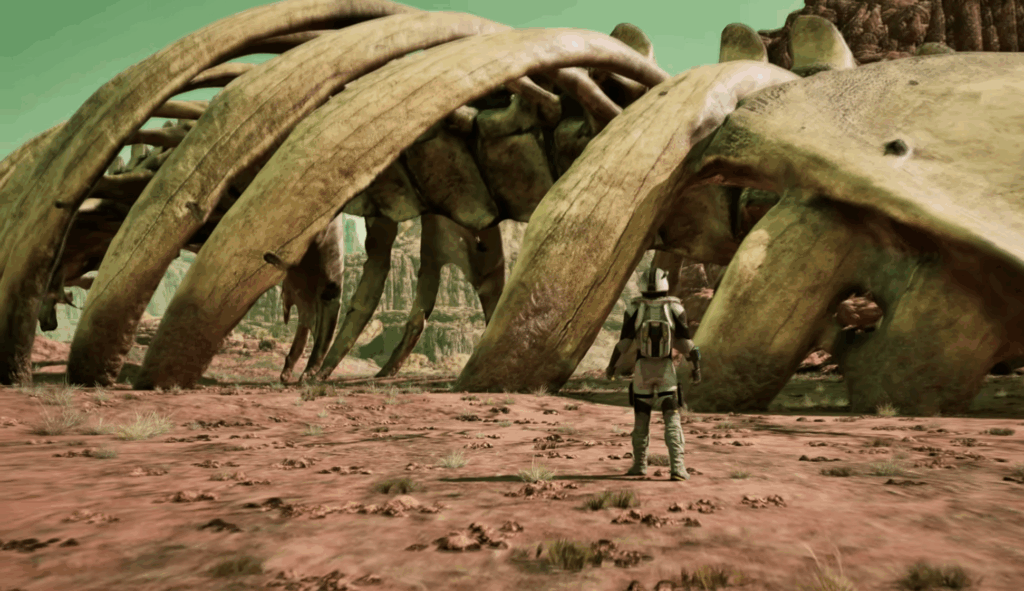
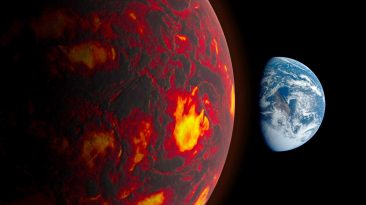
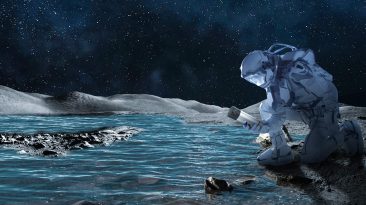
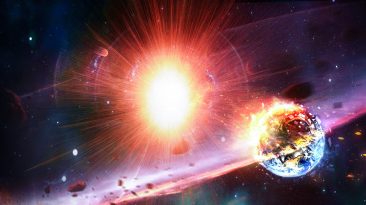
Suppose you survived the wormhole and emerged on the surface of an alien planet. You might watch catastrophic events unfolding around you, including planets colliding under the gravitational pull of the black hole.
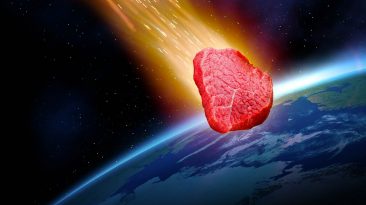
Survival would still be far from guaranteed. Meteors, collapsing planetary surfaces, and extreme gravitational effects would create an environment where staying alive requires constant care.
Push the speculation further and things get genuinely dizzying.
If multiple parallel universes exist, every possible outcome exists somewhere. A traveler could hop between them searching for one with survivable conditions, and each new universe might present completely different obstacles: enormous crowds, unexpected hazards, or realities where physical laws and social rules work nothing like ours.
In some you might land perfectly safe. In others disaster would be unavoidable from the moment you arrived.
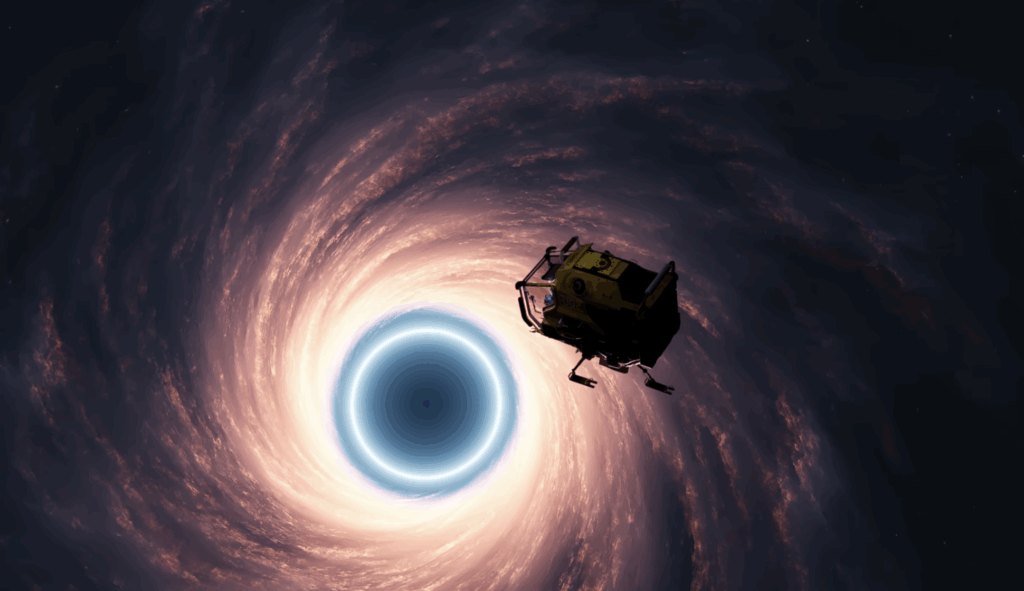
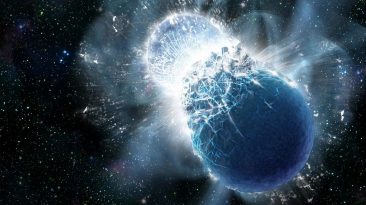
What the whole exercise really demonstrates is how extreme these objects are. Even brief contact can stretch, distort, or obliterate matter entirely, while possibly opening onto realms where ordinary rules of time and space stop applying.
Gateway or crusher, a black hole remains one of the most extreme environments in existence, a place where human intuition simply fails and imagination becomes the only usable tool.
So spending a nanosecond inside one is not really a question of survival. It is a reminder of how small and fragile we are, and how consistently the universe refuses to behave the way our understanding expects.