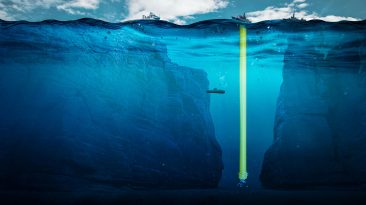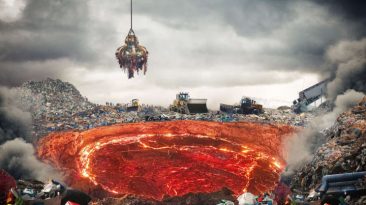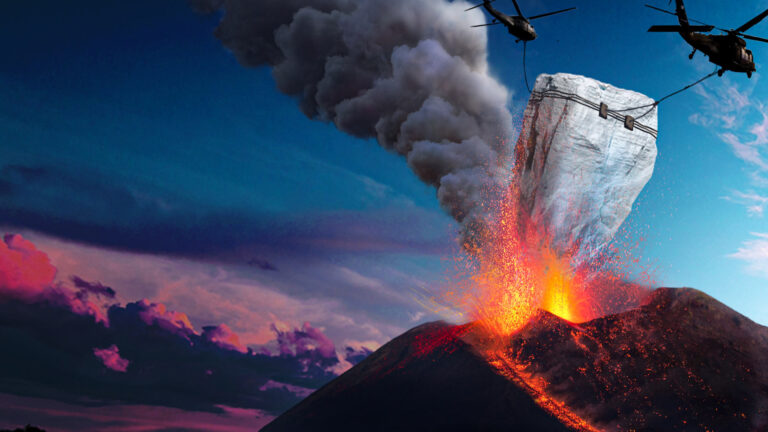
Picture yourself standing beside a volcano about to erupt, the ground is shaking, smoke is rising, and deep below, molten rock is moving towards the surface. Now picture some person coming up with the odd notion of dropping a huge iceberg into the volcano in order to cool everything down.
It sounds silly, but there is a straightforward explanation as to why the idea is appealing. Ice is freezing cold, and lava is incredibly hot. Therefore, if you placed enough ice against enough lava the result should be that it gets colder, shouldn’t it?
That wouldn’t make it any simpler.
Volcanoes have an enormous amount of heat and energy, lava can reach temperatures of over 1,000 degrees Celsius, a figure which is more than sufficient to destroy a large amount of ice almost immediately.
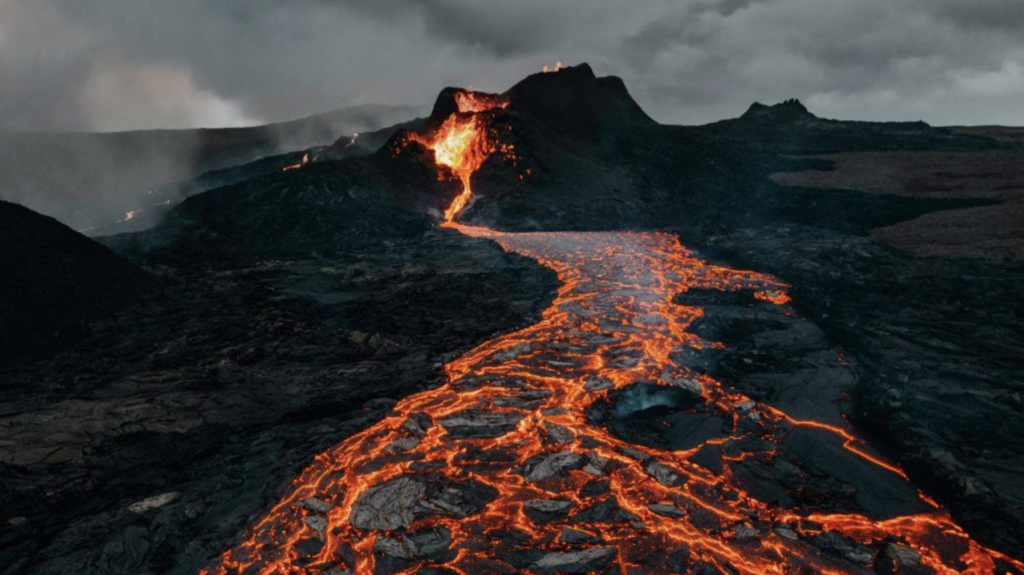
There does in fact exist a real instance of people using water to combat lava. When eruptions occurred in Iceland, firefighters and engineers pumped large quantities of seawater onto the lava as it advanced. Their objective was not to stop the eruption itself but to cool the lava and thus alter its course.
It functioned to some extent since the cooled lava moved more slowly and thus helped to protect the important areas.
That is a entirely different case when it comes to an iceberg.
Imagine now a huge piece of ice being forced into a crater containing molten rock, as soon as the iceberg comes into contact with the lava the surface of the ice will start to vanish very rapidly. The issue is that the lava is not just warm water, there is a huge difference in temperature between the two materials.
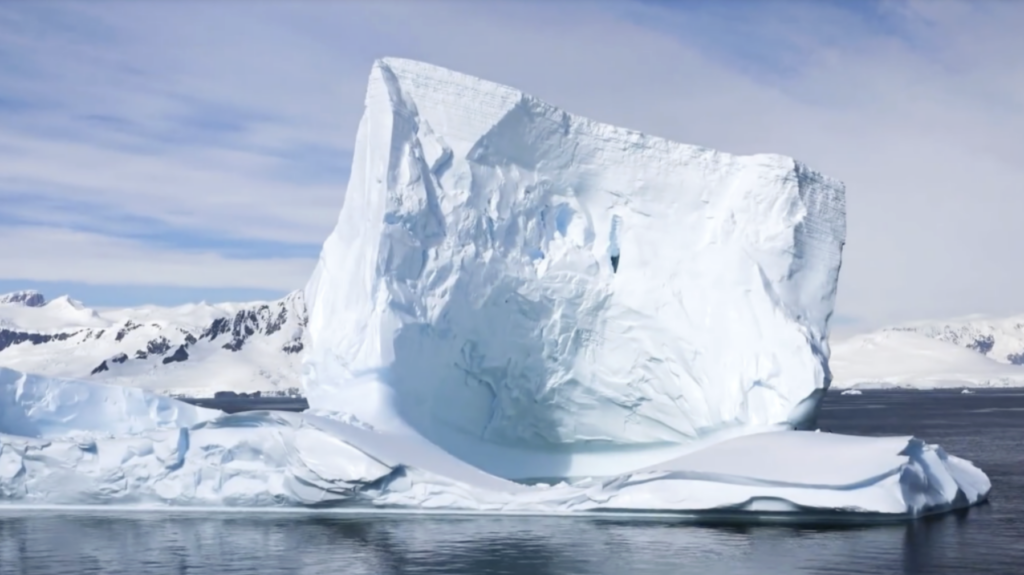
Rather than melting slowly like an ice cube in a drink, the water from the iceberg could become steam very quickly. Steam occupies much more space than the same amount of liquid water. A sudden expansion might result in a strong surge of pressure.
If a large amount of ice entered the volcano all at once, the steam could violently expel the molten rock, ash, and fragments of volcanic material from the crater. Instead of acting like a huge natural fire extinguisher, we might end up causing an explosive reaction.
There’s another possible problem.
Suppose that the ice is able to cool the top layer of the lava, the surface might then harden and act like a thick lid upon the liquid material below. At first, it might appear to be a success.
The volcano might seem quieter and the solid surface could make it look as if the lava has come to a stop. However, the conditions below the surface could be quite different. Magma has gases dissolved in it. When it rises towards the surface, the pressure diminishes and the gases thus have a chance to escape. If a thick layer of cooled material cuts off that escape route, the gases will become trapped below.
Pressure will keep on increasing beneath the hardened surface. At some point, one of them would have to give way.
If the pressure exceeded that of the rock or the cooling lava lying on it, the surface might break apart violently. This could cause the trapped gases and magma to be released in a far more explosive manner.
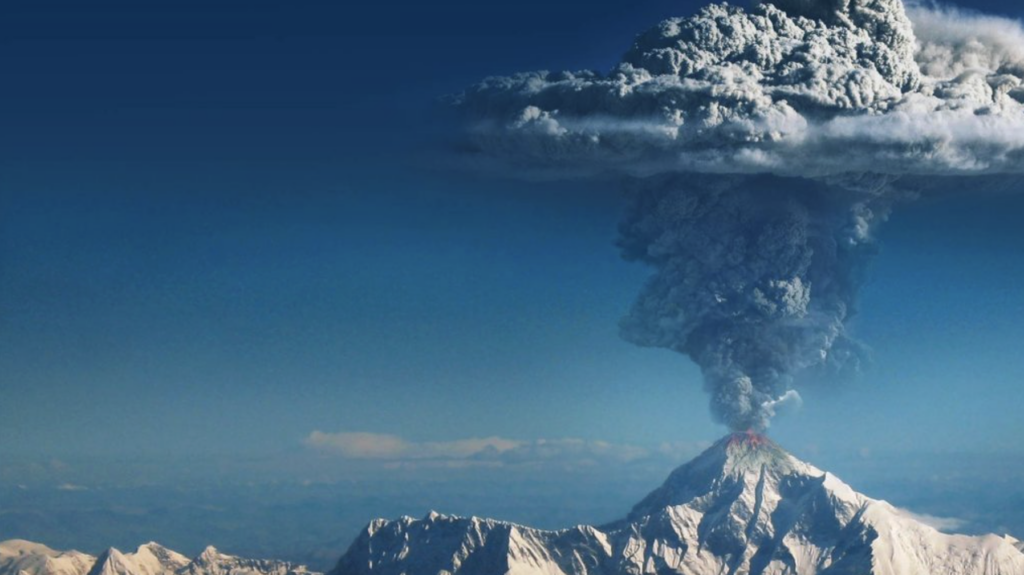
It is possible that the iceberg could make the situation worse rather than better. What needs to be understood is that a volcano is not just a huge body of molten material. Beneath the surface there are always ongoing interactions involving magma, gases, pressure, and rock.
Altering one aspect of that system can have an effect on all the other parts.
That is the reason why it is so difficult to control an active volcano, even something that appears logical, like pouring in huge quantities of a cold substance, can lead to an unexpected outcome. The greatest danger would most likely not be caused by the ice itself but by the situation that arises when huge quantities of ice suddenly come into contact with intense volcanic heat.
Steam might blow outwards, lava might be thrown into the air, and the trapped gases could cause the pressure under the surface to rise. Rather than switching off the volcano, we might accidentally provide it with another reason for erupting violently.
Therefore, should an iceberg seem to be the ideal solution for an angry volcano, it is most advisable to keep it as it is.
The notion of putting out a fire with ice works in a cartoon, but when facing one of Earth’s most powerful natural forces it could turn a bad situation into something even more dangerous.