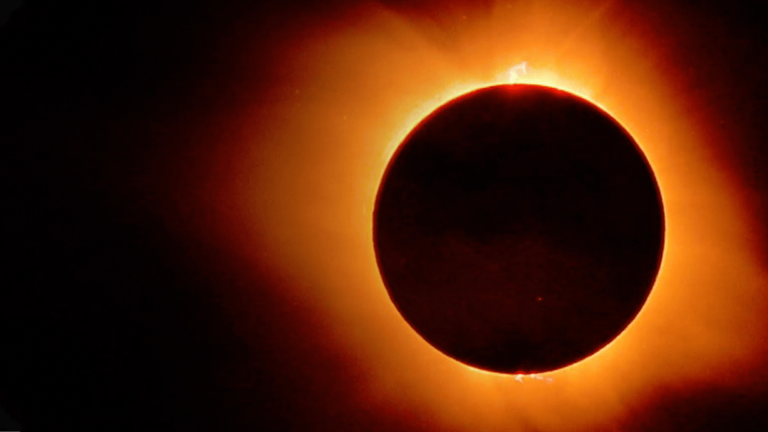
Somewhere on Earth, a circle of darkness 267 km across is crawling over the ground. That is roughly the size of West Virginia, moving across the planet, blotting out the Sun for everyone beneath it.
Underneath that shadow, the temperature falls by about 5 degrees Celsius.
And in this scenario, it never lifts.
The last total solar eclipse the world witnessed came in 2017, and sky watchers everywhere celebrated it as a rare marvel. But what if the next one simply refused to end?
Would the planet fall into permanent darkness? What would happen to the Moon? And what does it actually take for an eclipse to occur in the first place?
Humans have never handled eclipses calmly. Across history and across cultures, people interpreted them as a dragon devouring the Sun, a giant puma demon, or a pair of wolves hunting in the sky.
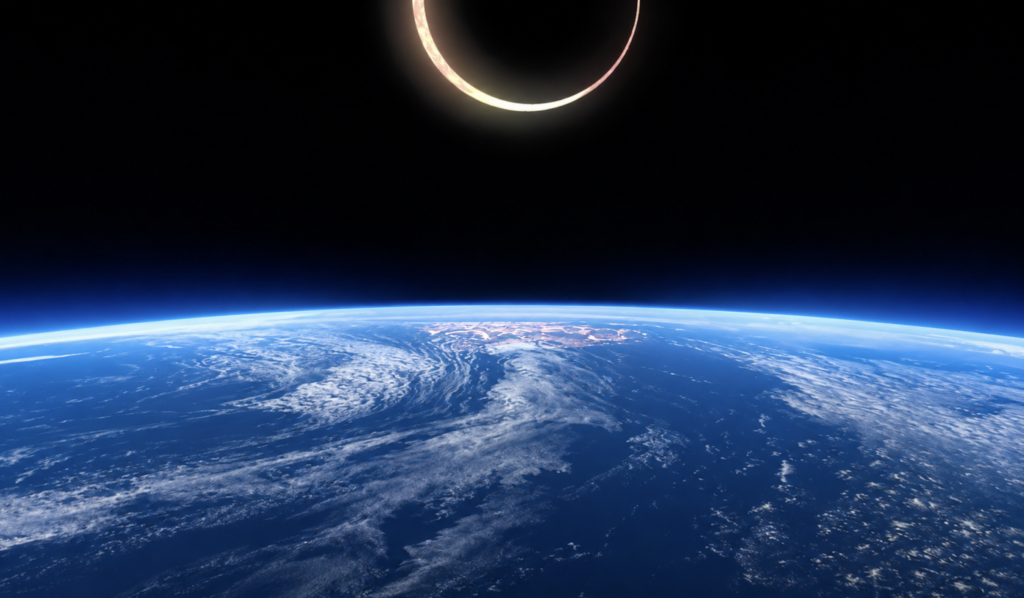
Even in 2017, with the physics fully understood, evangelist groups in the United States announced that the eclipse signaled an approaching apocalypse.
They were wrong about that one. But as you will see by the end, the version where the eclipse never ends actually does mean the end of everything.
First, understand how rare this alignment really is. A total solar eclipse requires three conditions to line up at once.
It has to be a new moon phase. The Moon has to be at perigee, its closest position to Earth. And the Moon has to sit directly in front of the Sun.
In this scenario, that rare configuration becomes permanent. So does that mean the whole planet lives in blackness?
No. And the reason comes down to the two parts of the Moon’s shadow.
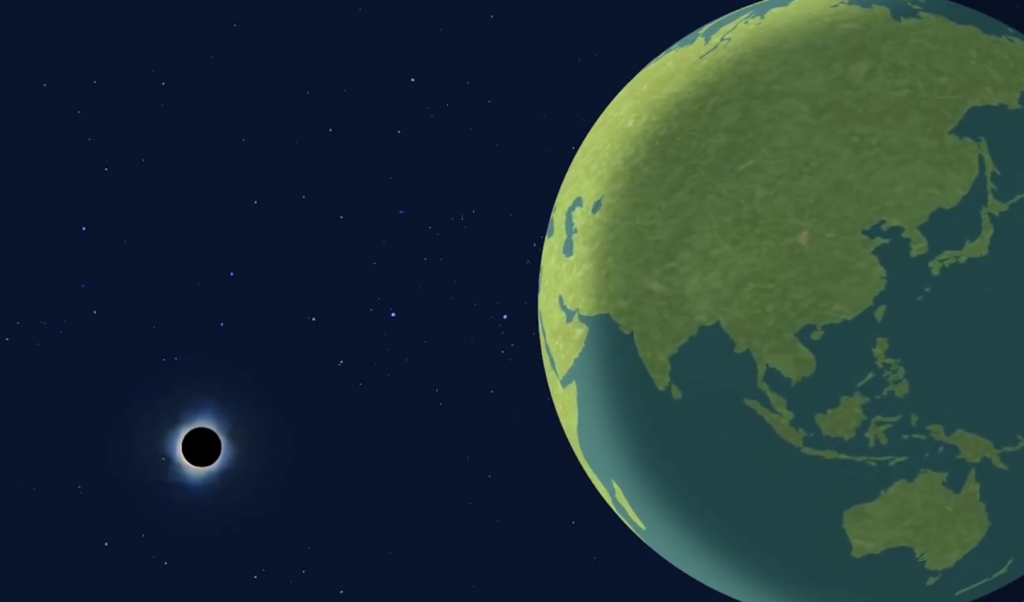
The umbra is the dark heart of the shadow, and it measures 267 km across. That is the West Virginia sized patch of total darkness. Around it lies the penumbra, the outer edge, where the Moon covers only part of the Sun.
Because of the tilt of Earth’s axis, that umbra would sweep across different regions of the globe as the seasons changed, dragging total darkness from place to place.
Everywhere else would sit under the penumbra. You would still get sunlight, just noticeably less of it, and the whole world would take on a permanently dimmed quality.
That dimming is where the real damage starts.
Life on Earth is built around the transition from day to night. Nearly every biological cycle we have, and nearly every cycle in the natural world around us, is anchored to that rhythm. A permanent eclipse would break the pattern completely.
Under the umbra, that 5 degree Celsius temperature drop sounds small on paper. It is not. Even minimal fluctuations ripple through ecosystems and agriculture.
Less sunlight and lower temperatures make farming enormously harder, which means humanity would have to reinvent how it grows food to fit a strange new cycle of light and shadow.

Then there is what it would do to us.
Cases of seasonal affective disorder would climb. SAD is a subtype of depression that strikes during long winter months at high latitudes, driven by the lack of sunshine, and living under a permanent shadow would produce the same hopelessness and drained energy on a far wider scale.
We would probably need a new name for it. Eclipse affective disorder, perhaps.
But here is the twist that turns this thought experiment from unsettling into terminal.
In a real total solar eclipse, the umbra races across the globe from west to east and lasts only about 7.5 minutes in any one spot. That motion is not optional. It happens because the Moon is orbiting the Earth, which makes a stationary eclipse physically impossible.
So there is exactly one way to get a permanent eclipse. The Moon would have to stop orbiting.
And a Moon that stops orbiting is a Moon with nothing left to resist Earth’s gravity. It would begin falling toward us. Eventually, it would destroy us.
That is the real answer hiding inside the question. A permanent eclipse would not be a climate problem or a farming problem or a mental health problem, though it would be all of those on the way down.
It would be a countdown.
An eclipse that never ends is not a beautiful sky. It is the moment you learn the Moon is coming down, and every dimmed day afterward is one day closer to impact.
Which makes a passing eclipse feel like a gift. A once in a lifetime marvel, over in minutes, precisely because everything above us is still moving the way it should.
Life on Earth depends on that predictability. And if our orderly cosmos ever stopped behaving, the darkness would be the least of our problems.