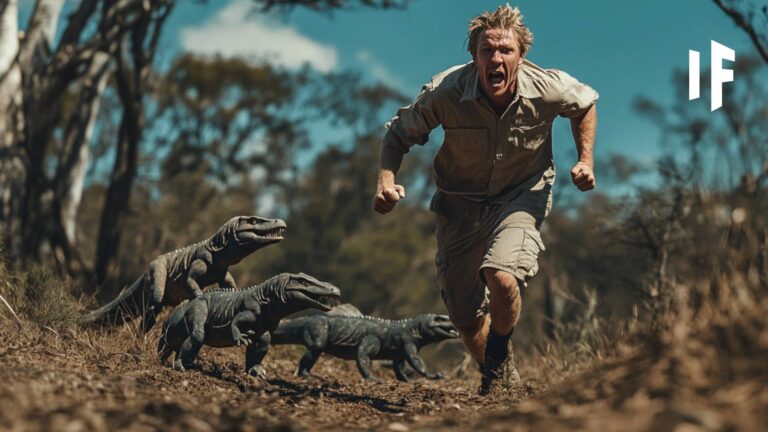
Australians love to joke that everything in their country wants to kill you. The spiders, the snakes, the jellyfish, even the birds.
They have no idea how good they have it.
Wind the clock back to the late Pleistocene, between roughly 126,000 and 12,000 years ago, and Australia was not merely dangerous. It was a continent ruled by monsters: marsupials the size of cars, lizards longer than crocodiles, snakes that crushed kangaroos, and ambush predators unlike anything alive today.
When the first humans set foot on this land, they were not stepping into a new home. They were stepping onto someone else’s hunting ground. Every waterhole, every forest, every open plain came with a simple rule: stay alert or become food.
These are the creatures that were waiting for them.
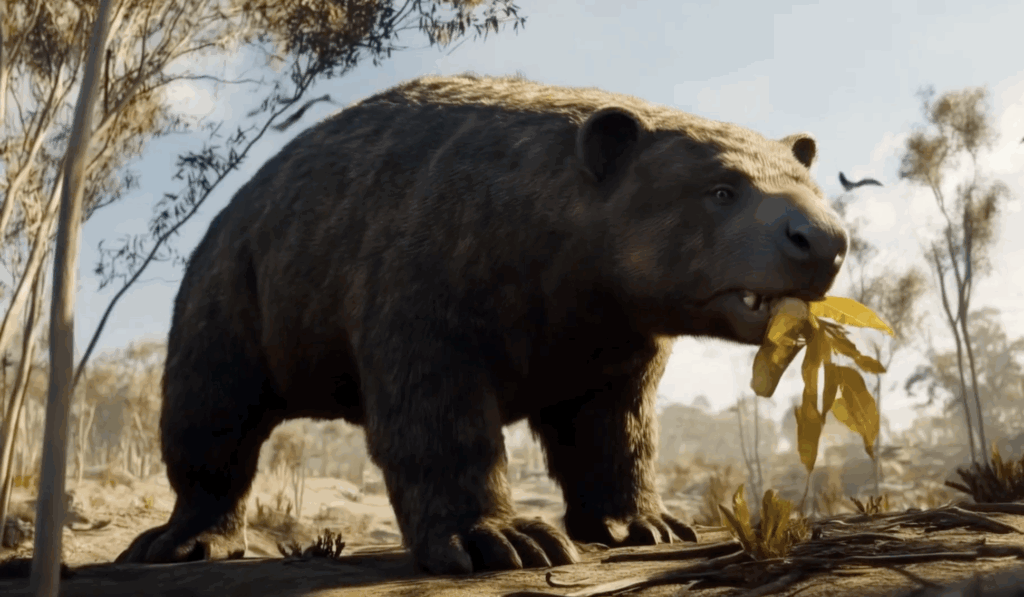
Start with the giant that, mercifully, had no interest in eating anyone. Diprotodon holds the title of the largest marsupial that has ever existed, stretching nearly four meters long and weighing as much as a small car. A walking mountain of muscle and fur.
Its secret was hidden inside its skull, which was filled with air pockets to cut down its weight, letting the animal swing that enormous head with surprising ease. It devoured leaves, shrubs, and branches in staggering quantities, and in doing so it quietly engineered the continent, scattering seeds across vast distances. Some researchers even believe early humans followed the same routes as these giants, both species chasing the same water and vegetation.
Diprotodon was proof that not every giant is a threat.
The next one was.
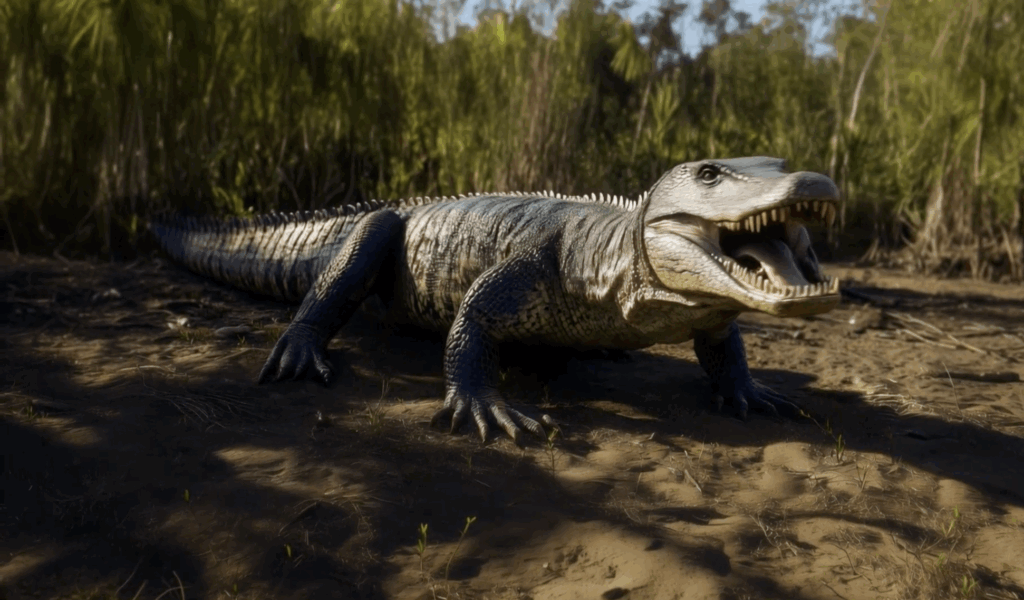
Megalania. If one name from prehistoric Australia deserves to be feared, it is this one. A monitor lizard grown to nightmare proportions, up to five meters of muscle, claws, and backward curving teeth, possibly armed with toxic saliva on top of everything else.
Think of a Komodo dragon, already one of the most unsettling predators alive today, then scale it up until it outweighs a group of grown men. That was Megalania. It was built for ambush and likely attacked anything it could overpower, from large mammals to birds. For the first humans, it meant that no stretch of open ground and no forest edge could ever be trusted completely.
And the danger did not end where the water began. It got worse.
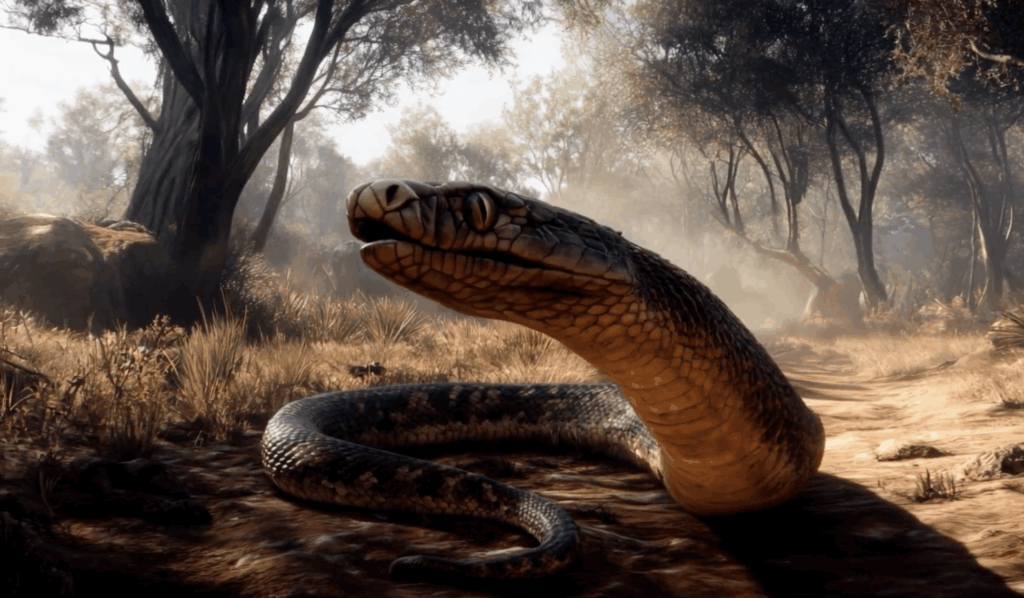
Coiled near rivers and waterholes lurked Wonambi, a constrictor snake reaching six meters in length. It carried no venom because it needed none. Its method was pure force: seize, wrap, and squeeze until nothing moved, a technique strong enough to take down kangaroos and wallabies. Early humans faced a cruel dilemma every single day, because the water they could not live without was guarded by something that hunted there.
But ask paleontologists which predator was truly the deadliest, and many point to something smaller. Thylacoleo, the marsupial lion.
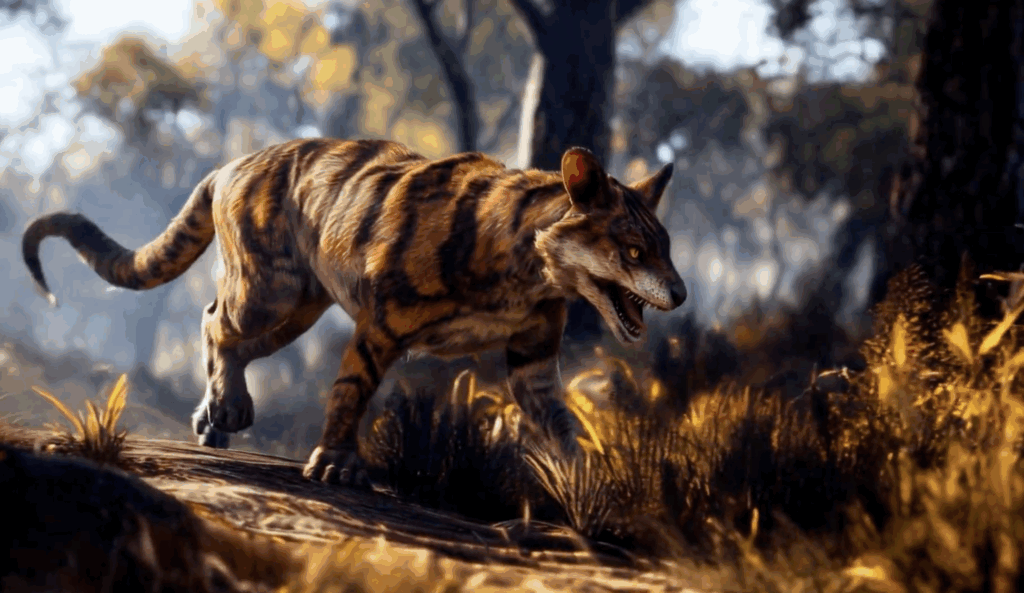
The name misleads. It was no true lion, but it occupied the same throne at the top of the food chain, and it may have earned it even more brutally. Compact and absurdly powerful, weighing around 100 kilograms or more, it carried enormous claws and specialized teeth engineered to shear through flesh and bone alike.
It was not fast, and it did not care. Thylacoleo was an ambush specialist, striking from cover in the forests and woodlands where speed means less than surprise. One perfectly timed attack was usually the only attack it needed.
Even the giant birds demanded respect. The Thunderbirds were flightless colossi standing over two meters tall and weighing up to 240 kilograms. They are believed to have been plant eaters, but a bird heavier than three grown men can afford to be peaceful, because nothing sensible provokes it. They ran fast, hit hard when cornered, and their enormous eggs hint at how deeply they shaped the vegetation and rhythms of the land around them.
So how did soft, clawless, thin skinned humans survive a continent like this?
Not with strength. With brains.
The first Australians answered the megafauna with sharpened stone and bone, with spears, and above all with fire. Flames held the night predators at a distance and doubled as a landscaping tool, clearing terrain so that nothing could strike unseen. Shelters built from rock formations and even animal bones added another layer between soft bodies and hard teeth.
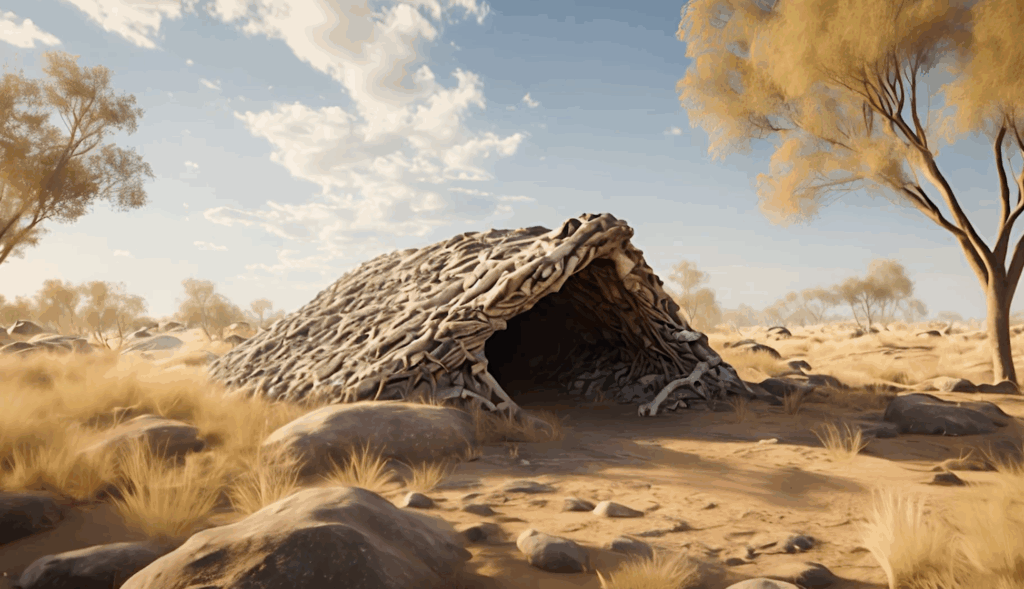
They learned the land like a chessboard. Coastal regions offered steadier food, inland deserts demanded constant adaptation, and moving between them meant reading water sources and seasons with precision. Groups that communicated and coordinated survived. Groups that did not became statistics in the fossil record.
Then, one era at a time, the monsters vanished, and the reason remains one of the fiercest debates in prehistoric science.
Humans reached Australia around 65,000 years ago and shared the continent with these giants for tens of thousands of years. Some scientists argue human hunting slowly bled the megafauna dry. Others blame the dying Ice Age, with its shifting rainfall, rising temperatures, and collapsing habitats crushing animals too specialized to adapt. The most likely truth is both at once, twin pressures squeezing the giants out of existence.
With them gone, Australia was reborn. Ecosystems reorganized, the balance of predator and prey reset, and a species with no claws, no armor, and no venom quietly took over the continent.
That is the forgotten story of Australia. Long before it was the land of spiders and snakes, it was a land of true giants, a place where terror had teeth measured in centimeters and bodies measured in meters, and where the most dangerous survival test our species ever faced was simply making it through the day.