Humans dominate Earth today, building cities, launching spacecraft and transforming the planet in ways no other known species ever has.
But what if we were not the first civilization to reach this level of technological advancement? Considering Earth’s immense history, some scientists have wondered whether another intelligent species could have risen, flourished and disappeared millions of years before humans ever existed.
While there is no evidence that such a civilization existed, the idea raises fascinating questions about what traces it might have left behind and whether we would even recognize them today.

Complex life has existed on Earth for roughly 400 million years, while our modern industrial civilization is only a few hundred years old. Compared to the planet’s history, humanity’s time at the top has been incredibly brief. During those hundreds of millions of years, there was plenty of time for another intelligent species to evolve, develop advanced technology and vanish long before humans appeared. The biggest challenge is that the farther back we look, the fewer clues survive.
Unlike ancient human civilizations that left behind ruins and artifacts, a civilization millions of years old would be almost impossible to detect. Buildings eventually collapse, metals corrode and even the strongest materials slowly break down under the forces of nature.
Over millions of years, earthquakes, volcanic eruptions and erosion would erase nearly every visible sign of an advanced society. Even if massive cities once existed, they could easily disappear beneath layers of rock or ocean sediments.
Fossils are not much more helpful. Only a tiny percentage of living organisms ever become fossilized, and the process depends on very specific environmental conditions.
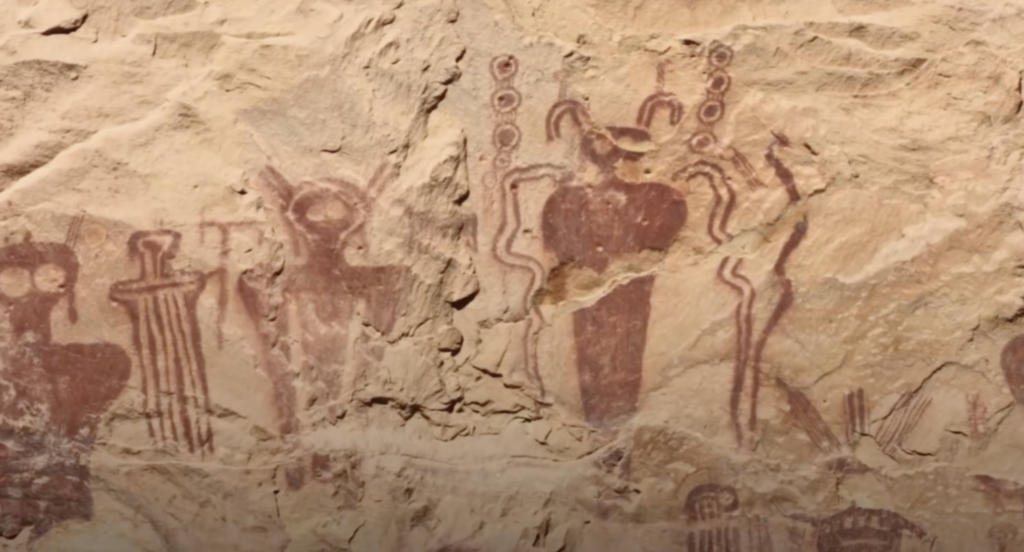
Even if an advanced civilization lasted for 100,000 years, hundreds of times longer than modern industrial society has existed, there is no guarantee that any direct evidence of its inhabitants would survive. Entire species have left only a handful of fossils, making it entirely possible that traces of an ancient civilization could simply be missing from the geological record.
Because physical evidence is so unlikely to survive, scientists have proposed looking for indirect signs instead. One possibility would be unusual chemical signatures preserved in ancient sediment layers.
Today’s civilization is already leaving behind enormous amounts of artificial materials, fertilizers, plastics and radioactive particles that will remain detectable long after cities disappear. Future scientists studying Earth’s rocks millions of years from now could easily recognize that something unusual happened during our era.
Modern agriculture is already changing the chemistry of lakes and oceans. Fertilizers wash into waterways, creating oxygen poor dead zones that become permanently recorded in sediments on the seafloor. At the same time, plastics, industrial chemicals and synthetic compounds are accumulating throughout the environment.

These substances do not occur naturally in such large quantities, making them potential markers of an industrial civilization even after all visible structures have vanished.
Another possible clue comes from fossil fuels. Burning coal, oil and natural gas releases carbon with a distinctive chemical signature into Earth’s atmosphere.
This changes the balance of carbon isotopes in ways that can be measured millions of years later. If another civilization had relied heavily on fossil fuels before disappearing, scientists might eventually detect a similar chemical fingerprint preserved in ancient rocks, even if every building and machine had long since disappeared.
Some researchers have even suggested that advanced civilizations could follow predictable life cycles. As industrial societies consume fossil fuels, they alter the planet’s climate and oceans. These environmental changes could eventually contribute to the civilization’s decline while also creating conditions that help form new fossil fuel deposits over geological timescales. In theory, one civilization’s collapse could unknowingly provide energy resources for another intelligent species millions of years later.

Although no convincing evidence has ever been found for a prehistoric technological civilization, exploring the possibility offers an important lesson. By studying the long term impact of our own civilization, scientists can better understand how human activity changes the planet and what evidence we may leave behind for the distant future. Whether or not another civilization ruled Earth before us, our actions today will become part of the geological record for millions of years.
For now, humanity remains the only known advanced civilization to have existed on Earth. But the planet’s vast history reminds us how little we truly know about its distant past. If an ancient civilization once rose and disappeared without leaving obvious traces, discovering it would be one of the greatest scientific breakthroughs in history. Until then, the idea remains an intriguing possibility that challenges us to think differently about both Earth’s past and humanity’s future.