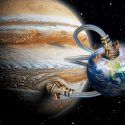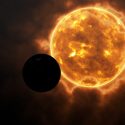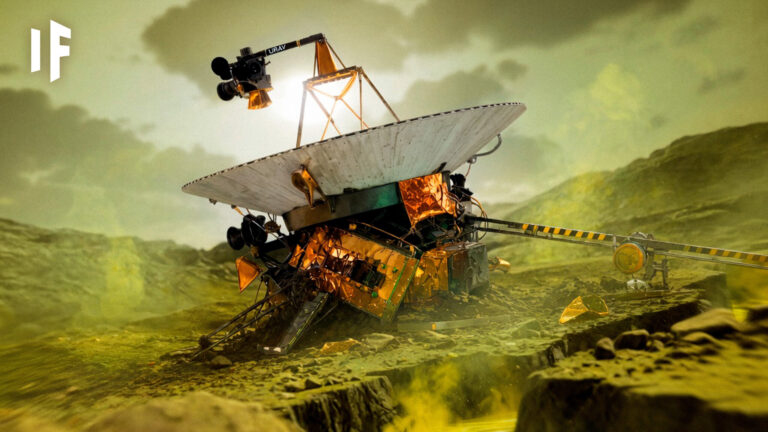
Voyager 1 is on a journey that will outlast civilizations, outlive the Sun’s familiar neighborhood, and eventually drift into regions of space no human made object has ever reached. It is moving without brakes, without a destination it was designed for, and without any real chance of being redirected. In the far future, it may even pass close to a distant world like Proxima Centauri b, raising a fascinating question. What would happen if humanity’s most distant messenger finally reached another planetary system?
To understand that possibility, we have to start with where Voyager 1 is right now and how it got here.
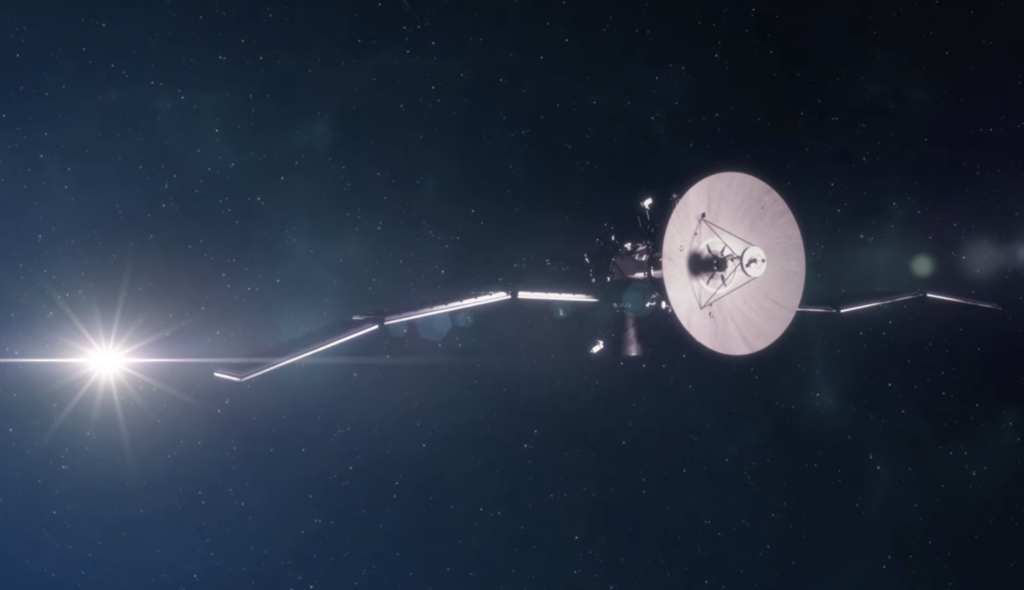 Launched in 1977 by NASA, Voyager 1 was originally designed for a short mission to study Jupiter and Saturn. It was expected to last only a few years. Instead, it has become one of the most important deep space missions ever launched, continuing to send data back to Earth nearly half a century later. Along the way, it transformed our understanding of the outer planets and gave humanity its most iconic perspective on itself.
One of its most famous achievements came in 1990, when Voyager 1 turned its camera back toward Earth from about six billion kilometers away. The result was the image known as the Pale Blue Dot. Earth appears as a tiny speck suspended in sunlight, a reminder of just how small and isolated our world is in the vastness of space.
Today, Voyager 1 is more than 25 billion kilometers from Earth. Even at the speed of light, its signals take nearly an entire day to reach us. In November 2026, it will reach another milestone when communication becomes effectively a one light day round trip. That means a message sent from Earth will take 24 hours to arrive and another 24 hours to return. For comparison, signals reach the Moon in just over a second and the Sun in about eight and a half minutes.
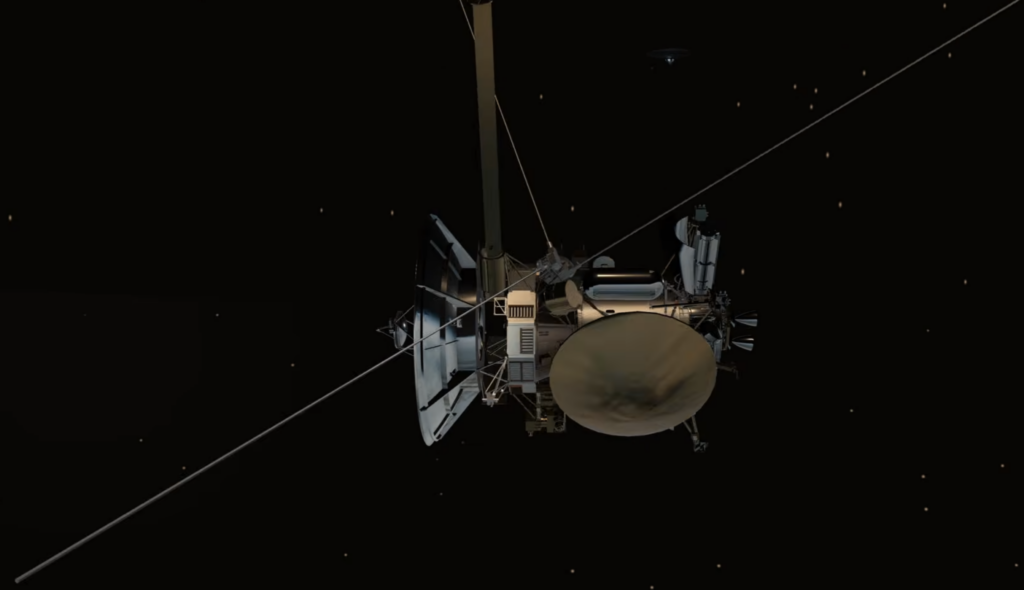
Voyager 1 is traveling at around 61,000 kilometers per hour. That sounds fast by human standards, but space is so vast that even this speed turns its future into a journey lasting tens of thousands of years.
Before leaving our solar system, Voyager 1 crossed one of the most important boundaries in space science, the heliosphere. This is a vast bubble created by the solar wind, which shields our solar system from much of the radiation coming from the galaxy. Voyager 1 crossed this boundary in 2012, becoming the first human made object to enter interstellar space.
Onboard instruments such as its magnetometer confirmed the transition by detecting changes in magnetic fields. Other systems helped it study Jupiter’s storms, Saturn’s rings, and dozens of moons during its planetary flybys. Many of these instruments have since been turned off to conserve power, but the spacecraft continues its slow drift outward.
It also carries one of humanity’s most symbolic artifacts, the Golden Record. This phonograph disc contains images, music, and sounds from Earth. It was designed as a message to any extraterrestrial intelligence that might one day find it. It includes greetings in multiple languages, natural sounds like wind and thunder, and music ranging from classical compositions to modern recordings. It also contains scientific information about humanity and the location of Earth in the galaxy.
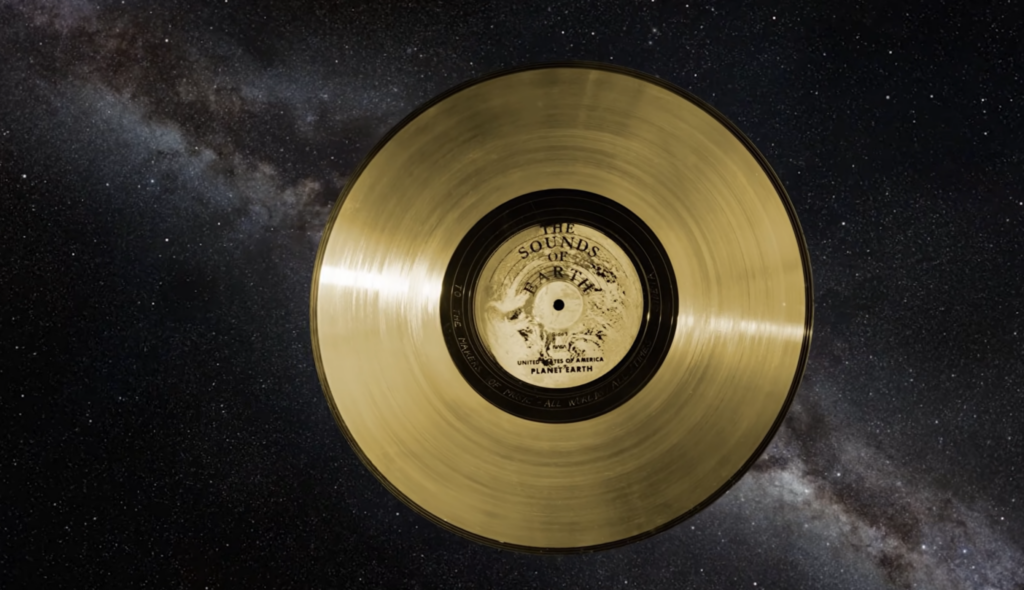
The idea behind the Golden Record was simple but profound. If Voyager 1 is ever discovered, it could tell the story of a civilization that once lived on a small blue planet orbiting an ordinary star.
At the moment, however, Voyager 1 is not heading toward any known planetary system. Its trajectory is taking it in a completely different direction, toward a distant region of the galaxy where stars like Gliese 445 drift through space. There are no confirmed planets in its direct path.
Far into the future, this raises an interesting possibility. If its course were altered by a gravitational encounter with a rogue object or distant planetary body, it could theoretically be redirected toward another star system.
One of the most intriguing candidates is Proxima Centauri b, an exoplanet located in the closest known star system to Earth. It orbits Proxima Centauri, a red dwarf star about 4.2 light years away. Even though it is the nearest neighbor, that distance still equals about 40 trillion kilometers.
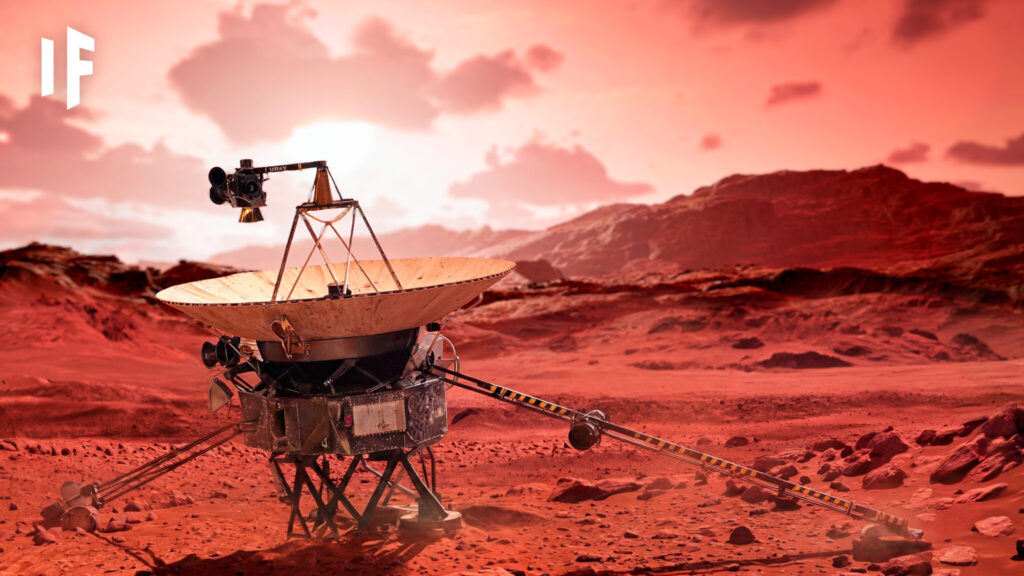
If Voyager 1 were somehow aimed in that direction, the journey would take around 75,000 years. That is longer than recorded human history many times over. It would mean the spacecraft could still be traveling long after Earth’s current civilizations have changed beyond recognition.
However, Voyager 1 is not guaranteed to remain functional that long. By around 2036, scientists expect it may lose contact with Earth as its power supply continues to weaken. The spacecraft uses radioisotope thermoelectric generators, which produce electricity from the heat of decaying plutonium. These systems slowly lose power over time, reducing available energy for instruments and communication.
Once contact is lost, Voyager 1 will become silent. It will still move through space at the same speed, but it will no longer speak to Earth. It will effectively become a drifting relic of human civilization.
Even in silence, its journey continues. Over tens of thousands of years, it will pass through the outer regions of the solar system and enter the Oort Cloud, a vast spherical shell of icy objects surrounding our Sun. This region may extend nearly 100,000 astronomical units from the Sun and contains billions of comet like bodies. It is considered the outermost boundary of our solar system.
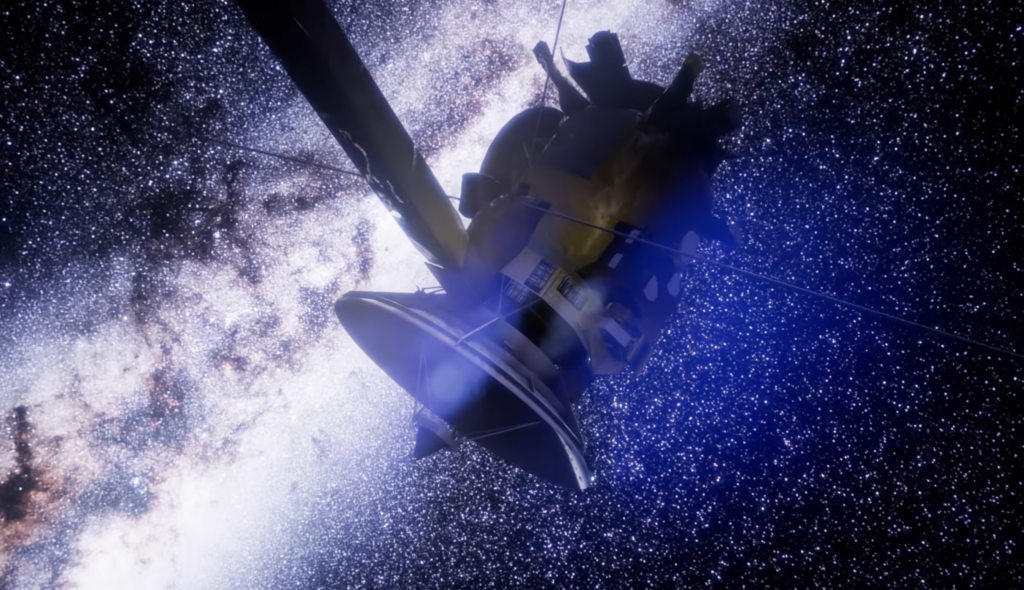
Passing through this region would expose Voyager 1 to potential gravitational disturbances from comets or even unseen objects, although the vast distances between them make collisions extremely unlikely. Most likely, it would simply drift through empty cold space, surrounded by ancient ice that has existed since the formation of the planets.
Eventually, Voyager 1 would leave the Oort Cloud entirely and continue into interstellar space, where it would remain for millions or even billions of years unless it encountered something in its path.
If it ever reached a planet like Proxima Centauri b, the outcome would depend on conditions we can only estimate. The planet is believed to be tidally locked, meaning one side always faces its star while the other remains in darkness. One side may experience extreme heat and radiation, while the other remains frozen.
Voyager 1 would not land gently. It would strike the atmosphere at extremely high speed, likely around 20 kilometers per second relative to the planet. Without a heat shield, it would disintegrate almost instantly. Most of its structure would vaporize, leaving only small fragments and possibly the most durable components, such as its nuclear power modules, to survive briefly before breaking apart.
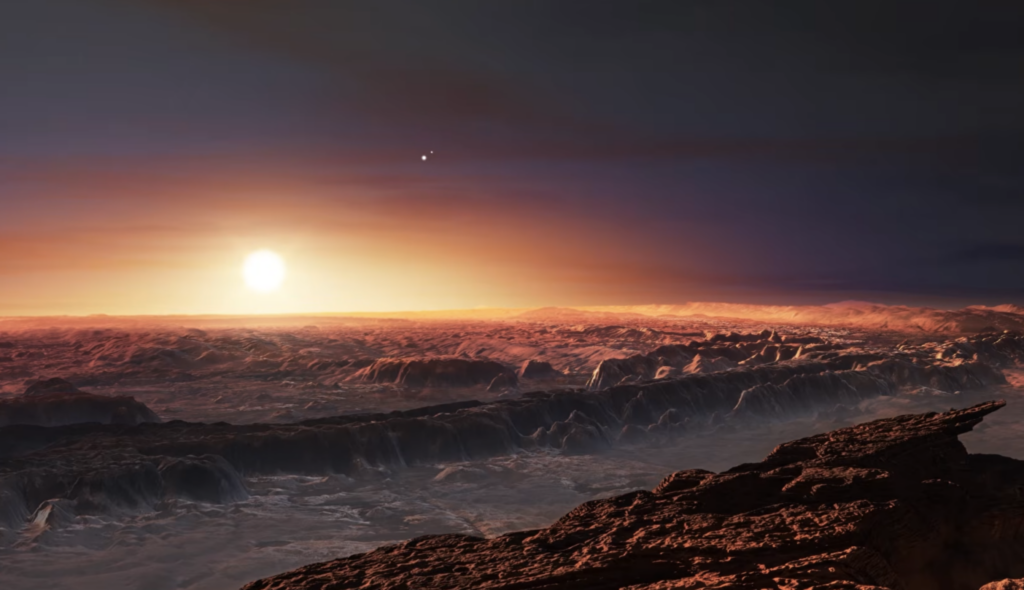
Even in destruction, the Golden Record might remain partially intact. Made of gold plated copper, it is one of the most durable objects ever sent into space. If it survived impact, it could eventually rest on the surface of another world as a silent artifact of an alien civilization.
If an intelligent species ever discovered it, they might decode the pulsar map etched into its cover. That map shows the location of Earth relative to known pulsars, acting as a kind of cosmic address. It is one of the most deliberate attempts humanity has ever made to say we were here.
What makes Voyager 1 remarkable is not just where it might go, but how far it has already traveled beyond its original purpose. It has crossed boundaries no spacecraft was expected to survive, sent back discoveries that reshaped planetary science, and carried a message of humanity far beyond the reach of the Sun.
Whether it ultimately drifts forever in darkness or one day encounters another world, Voyager 1 represents something larger than itself. It is a reminder that exploration does not always end where we expect. Sometimes, it continues long after we stop listening.