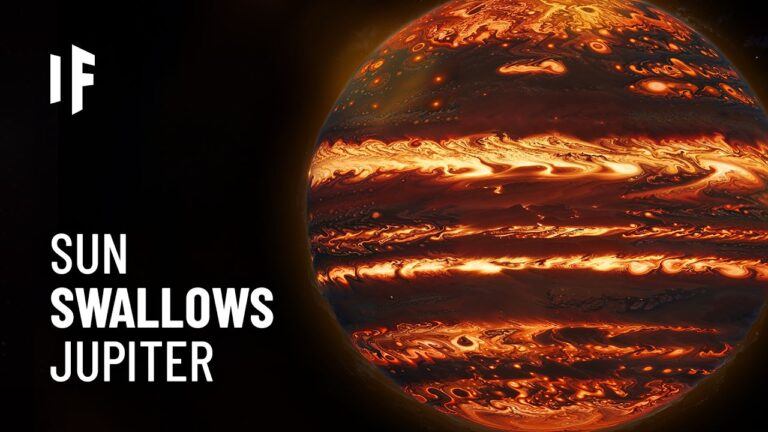
In order for Jupiter to crash into the Sun, something truly extraordinary would need to happen. Its orbit would need to be drastically altered by a gravitational disturbance. And not just any disturbance. An absolutely massive one.
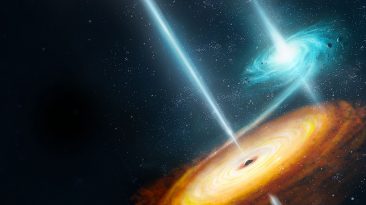
The most likely culprits would be a rogue star or black hole passing dangerously close to our Solar System. And these objects would have to be really huge. At the very least, they’d need to be a couple times more massive than our Sun.
But, there’s a pretty big catch here, though. Somehow, these gigantic rogue objects would have to pass by at the exact right moment. A moment where they would only impact Jupiter. Otherwise, it wouldn’t be the only planet in our neighborhood careening out of orbit and toward imminent heat death.
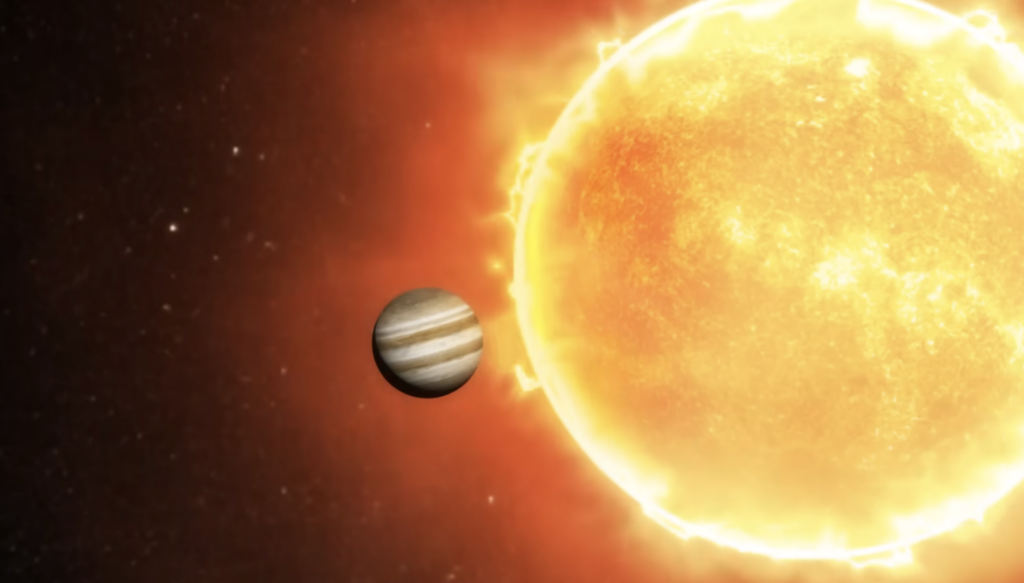
After a few billion years of orbiting the Sun at an average distance of 778 million km (484 million mi), Jupiter would begin its death dive toward our star. But this wouldn’t happen overnight. It could take years, decades, maybe even centuries.
The gas giant would need to travel this incredibly vast distance, accelerating faster and faster under the immense pull of the Sun’s gravity. This process is known as spiraling orbital decay and it would result in Jupiter orbiting in tighter and tighter spirals until, well, it reaches oblivion.
The next phase of this planetary destruction would occur when Jupiter would be close enough to be torn apart. This is known as the Roche limit. And for a body as big as Jupiter, it would begin when it’s just under 900,000 km (556,000 mi) from the Sun.
At a distance this close, the planet would likely become tidally locked, just like Mercury is. This means that it would only make one full rotation on its axis for every full revolution around the star. But for that to occur before the planet starts to disintegrate, it’s rotation speed would also need to undergo significant changes.
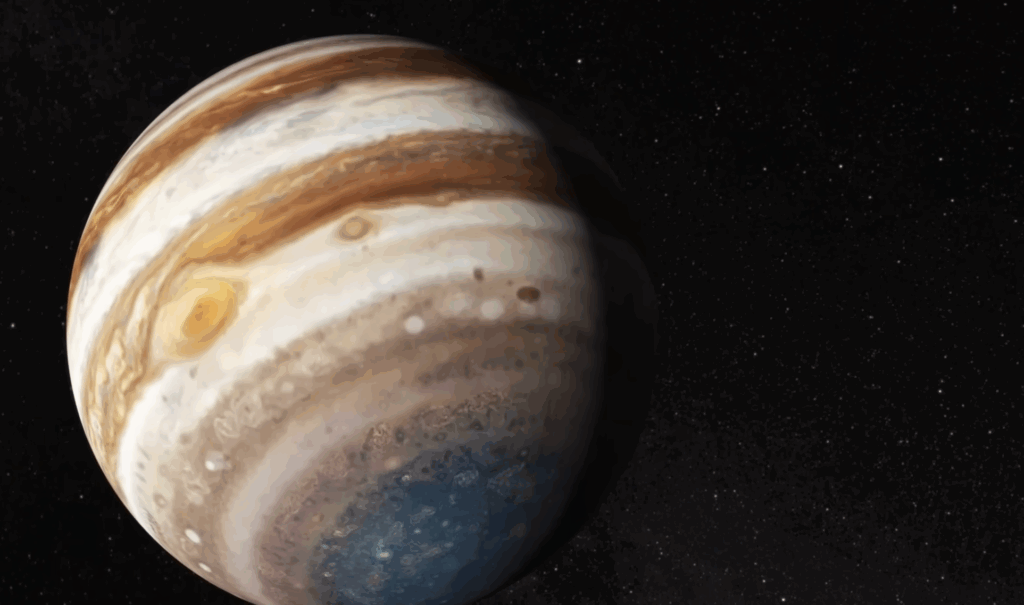
Currently, Jupiter makes one full turn every 10 hours. But to become truly tidally locked at this distance it would need to more than double its rotational speed.
If this were to happen, only one side of Jupiter would ever fully face the Sun. And each of the two sides would experience varying levels of gravitational pull with the day side, or near side, getting stretched out more and more.
Jupiter would no longer resemble a gigantic gaseous sphere. Instead it would have a more oblong, elliptical shape. You can almost imagine Jupiter going through the process of getting spaghettified, like what happens when an object crosses over the event horizon of a black hole. Though this would be slightly less extreme.
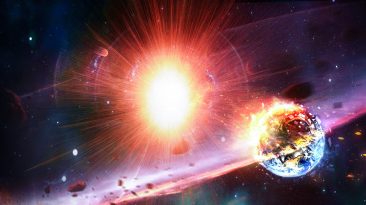
But that doesn’t mean it’s not the end of days for our biggest neighbor. Its atmosphere would be getting stripped away, forming a glowing ring of dust and gas around the Sun. This is called an accretion disk.
And, this is where Jupiter’s existential plunge would get really interesting. Both the planet and the Sun are mostly made up of hydrogen and helium. So as Jupiter gets absorbed, would the Sun get bigger and more powerful?
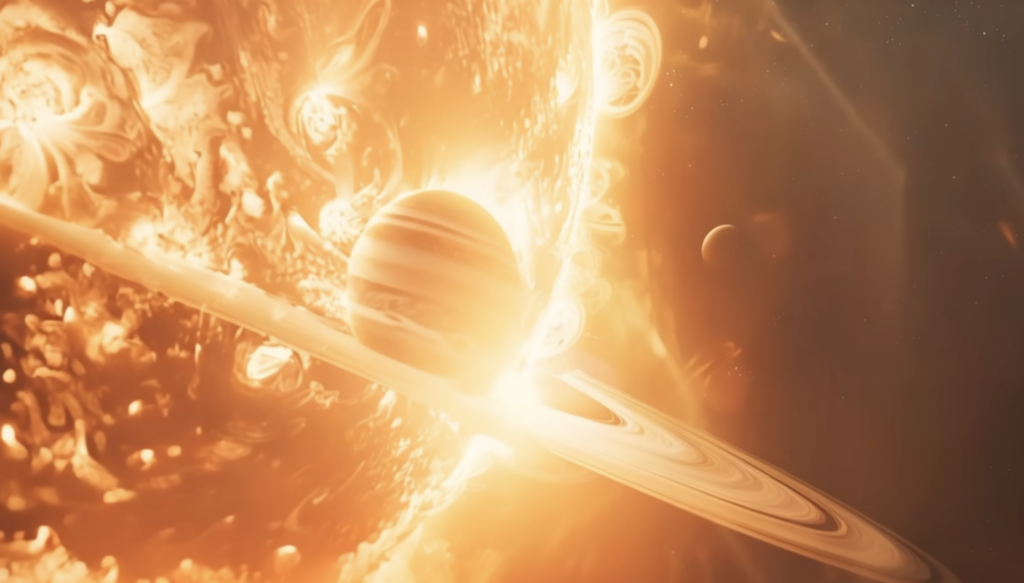
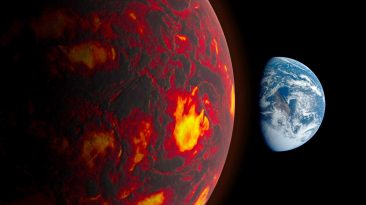
Considering that our planet is already warming at a dangerous pace, this could trigger some alarm bells for you. But don’t worry too much. This collision isn’t about to change much in terms of the Sun’s energy output.
As big as Jupiter is, it’s only about 0.1% the mass of the Sun. So we’re not talking about a hugely noticeable difference. For a short amount of time, the Sun would be a bit brighter as it converts all of Jupiter’s energy.
This would be the first effect that this whole scenario would have back here on Earth. You’d be treated to a little extra sunlight during the day and the night sky would be a bit brighter as you’d watch Jupiter’s final days before it vanishes into the Sun.
The biggest effect would come from the gigantic gravitational hole that Jupiter would be leaving in our Solar System. For billions of years, it acted as so-called cosmic vacuum cleaner by attracting comets and asteroids of all shapes and sizes.
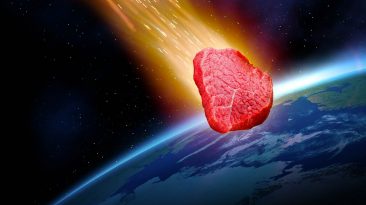
Without its presence, Earth would find itself exposed to dangers in entirely new ways. The chances of impacts from large objects, known as planet killers, would become higher. And that would be one of the greatest existential risks for all lifeforms on our planet.