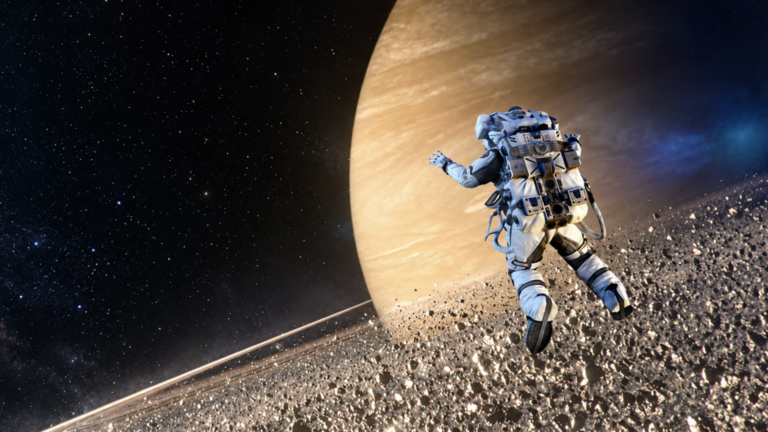
Trying to reach Saturn would take you into one of the strangest and most dangerous environments in the Solar System. From Earth, the planet appears peaceful, surrounded by its beautiful rings. Up close, however, that peaceful appearance disappears, revealing a world of violent storms, crushing pressure, freezing temperatures, and conditions no human could survive.
Before reaching the planet itself, you would encounter Saturn’s remarkable collection of moons. Enceladus would stand out with its bright icy surface, while distant Iapetus has an unusual two toned appearance. Then there is Titan, the largest of Saturn’s moons and one of the most scientifically fascinating places in the outer Solar System. Every one of these worlds could become an expedition of its own, yet Saturn would remain ahead.
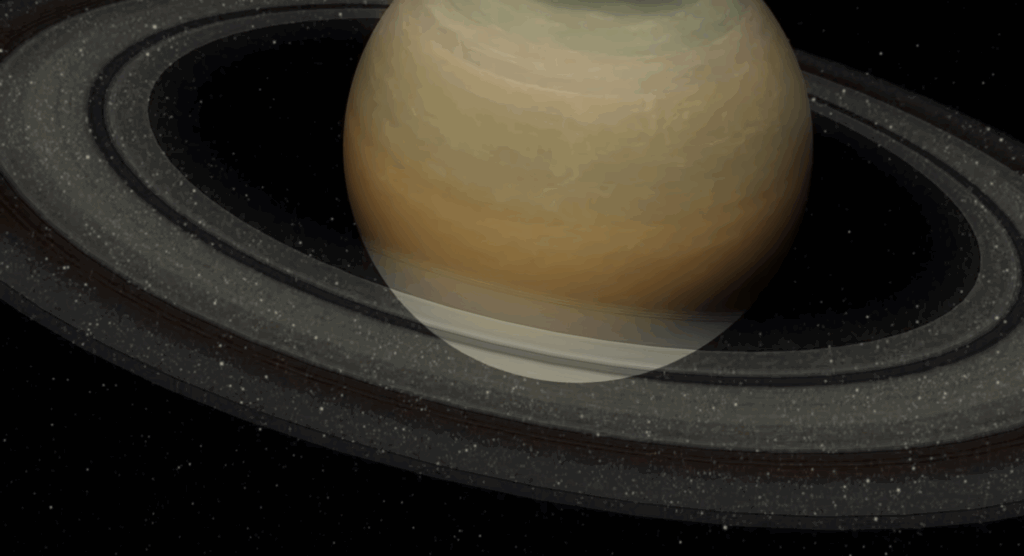
Eventually, your journey would carry you into Saturn’s enormous ring system. Although they look like solid bands from far away, the rings are actually made from billions of individual pieces of ice and dust. They orbit the planet at tremendous speeds, meaning a spacecraft moving through them would encounter a constantly shifting field of material rather than a smooth path through space.
As the journey continued toward the planet, Saturn’s atmosphere would begin filling your view. Hundreds of kilometers above the clouds, unusual glowing effects can appear as charged particles and hydrogen interact with radiation from the Sun. The sight might be spectacular, but it would be an early warning that you were approaching an environment governed by extreme atmospheric forces.
Near Saturn’s northern pole lies one of the Solar System’s most unusual atmospheric formations. Its enormous six sided pattern, known as the hexagon, surrounds a powerful polar storm. The structure is wider than Earth and contains winds moving at extraordinary speeds. Despite decades of observations, scientists are still investigating exactly how this remarkable pattern maintains its unusual shape.
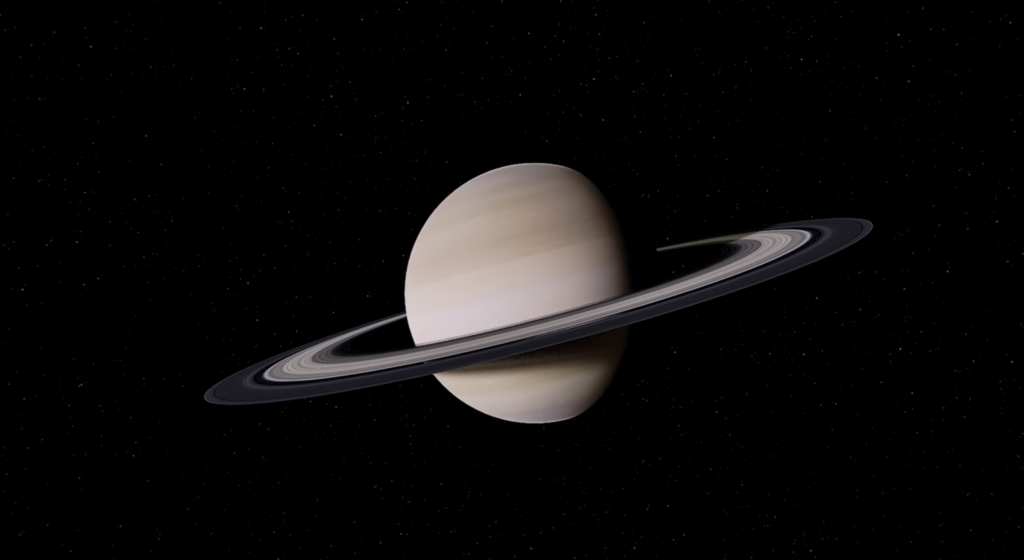
The upper atmosphere would be immediately hostile to an unprotected human. Temperatures can fall to roughly minus 250 degrees Celsius, while layers of ammonia ice and other chemicals form clouds throughout the atmosphere. There would be no breathable air and no way for a human body to remain intact in these conditions.
Moving farther downward would make the situation increasingly dangerous. Pressure would begin climbing rapidly as the atmosphere became denser. Instead of feeling like ordinary air, the surrounding material would eventually exert forces vastly greater than those experienced in even the deepest parts of Earth’s oceans.
At some point, you would reach what is sometimes casually described as Saturn’s surface. But that description is misleading because Saturn has no solid surface like Earth. What appears to be the planet’s surface from space is actually an upper atmospheric boundary where increasingly dense gases begin transitioning into deeper layers.
Farther below, the enormous pressure would force hydrogen and helium into completely different physical states. Instead of remaining ordinary gases, they would gradually become liquids as pressure increased. These dense layers would surround the deeper interior of Saturn, creating an environment unlike anything found naturally on Earth.
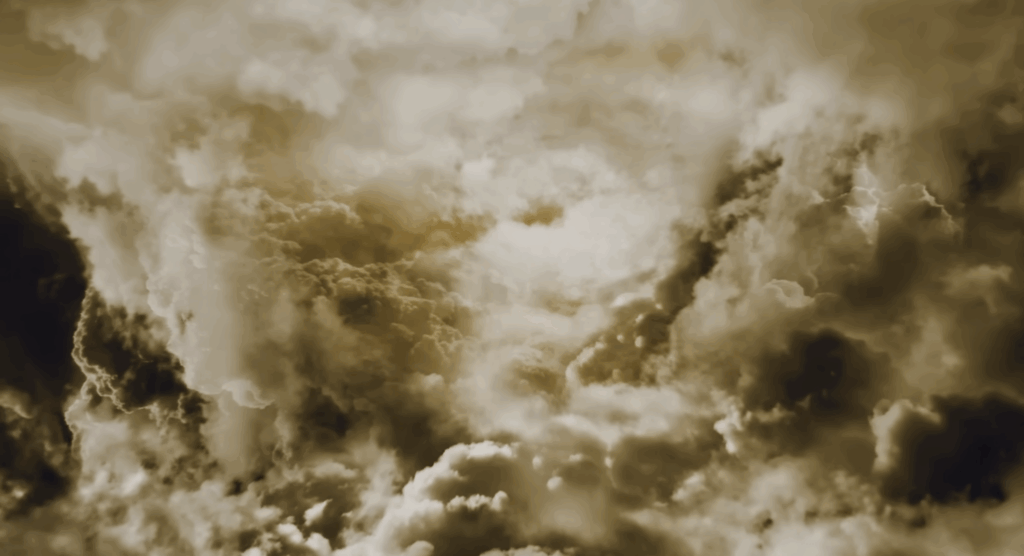
The deeper you traveled, the more extreme everything would become. Temperatures could eventually climb beyond 11,000 degrees Celsius, while pressure would reach thousands of times the pressure found at Earth’s surface. Scientists believe Saturn contains a dense central region that may be several times more massive than Earth, buried beneath layers of highly compressed material.
There would ultimately be nowhere to stand and nowhere to establish a base. Saturn does not offer a solid landscape, mountain range, or ocean floor waiting beneath its clouds. Instead, everything would continue sinking into progressively hotter and denser layers until the surrounding conditions became impossible to survive.
Even an advanced spacecraft capable of entering Saturn’s atmosphere would face an enormous challenge. Its journey would not end at a clearly defined destination because there is no ordinary surface to reach.
That is what makes Saturn so different from a planet like Earth. It may look beautiful from millions of kilometers away, but getting closer would reveal a world where pressure, temperature, and atmospheric forces eventually overwhelm anything humans could build.