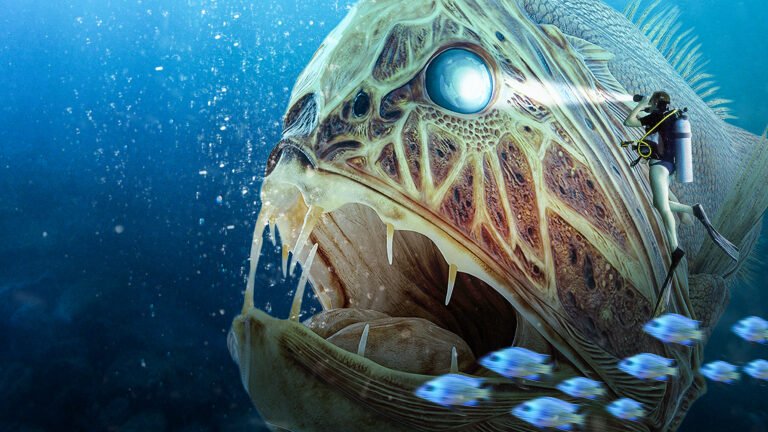
Point a light at it and the light does not come back.
Almost none of it, anyway. The skin of this fish absorbs up to 99.5 percent of everything that touches it, which means that even in a place where a stray photon can mean the difference between eating and being eaten, this animal registers as a hole in the water.
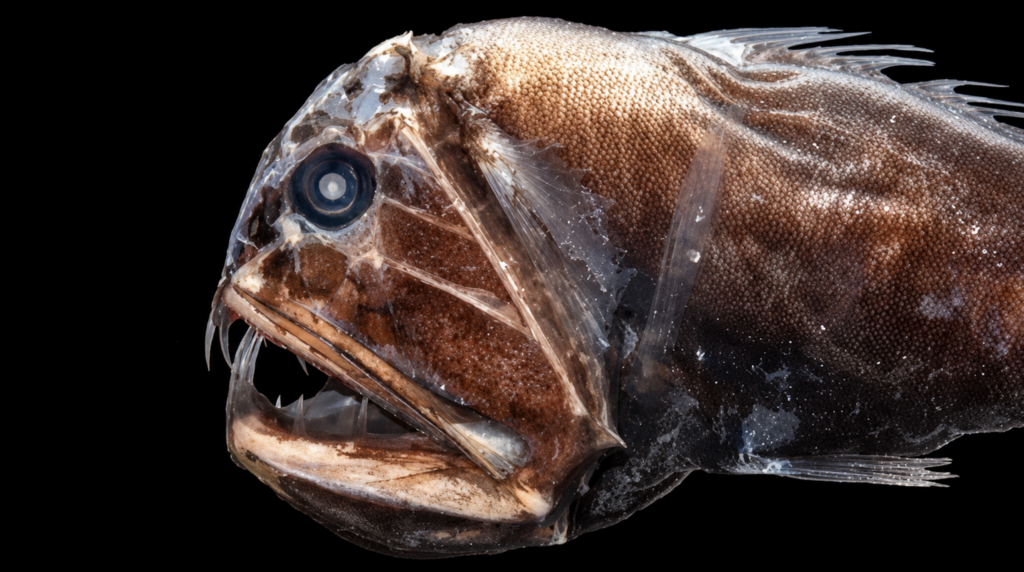
It is called the fangtooth, and it lives thousands of meters below the surface looking like something evolution built as a threat.
Oversized fangs. A massive head. A body shaped entirely by eternal darkness. It regularly earns the title of one of the ugliest and most intimidating creatures in the sea.
It is also one of the least understood animals on Earth.
The fangtooth patrols deep waters across the Atlantic, Pacific, and Indian Oceans, along with regions near Australia and the British Isles. Much of its life plays out far below the reach of sunlight, sometimes approaching 5,000 meters down, which is precisely why we know so little about it.
Now for the detail that surprises everyone.
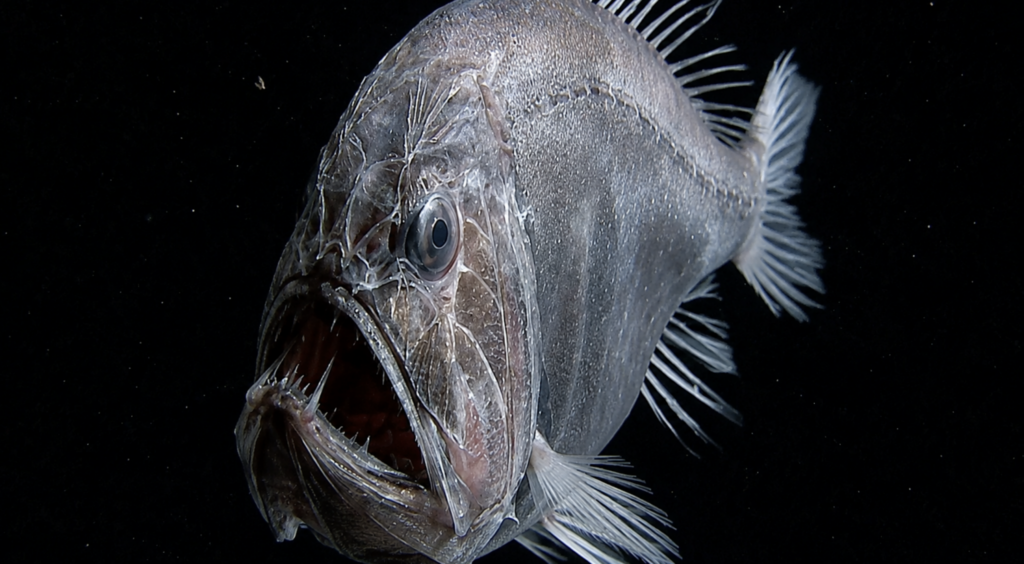
Look at that mouth and those teeth and your brain immediately fills in the rest: something enormous, several meters long, cruising the abyss.
An adult fangtooth measures 15 to 18 centimeters. You could hold it in one hand.
But it carries some of the largest teeth relative to body size of any fish in the ocean, with fangs growing between 5 and 7.5 centimeters. Those proportions create a genuine engineering problem, because the teeth are too long for the mouth to close around them.
Evolution solved it with something that sounds invented. The roof of its mouth contains protective pockets, sheaths that receive the lower teeth when the jaws shut, stopping them from stabbing straight up through the fish’s own head.
Its teeth would kill it without that adaptation.
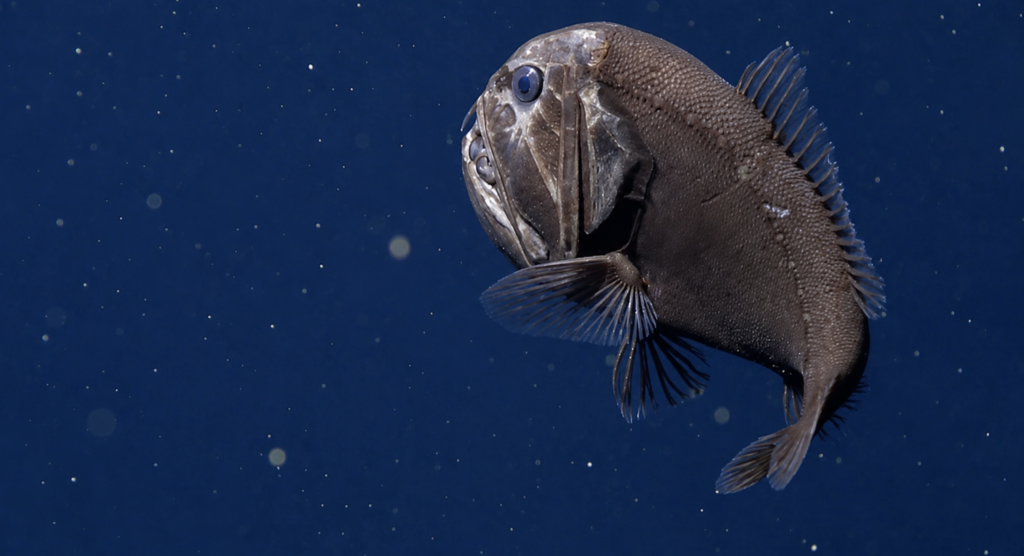
And here is the twist about those fangs: they are not for shredding.
Rather than tearing prey apart, the fangtooth uses its oversized mouth and spike like teeth to skewer smaller animals and swallow them whole. Shrimp, small squid, and other deep sea creatures make up most of its diet, and its large head and flexible jaws mean very little chewing is required.
Which raises the harder question. In a place with essentially no light, how does it find anything at all?
Its eyes barely help. They are small, and down there they contribute almost nothing. So the fangtooth hunts using stealth and a set of specialized senses instead.
That is where the ultra black skin comes in.
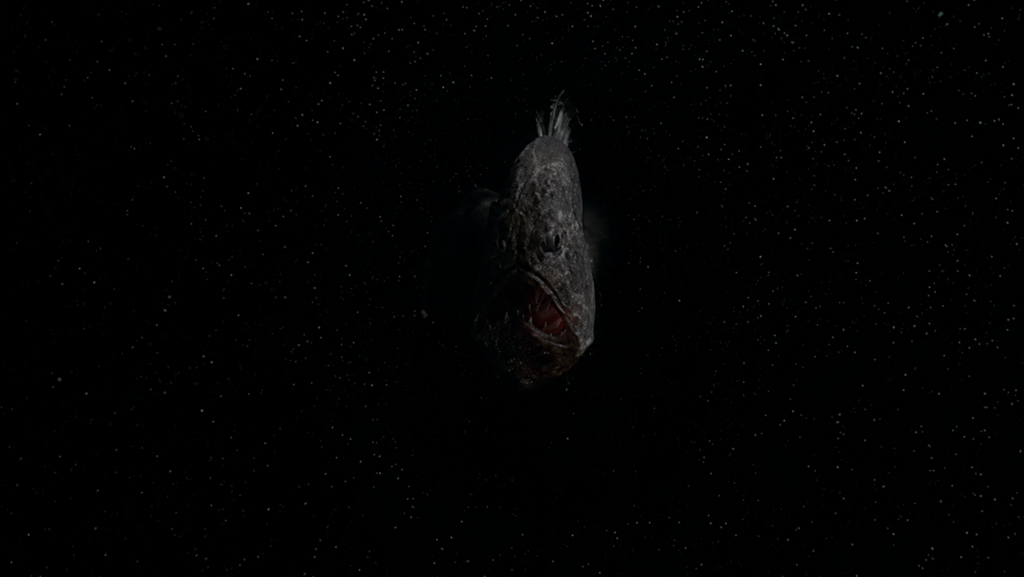
Absorbing up to 99.5 percent of incoming light means the fangtooth reflects almost nothing back into the water. Faint sunlight filtering down from above, or the glow of a bioluminescent creature nearby, simply disappears against its body.
To anything watching, it does not look like a fish. It looks like nothing.
Layered on top of that invisibility is a highly developed lateral line system running along its body, a sensory network that reads vibrations and movement in the surrounding water. Add chemical receptors that work something like a sense of smell, and the fangtooth can locate prey without needing to see it.
The same toolkit works in reverse.
Larger predators like marlin and tuna sometimes venture deep, or cross paths with fangtooths moving toward shallower water. In those encounters, being effectively invisible is worth more than any weapon, and it is likely the main reason this small fish survives among far bigger hunters.
And yet, for everything we have pieced together about how it hunts and hides, enormous gaps remain.
Scientists still know remarkably little about fangtooth population sizes, reproductive behavior, growth patterns, or life cycle. The habitat that makes the fish so successful is exactly what makes it nearly impossible to study.
That is the real point buried under the nightmare face. We built a reputation for this animal out of its teeth, when the genuinely extraordinary thing about it is a skin that erases it from existence.
Thousands of meters down, in water we have barely explored, a 15 centimeter predator drifts through the dark absorbing nearly all the light that finds it, and nothing around it ever sees it coming.