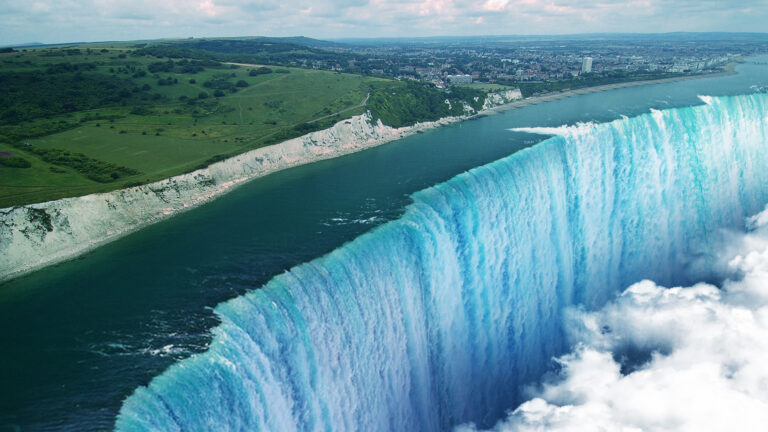
If the Earth had an edge, it might look something like this, the edge of a flat Earth. A vast frozen wall at the horizon, trees growing at strange angles, and a sky that behaves nothing like we expect.
It sounds like imagination, but it is an idea that refuses to disappear. The concept of a flat Earth has survived for centuries, resurfacing again and again in modern discussions.
So what if, just for a moment, the flat Earth idea was true?
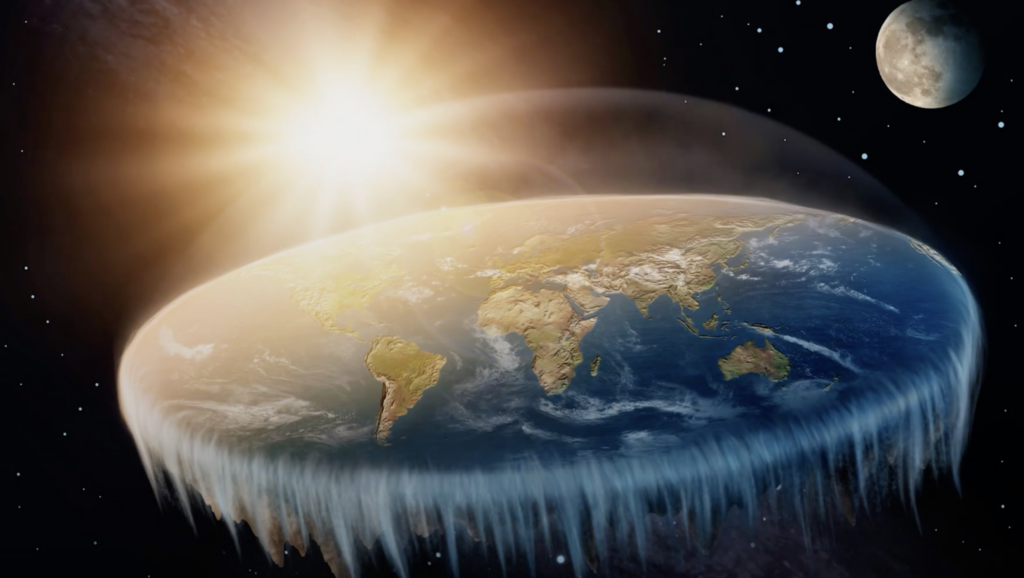
How would the planet behave in space? Would the Sun orbit the Earth, or would everything still follow the laws of modern astronomy?
And why would no one ever reach the edge?
For most of human history, people believed the Earth was flat and that everything in the sky revolved around it. It was a simple way to understand the Universe, and it placed humanity at the center of everything.
Then came Nicolaus Copernicus, who proposed something very different. The Earth was not flat, not stationary, and not the center of the Universe. Instead, it was a spherical planet orbiting the Sun.
This idea changed everything, even though at the time it was dangerous to say such things.
Today, centuries later, the scientific consensus is clear. The Earth is a sphere. But the flat Earth debate still exists in some circles, raising questions about how such a world would even function.
The answer starts with gravity.
Gravity pulls matter equally in all directions, which naturally forms planets into spheres. A flat Earth would behave very differently under such a force.
In a simplified flat Earth model, gravity would pull everything toward the center of the disk. The closer you move toward the edge, the more unusual the effects would become.
Instead of walking freely in all directions, movement would become increasingly difficult the further you travel from the center. In extreme cases, it might even feel like climbing uphill just to move across the surface.
This would explain one of the biggest ideas in flat Earth discussions, the so called edge that is supposedly guarded by an enormous ice wall. In reality, if such gravity existed, reaching the edge would become nearly impossible long before anyone ever got there.
But this type of gravity would create strange consequences.
Rivers, oceans, and even rainfall would slowly drift toward the center of the Earth, gathering in a massive concentrated region. The edges would become dry and unstable, while the center would be overwhelmed with water and atmospheric pressure.
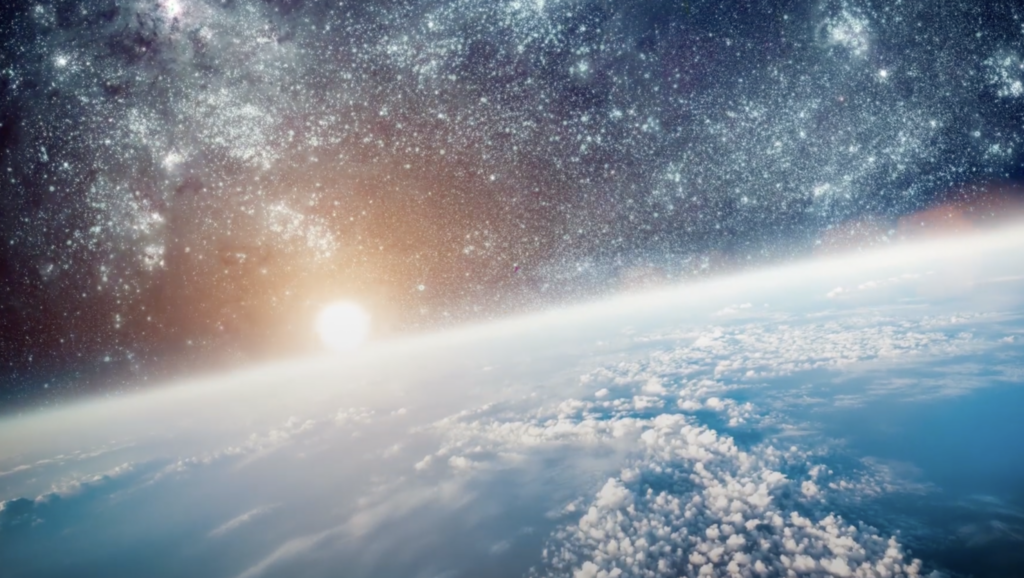
Air itself would behave strangely too. The atmosphere would be pulled inward, meaning that regions near the edge could struggle with breathable air, while the center would be crushed under extreme pressure.
Life across such a world would be extremely uneven and likely unsustainable.
Then comes one of the biggest questions, the sky.
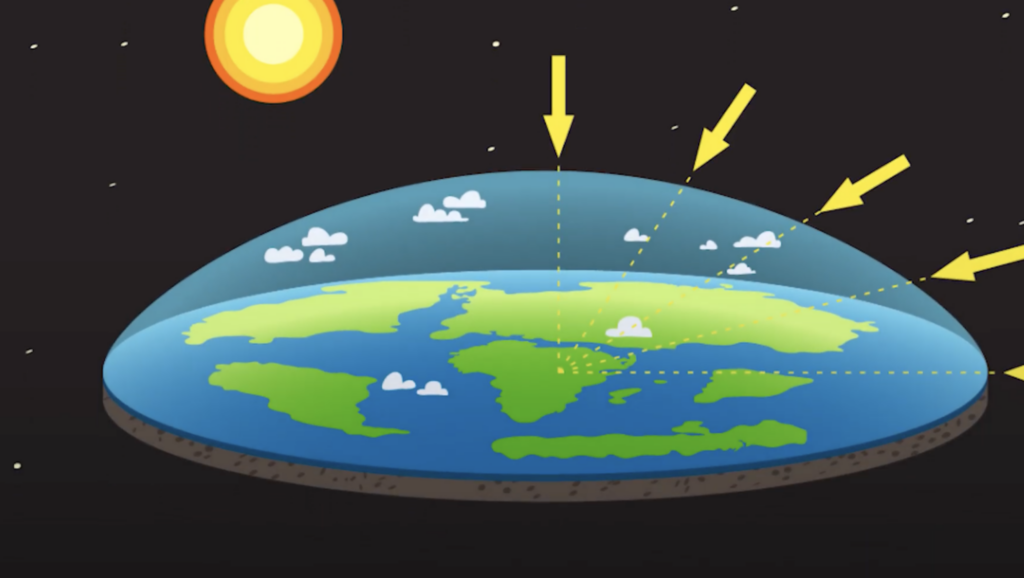
In flat Earth models, the Sun and Moon are often imagined as smaller objects circling above the surface like moving spotlights. But if that were true, the entire planet would be illuminated in ways that do not match what we observe today.
A spotlight Sun would still scatter light across the sky, meaning daytime and nighttime would not behave as cleanly as they do in reality.
To produce a proper day and night cycle, the Sun would have to orbit in a way that lights the entire surface at once during the day and leaves it in darkness during the night. Even then, there would be no true time zones or seasons as we know them.

Temperature would also become a major issue. If the Sun were too large or too close, parts of the flat Earth would overheat. If it were too small or too far, large regions would freeze. The balance required for life would be extremely difficult to maintain.
Even celestial events like lunar eclipses would become complicated. On a spherical Earth, they occur when Earth blocks sunlight from reaching the Moon. On a flat Earth, this alignment would require entirely different mechanics, none of which fit easily with observation.
Ultimately, every part of the flat Earth model runs into the same problem. It does not match the physical behavior of gravity, light, atmosphere, or planetary motion that we observe in reality.
This is why modern science overwhelmingly supports a spherical Earth. Not because of belief, but because of consistent evidence from physics, astronomy, and direct observation.
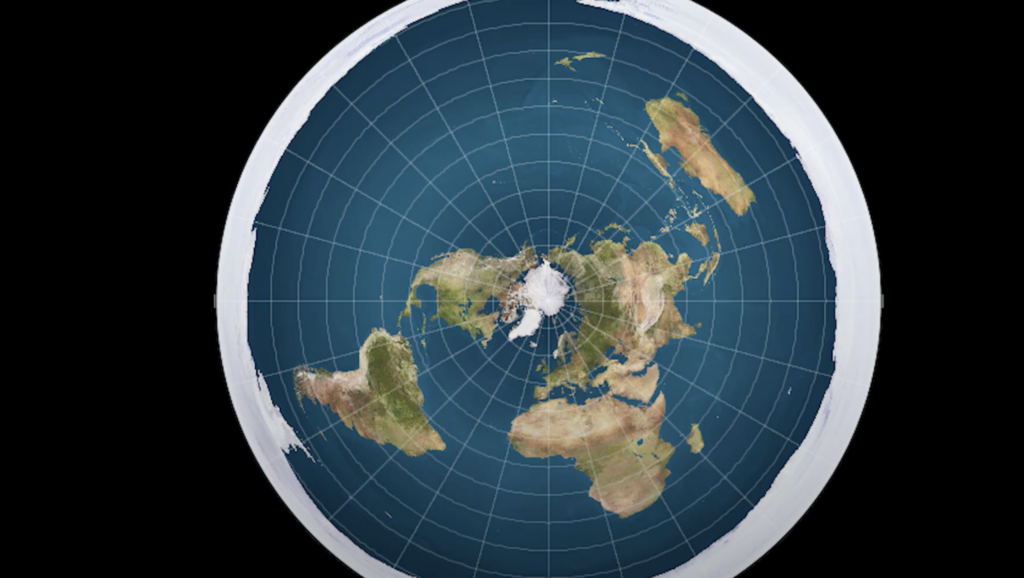
Still, the debate continues online and in popular culture, often fueled by misunderstandings or selective interpretations of data.
In the end, the question is not just about shape. It is about how we understand evidence, and how we separate imagination from physical reality.
And while the idea of a flat Earth may be interesting to explore, the science of our planet tells a very different story.
Or at least it would, if the Earth were shaped like a donut.
But that is a story for another WHAT IF.