You might be wondering how I keep ending up in these situations. Well, let me roll it back a bit.
Triton, Neptune’s gargantuan moon, is one of the strangest objects in the Solar System. It orbits backwards, it may hide a subsurface ocean that could potentially support life, and its surface is constantly reshaped by ice volcanoes.
Or as I mistakenly called it once before… Titan.
Ah yes. Titan. My old nemesis. That’s right, I was supposed to make my epic return to Triton. Instead, I ended up on Titan. Which, apparently, is not the same thing. At all.
Look, in my defense, I did punch it into the navigation system. I’m pretty sure I typed Triton. But I was informed, very calmly, that I was currently standing on Titan, a completely different moon orbiting Saturn.
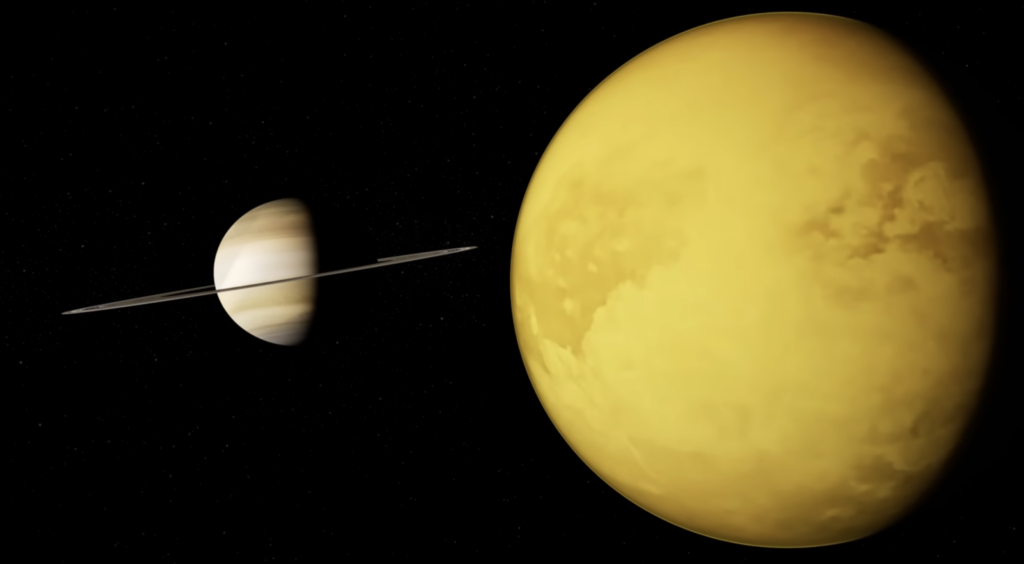
Wrong. One orbits Saturn, the other orbits Neptune. Two different planets, two very different destinations, and about billions of kilometers of regret between them.
And just for scale, Triton is about 4.5 billion kilometers from the Sun, while I was sitting roughly 1.4 billion kilometers from it. That leaves a gap of over 3 billion kilometers between me and the correct moon. Which is only “close” in the way that galaxies are “kind of near each other.”
Also, Saturn and Neptune don’t even stay close. Their orbits take them on wildly different paths around the Solar System. Saturn takes about 29 years to circle the Sun once, while Neptune takes about 165 years. At opposite ends of their orbits, Triton and Titan can be nearly 6 billion kilometers apart.
So yes. Slight miscalculation. Anyway, after some professional disappointment and interplanetary confusion, I was reassigned.
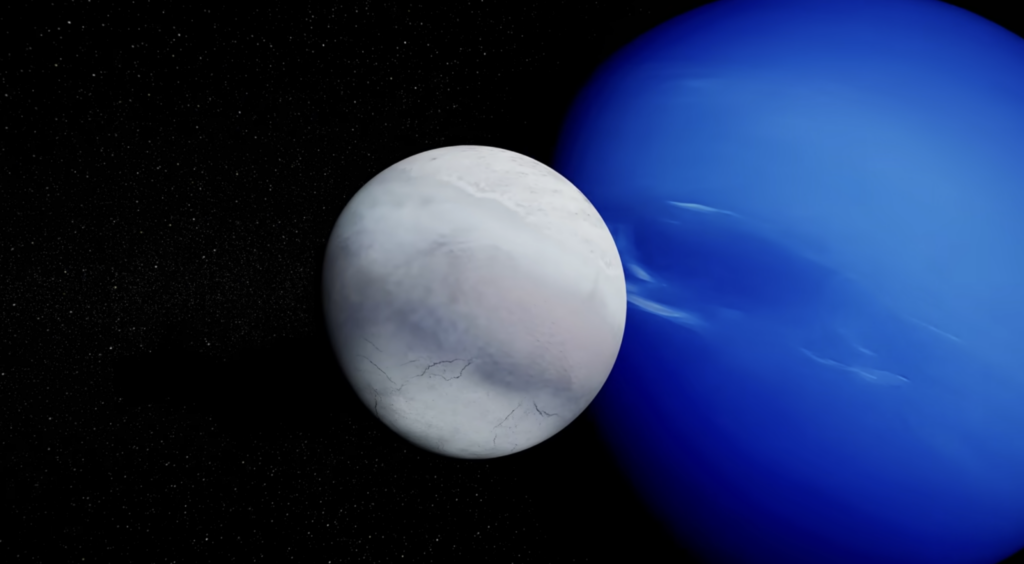
Triton.
Neptune’s largest moon is no ordinary rock. With a diameter of about 2,700 kilometers, it is bigger than dwarf planets like Pluto, though still smaller than Earth’s Moon. For a moon, it is absolutely massive.
But size is not even the weird part.
Triton is the only large moon in the Solar System that orbits in reverse. It moves in the opposite direction of Neptune’s rotation, a rare motion known as retrograde orbit.
That alone makes it a cosmic oddball. But scientists think it also reveals something deeper: Triton probably did not form with Neptune at all. Instead, it may have been captured from the Kuiper Belt billions of years ago, pulled in by Neptune’s gravity and locked into place.
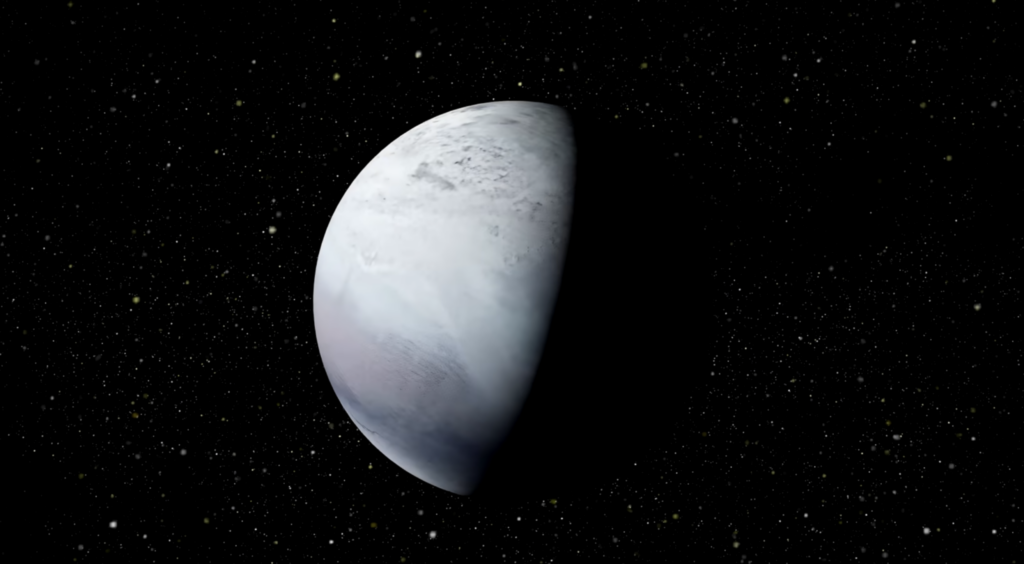
So yes, in a sense, Triton is a kidnapped moon.
And it gets even stranger. Its orbit is not just backwards, it is tilted at about 157 degrees. That kind of extreme angle is another clue that it was not originally part of Neptune’s system.
Once captured, Triton likely caused chaos. Its arrival may have disrupted Neptune’s original moons, smashing some, altering others, and ejecting a few entirely from the Solar System. It is often described as a “moon killer” for that reason.
Despite that violent history, Triton itself is frozen almost beyond imagination. Surface temperatures drop to around minus 235 degrees Celsius, just a few degrees above absolute zero.
Its surface is a mix of nitrogen, methane, and water ice, and it is still geologically active in a very unusual way.
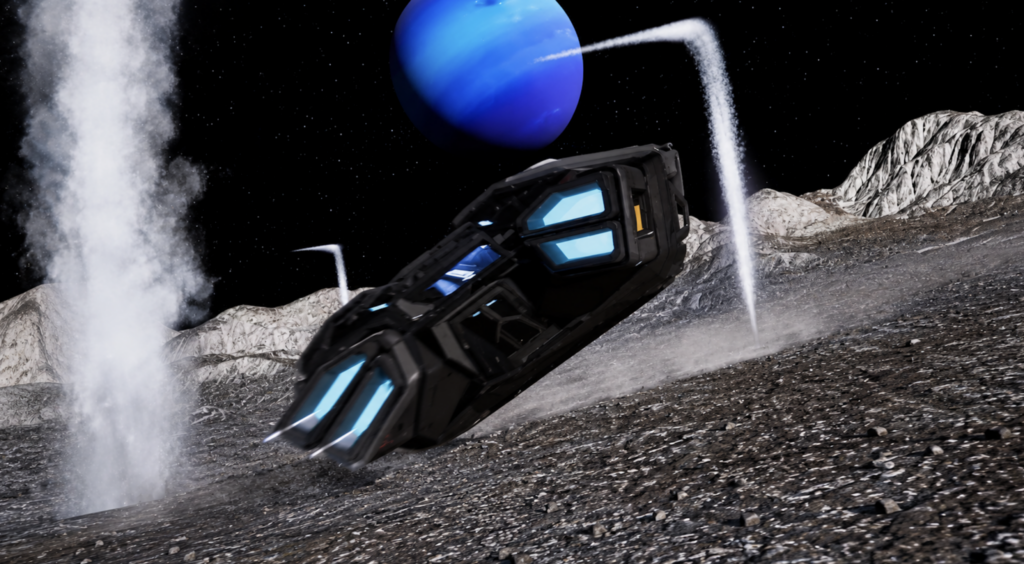
Instead of lava, Triton has ice volcanoes, known as cryovolcanoes. These erupt not molten rock, but slushy mixtures of nitrogen and water ice, blasting plumes kilometers into its extremely thin atmosphere.
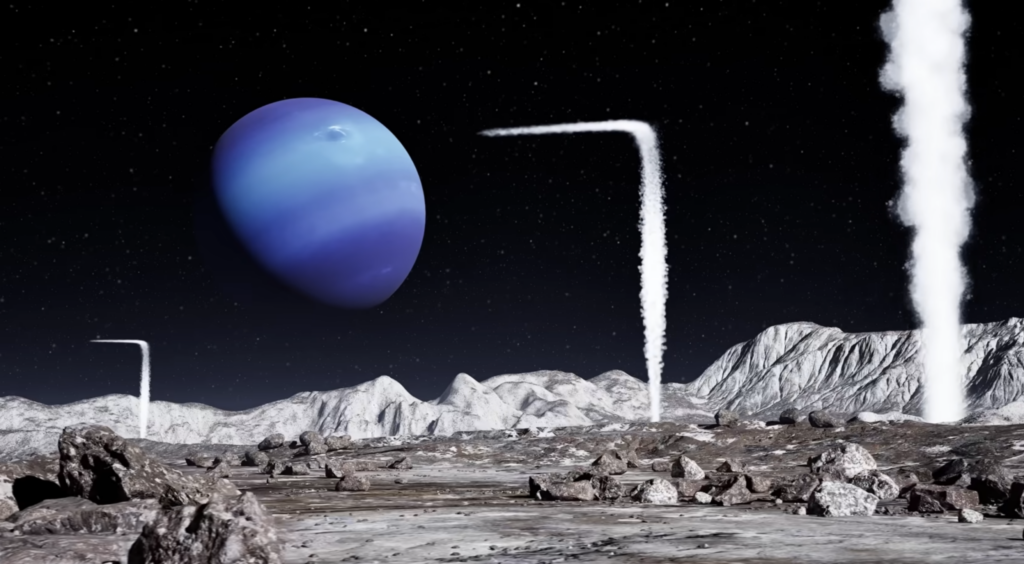
And yes, there is an atmosphere, but barely. It is about 70,000 times thinner than Earth’s, mostly nitrogen with traces of methane and carbon monoxide. Much of it is thought to be replenished by those very cryovolcanic plumes.
It sounds beautiful until you realize how deadly it is.
Without a helmet, there is no breathing. The pressure is so low that bodily fluids would begin to boil instantly. Not because it is hot, but because there is nothing pressing against you to keep liquids stable. It is rapid, violent decompression followed by unconsciousness in seconds.
And then there is the cold. At minus 235 degrees Celsius, exposed skin would freeze almost instantly.
Still, Voyager 2 gave us our only close look at Triton back in 1989. From about 40,000 kilometers away, it managed to photograph roughly 40 percent of the surface before continuing its journey out of the Solar System. It was humanity’s first and last close encounter with this world.
And what it saw was bizarre.
One of the most famous features is “cantaloupe terrain,” a region of icy ridges and pits that looks uncannily like the skin of a melon. No actual cantaloupes, unfortunately, just geology that looks like it.
Underneath all that ice, scientists suspect something even more intriguing. A rocky core, possibly surrounded by a subsurface ocean of liquid water. That ocean, warmed by internal heat and radioactive decay, could theoretically create conditions suitable for life.
Not complex life necessarily. More likely microbial, simple, hidden ecosystems. But still life. A frozen world with a hidden ocean is one of the most promising places in the outer Solar System.
By this point, I am already mentally preparing for a five second landing. Five seconds does not sound like much. But on Triton, it is everything.
The descent is rough. The atmosphere is thin, unstable, and filled with nitrogen plumes venting from the surface. Gravity is weak, only about 8 percent of Earth’s, meaning every step has to be carefully controlled or you risk drifting, slipping, or launching yourself into a frozen trench with no easy return.
Then there are the cryovolcanoes. One region, Leviathan Patera, is essentially a giant frozen caldera shaped by ancient eruptions of ice.
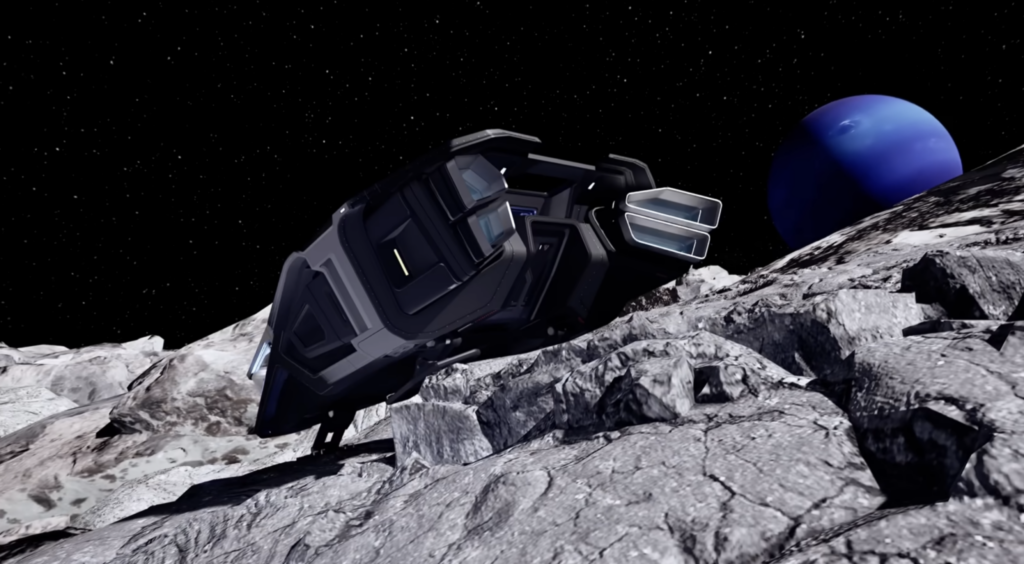
It looks calm from orbit. Up close, it is anything but. As the landing system touches down, the terrain begins to shift. Fractures in the ice widen. The surface is not stable. The entire region feels alive in a slow, grinding way.
And then, a plume erupts nearby.
Not lava. Cryomagma. A mix of nitrogen and water ice bursting upward as sunlight warms darker material beneath the surface, building pressure until it finally escapes.
It is like a geyser, except it is happening on a world where everything is frozen solid.
Somewhere beneath it all, there may even be a hidden ocean. A layer of liquid water beneath kilometers of ice, sitting on top of a rocky core. If that ocean exists, it could contain the basic ingredients for life: carbon, hydrogen, nitrogen, and energy.
We do not know what it would produce. Microbes, chemistry, or nothing at all. Triton does not give answers easily.
At this point, the countdown begins.
Five seconds.
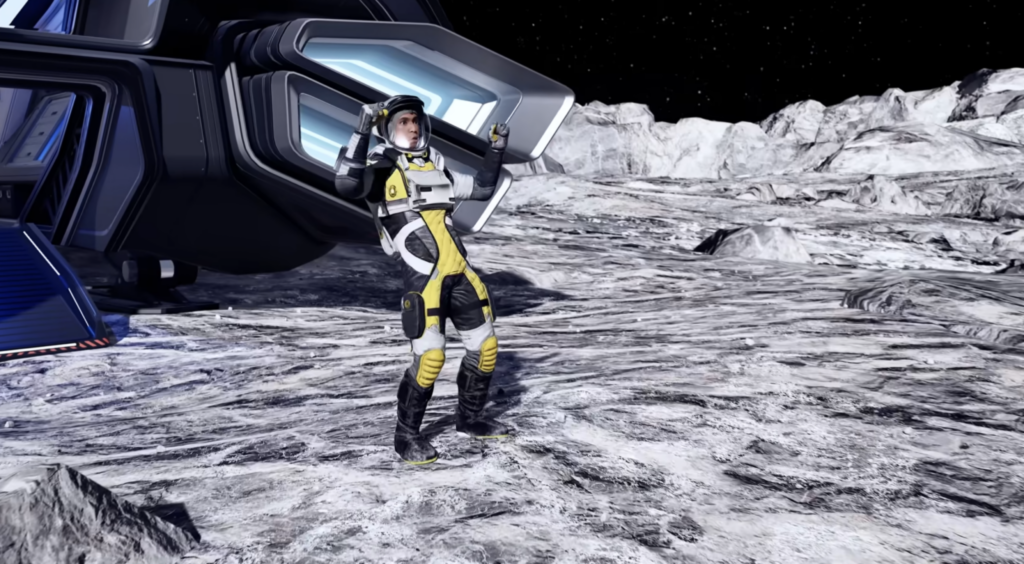
That is all the time I get to experience one of the most extreme environments in the Solar System.
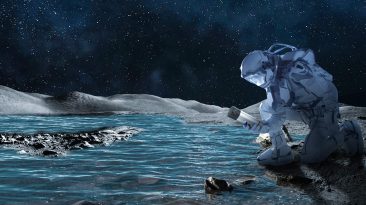
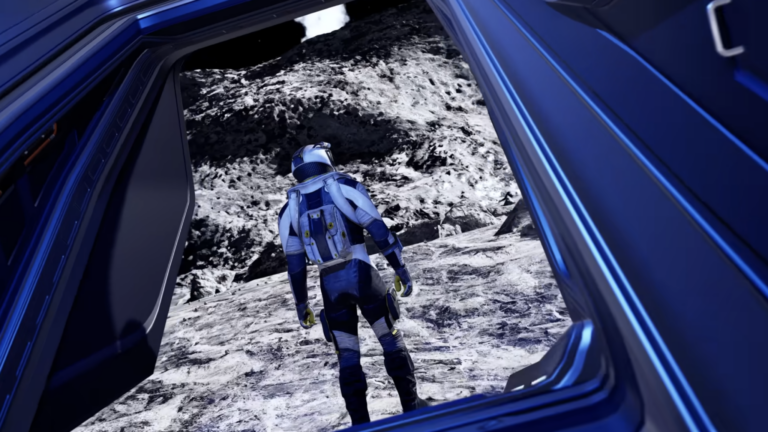
The boots hit the ice. The surface crunches. The horizon is a strange blend of pale blues and shadowed ridges. In the distance, plumes rise like frozen smoke signals from another world.
And just like that, it is over.
Five seconds on Triton.
Long enough to stand on a moon that moves backwards through space, long enough to witness ice erupting like volcanic fire, and long enough to realize that even in the farthest reaches of the Solar System, nothing is simple.
Triton remains one of the most mysterious places we know. A captured world. A potential ocean world. A frozen survivor of cosmic chaos.
And as for me, I am just hoping next time the navigation system double checks my destination before I volunteer for interplanetary revenge missions.